
Listen to this blog

Arts accounted for 34.2% of all undergraduate enrolment in India (AISHE 2021-22), making it the largest undergraduate discipline by enrolment.
These numbers surely indicate a very strong point. For recent 12th arts graduates, career options after 12th arts are seeing a surge we have never witnessed before. A few years back, there weren’t many options or courses after 12th arts, but now, with several specialized fields of study, there is a wide range of choices.
But this has never stopped the course from being chosen. As per AISHE, it has consistently been the most chosen undergraduate course after 12th. But one major change was the introduction of multidisciplinary education in NEP 2020, allowing students to combine subjects such as psychology, economics, sociology, media, and business. This reduced the perception that Arts was a limited career stream and made degrees more aligned with modern job markets.
The most important fact about the arts stream is that most individuals who study politics and administration prioritize it as their primary field of study. This guide walks you through the best career options after 12th arts, the courses that lead to them, expected salaries, and how to plan a path that fits your interests and strengths.
Also read: Career Options in Arts: A Complete Guide
Top Career Options After 12th Arts at a Glance
Before diving into the details, here is a quick snapshot of popular paths on what to do after 12th arts, useful if you want a fast overview before reading further.
| Career | Recommended Course | Average Salary (Entry Level) | Growth Outlook |
|---|---|---|---|
| Lawyer | BA LLB | ₹2.5-6 LPA | High, especially in corporate and litigation law |
| Journalist | BJMC / BA in English | ₹2.5-5 LPA | High, driven by digital media and news platforms |
| Teacher | BA + BEd | ₹2.5-4.5 LPA | High, with opportunities in schools, colleges, and EdTech |
| Psychologist | BA in Psychology + MA | ₹2.5-4.5 LPA | High, increasing demand for mental health professionals |
| HR Manager | BBA in HR / BA + MBA (HR) | ₹2.5-4.5 LPA | High, with demand across industries |
| Digital Marketing Specialist | BBA/BA/BCom + Digital Marketing Specialization/Certification | ₹3-6 LPA | Very high, driven by digital transformation |
| Content Strategist | BA in English / Mass Communication | ₹2.5-4.5 LPA | High, supported by content marketing and digital media |
| Public Relations Specialist | BA in Mass Communication / Journalism | ₹2.5-5 LPA | High, growing demand for corporate communications and brand management |
| Fashion Designer | BDes in Fashion Design | ₹3-6 LPA | Good, with opportunities in fashion, retail, and e-commerce |
| Interior Designer | BDes in Interior Design | ₹3-5 LPA | Good, driven by real estate and commercial projects |
| Hotel Manager | BHM (Bachelor of Hotel Management) | ₹3-5 LPA | Strong, especially with hospitality, tourism, and global hotel chains |
Note: All salaries are sourced from Ambition Box
Best Career Options After 12th Arts
Here is a closer look at some of the most rewarding career options after 12th arts, spanning traditional professions and newer, in-demand roles. Each one is assessed on what the work involves, the qualifications needed, key skills, and salary potential.
Lawyer
Lawyers are legal advisers who advise clients, assist in drafting legal documents, and help represent clients in court at times of need, such as during negotiations. A BA LLB or a three-year LLB after graduation is the traditional career path after 12th. Enrolment with the Bar Council will follow this.
- Course: BA LLB (Bachelor of Arts and Bachelor of Legislative Law)
- Duration: 5 years (Integrated undergraduate program)
- Eligibility: 10+2 or equivalent from a recognized board. Most universities require a minimum of 45-50% aggregate marks (varies by institution and category). Admission is generally through entrance exams such as CLAT, AILET, SLAT, or university-specific tests.
- Entry level Salary: ₹2.5-6 LPA
- Higher level Salary: ₹10-25+ LPA
- Skills required: Critical thinking, analytical reasoning, communication and public speaking, legal research, problem-solving, negotiation, persuasive writing, attention to detail, ethics and integrity, and time management.
Journalist
Journalists research, report, and write news stories across print, television, and digital media. A BJMC (Bachelor of Journalism and Mass Communication) or a BA in English or Political Science works well as a foundation.
- Course: BJMC (Bachelor of Journalism and Mass Communication)
- Duration: 3 years (Undergraduate program)
- Eligibility: 10+2 or equivalent from a recognized board. Most universities require a minimum of 45-50% aggregate marks (varies by institution). Some institutes may conduct entrance exams or personal interviews.
- Entry Level Salary: ₹2.5-5 LPA
- Higer Level Salary: ₹8-15+ LPA (depending on specialization, organization, and experience)
- Skills: Strong communication skills, writing and editing, creativity, storytelling, research, interviewing, digital media proficiency, social media management, critical thinking, and adaptability.
For further research purposes, check this course out: Master of Arts in Journalism & Mass Communication
Teacher
Teachers educate students at the school or college level, planning lessons and assessing progress. A BA followed by a BEd is the standard qualification for school teaching, while a postgraduate degree is required for college-level roles.
- Course: BA followed by BEd (Bachelor of Arts + Bachelor of Education)
- Duration: 6 years (3-year BA + 2-year BEd, or as per the university’s program structure)
- Eligibility: 10+2 or equivalent from a recognized board for BA. After completing BA, candidates must meet the eligibility criteria for admission to a BEd program, which typically requires a minimum aggregate percentage (varies by university).
- Entry Level Salary: ₹2.5 LPA to ₹4.5 LPA
- Higer Level Salary: ₹8 LPA to ₹12 LPA+ (depending on experience, institution, qualifications, and role)
- Skills: Communication and presentation skills, Subject knowledge, Classroom management, Critical thinking, Creativity and lesson planning, Leadership and mentoring, Patience and empathy, Problem-solving, Time management, Interpersonal skills
Interesting find: How to become a teacher?
Psychologist
Psychologists assess and support mental health and behaviour through counselling, therapy, or organisational consulting. This path requires a BA in Psychology, followed by an MA and, for clinical practice, an MPhil in Clinical Psychology.
- Course: BA in Psychology
- Duration: 3 years
- Eligibility: 10+2 or equivalent from a recognized board. Some universities may require a minimum aggregate percentage for admission.
- Entry Level Salary: ₹2.5 LPA to ₹4.5 LPA
- Higer Level Salary: ₹8 LPA to ₹15 LPA+ (depending on higher education, specialization, experience, and job role)
- Skills: Analytical thinking, Communication skills, Active listening, Empathy, Observation skills, Critical thinking, Research and data analysis, Problem-solving, Emotional intelligence, Interpersonal skills
A good read: Behavioural Economics – Theories, Key Concepts, and Examples
HR Manager
HR managers handle recruitment, employee relations, performance management, and workplace policy. A BBA in HR or a BA followed by an MBA in HR builds the right foundation.
- Course: BBA in Human Resource Management (BBA in HR)
- Duration: 3 years (Undergraduate program)
- Eligibility: 10+2 or equivalent from a recognized board. Some universities may require a minimum aggregate percentage for admission.
- Entry Level Salary: ₹2.5 LPA to ₹4.5 LPA
- Higer Level Salary: ₹8 LPA to ₹15 LPA+ (depending on higher education, specialization, experience, and job role)
- Skills: Analytical thinking, Communication skills, Active listening, Empathy, Observation skills, Critical thinking, Research and data analysis, Problem-solving, Emotional intelligence, Interpersonal skills
Deep dive: Highest Paying HR Jobs in India 2026
Digital Marketing Specialist
Digital marketing specialists plan and execute campaigns across search, social media, and paid advertising to drive brand growth. A BBA, BA, or BCom combined with digital marketing certifications (Google Ads, SEO, analytics) works well.
- Course: BBA/BA/BCom with a specialization in Digital Marketing (or BBA/BA/BCom + Digital Marketing Certification)
- Duration: 3 years (Undergraduate program)
- Eligibility: 10+2 or equivalent from a recognized board. Most universities require a minimum of 45-50% aggregate marks (varies by institution). Admission is generally merit-based, while some institutions may conduct entrance exams.
- Entry Level Salary: ₹3-6 LPA
- Higer Level Salary: ₹8 LPA to ₹15 LPA+ (depending on higher education, specialization, experience, and job role)
- Skills: Analytical thinking, Communication skills, Active listening, Empathy, Observation skills, Critical thinking, Research and data analysis, Problem-solving, Emotional intelligence, Interpersonal skills
Must read: Digital Marketing Career Path: Why It’s One of the Best Career Choices in 2026
Content Strategist
Content strategists plan what content an organisation publishes, ensuring it aligns with audience needs and business goals across blogs, social media, and campaigns. A BA in English, Mass Communication, or a related field is a strong base, often paired with SEO and analytics know-how.
- Course: BA in English, Mass Communication
- Duration: 3 years
- Eligibility: 10+2 or equivalent from a recognized board. Some universities may require a minimum aggregate percentage for admission.
- Entry Level Salary: ₹2.5 LPA to ₹4.5 LPA
- Higer Level Salary: ₹8 LPA to ₹15 LPA+ (depending on higher education, specialization, experience, and job role)
- Skills: Analytical thinking, Communication skills, Active listening, Empathy, Observation skills, Critical thinking, Research and data analysis, Problem-solving, Emotional intelligence, Interpersonal skills
Give it a try: 10 skills required for a Content Writer
Public Relations Specialist
PR specialists manage an organisation’s public image, handling media relations, press releases, and crisis communication. A BA in Mass Communication or Journalism is the standard qualification, sometimes paired with a PR-specific postgraduate diploma.
- Course: BA in Mass Communication or Journalism
- Duration: 3 years
- Eligibility: 10+2 or equivalent from a recognized board. Some universities may require a minimum aggregate percentage for admission.
- Entry Level Salary: ₹2.5 LPA to ₹5 LPA
- Higer Level Salary: ₹10 LPA to ₹20 LPA+ (depending on experience, specialization, organization, and role)
- Skills: Communication skills, Writing and editing skills, Research skills, Storytelling, Media production skills, Public speaking, Digital media skills, Social media management, Critical thinking, Creativity, Interviewing skills, Adaptability, Time management
Must read: Role of public relations during social media age
Fashion Designer
Fashion designers conceptualise and create clothing and accessory collections, working across sketching, fabric selection, and production oversight. A BDes in Fashion Design or a similar specialised degree is required.
- Course: BDes in Fashion Design (Bachelor of Design in Fashion Design)
- Duration: 4 years (Undergraduate design program)
- Eligibility: 10+2 or equivalent from a recognized board in any stream. Most universities require a minimum of 45-50% aggregate marks (varies by institution). Admission may be based on merit, portfolio evaluation, or entrance exams such as NIFT Entrance Exam or university-specific design aptitude tests.
- Entry Level Salary: ₹3-6 LPA
- Higer Level Salary: ₹10-25+ LPA
- Skills: Creativity and design thinking, knowledge of fabrics and textiles, fashion illustration, trend forecasting, visual communication, garment construction, colour theory, attention to detail, computer-aided design (CAD), problem-solving, and understanding of consumer preferences.
Interior Designer
Interior designers plan and style functional, aesthetically considered spaces for homes, offices, and commercial establishments. A BDes in Interior Design or a diploma from a recognised design institute is the typical path.
- Course: BDes in Interior Design
- Duration: 4 years
- Eligibility: 10+2 or equivalent from a recognized board. Some universities may require candidates to qualify for a design entrance exam or portfolio review.
- Entry Level Salary: ₹3 LPA to ₹5 LPA
- Higer Level Salary: ₹12 LPA to ₹25 LPA+ (depending on experience, specialization, employer, and freelance projects)
- Skills: Creativity, Spatial planning, Design thinking, Color theory, CAD software proficiency, 3D visualization, Sketching and rendering, Material and furniture knowledge, Attention to detail, Problem-solving, Project management, Communication skills, Client management, Time management
Give it a read: Trending non-technical online courses that help your career
Hotel Manager
Hotel managers oversee daily operations across front office, housekeeping, food and beverage, and guest services in hospitality establishments. A BHM (Bachelor of Hotel Management) is the standard qualification.
- Course: BHM (Bachelor of Hotel Management)
- Duration: 4 years (Undergraduate program)
- Eligibility: 10+2 or equivalent from a recognized board in any stream. Most universities require a minimum of 45-50% aggregate marks (varies by institution). Admission may be merit-based or through entrance exams such as NCHM JEE or university-specific entrance tests.
- Entry Level Salary: ₹3-5 LPA
- Higer Level Salary: ₹10 LPA to ₹20 LPA+ (depending on experience, specialization, hotel brand, and management role)
- Skills: Communication skills, Customer service skills, Hospitality management, Leadership skills, Team management, Problem-solving, Time management, Food and beverage management, Event management, Financial management, Interpersonal skills, Multitasking, Attention to detail
Event Manager
Event managers plan and execute events, from corporate conferences to weddings, coordinating vendors, budgets, and logistics. A BBA, BHM, or a specialised event management diploma provides a solid foundation.
- Course: BHM (Bachelor of Hotel Management) / BBA in Hospitality Management
- Duration: 3-4 years (depending on the program and institution)
- Eligibility: 10+2 or equivalent from a recognized board in any stream. Most universities require a minimum of 45-50% aggregate marks (varies by institution). Admission may be merit-based or through entrance exams such as NCHM JEE or university-specific entrance tests.
- Entry Level Salary: ₹3-5 LPA
- Higer Level Salary: ₹10-20+ LPA
- Skills: Customer service, communication, leadership, hospitality operations, team management, problem-solving, time management, organizational skills, interpersonal skills, event management, food and beverage management, and adaptability.
Civil Services Officer
Civil services officers (IAS, IPS, IFS, and allied services) administer government policy, maintain law and order, and manage public welfare programmes. Any bachelor’s degree, commonly a BA in History, Political Science, or Public Administration, qualifies candidates for the UPSC Civil Services Examination.
- Course: BA (Bachelor of Arts)
- Duration: 3 years (Undergraduate program)
- Eligibility: 10+2 or equivalent from a recognized board in any stream. Most universities require a minimum of 45-50% aggregate marks (varies by institution). Admission is generally merit-based, while some universities may conduct entrance exams.
- Entry Level Salary: ₹2.5-4.5 LPA
- Higer Level Salary: ₹8-12+ LPA (depending on qualifications, experience, institution, and role)
- Skills: Subject knowledge, communication and presentation skills, classroom management, lesson planning, critical thinking, creativity, leadership, patience, empathy, problem-solving, interpersonal skills, and time management.
Must read: How to start preparing for UPSC after 12th?
Social Worker
Social workers support individuals and communities facing hardship, working across healthcare, child welfare, rehabilitation, or community development programmes. A BSW (Bachelor of Social Work) is the standard qualification, often followed by an MSW for specialised roles.
- Course: BSW (Bachelor of Social Work)
- Duration: 3 years (Undergraduate program)
- Eligibility: 10+2 or equivalent from a recognized board in any stream. Most universities require a minimum of 45-50% aggregate marks (varies by institution). Admission is generally merit-based, while some universities may conduct entrance exams or interviews.
- Entry Level Salary: ₹2.5-4.5 LPA
- Higer Level Salary: ₹8-15+ LPA (depending on specialization, organization, and experience)
- Skills: Empathy, communication, active listening, problem-solving, critical thinking, counselling, community outreach, conflict resolution, case management, teamwork, cultural sensitivity, and ethical decision-making.
Entrepreneur
Entrepreneurs identify problems and build businesses, products, or services to solve them, taking on the risk and responsibility of running an independent venture. A BBA is a common (though not mandatory) foundation, building skills in finance, marketing, and operations.
- Course: BBA in Entrepreneurship
- Duration: 3 years (Undergraduate program)
- Eligibility: 10+2 or equivalent from a recognized board in any stream. Most universities require a minimum of 45-50% aggregate marks (varies by institution). Admission is generally merit-based, while some universities may conduct entrance exams or interviews.
- Entry Level Salary: ₹3-6 LPA (for graduates who take up roles in startups or business development)
- Higer Level Salary: ₹10-25+ LPA (for professionals in senior business roles or successful entrepreneurs; entrepreneurial income can vary significantly based on business performance)
- Skills: Business planning, leadership, innovation, problem-solving, financial management, strategic thinking, communication, negotiation, decision-making, marketing, risk management, networking, and adaptability.
Must read: The 101 of Startups: A guide to the entrepreneurial journey
Corporate Communications Executive
Corporate communications executives manage internal and external messaging for organisations, covering everything from employee communication to media statements and brand messaging. A BA in Mass Communication or English, sometimes paired with an MBA, is a strong foundation.
- Course: BA in Mass Communication or English
- Duration: 3 years (Undergraduate program)
- Eligibility: 10+2 or equivalent from a recognized board in any stream. Most universities require a minimum of 45-50% aggregate marks (varies by institution). Admission is generally merit-based, while some universities may conduct entrance exams or interviews.
- Entry Level Salary: ₹2.5-5 LPA
- Higer Level Salary: ₹8-18+ LPA
- Skills: Excellent written and verbal communication, storytelling, content writing, editing and proofreading, research, interviewing, critical thinking, creativity, digital content creation, SEO basics, social media management, and adaptability.
Must read: What is the role of a Communications Specialist?
Career Options After 12th Arts Based on Your Interests
If you’re unsure where to start, working backward from what you enjoy is often the most reliable way to choose a career after 12th arts. The table below maps common interests to career directions worth exploring.
| If You Enjoy… | Consider… |
|---|---|
| Writing | Journalism, Content Strategy |
| Creative expression | Design (Fashion, Interior, BDes) |
| Business & strategy | BBA, Management careers |
| Helping people | Psychology, Social Work |
| Leadership & governance | Civil Services |
| Travel & hospitality | Hotel Management |
Government Career Options After 12th Arts
From defence and railways to banking and civil services, discover the top government career paths you can pursue after 12th Arts.
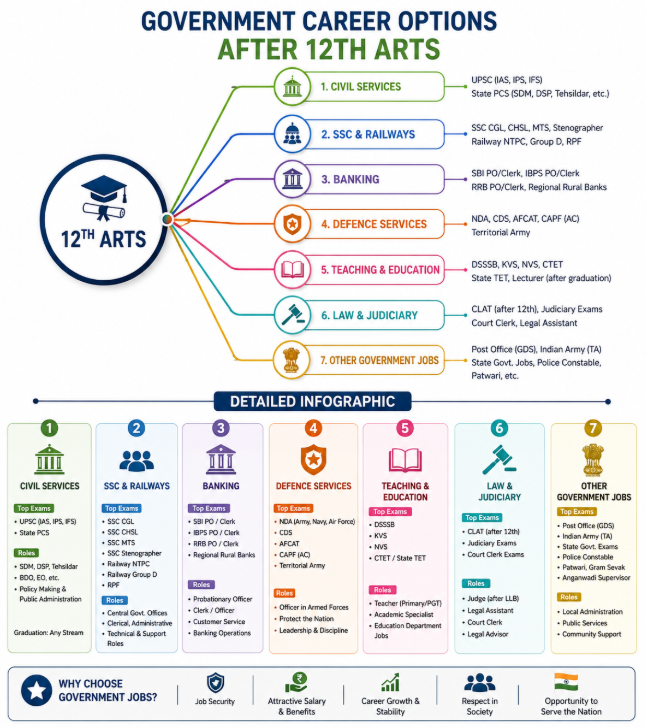
Also read: Top Government Jobs for Online BA Graduates
Tips for Choosing the Right Career After 12th Arts
- Identify your interests and choose a career after 12th Arts that aligns with your passion instead of following trends or peer pressure.
- Assess your strengths and skills such as communication, creativity, leadership, or analytical thinking to find suitable career options after 12th Arts.
- Research different courses after 12th Arts by comparing their curriculum, career opportunities, industry demand, and job prospects before making a decision.
- Evaluate salary potential and future scope to understand the long-term growth, stability, and earning opportunities of your chosen career path.
- Develop industry-relevant skills through internships, certifications, workshops, and practical projects to improve your employability after graduation.
- Seek career guidance from mentors, career counsellors, or industry professionals to make informed career planning after 12th Arts and choose the right path confidently.
Must read: Your Complete Journey at Online Manipal: From Registration to Degree Completion
Conclusion
Whichever direction you choose, formal education remains one of the strongest foundations for a successful career after 12th arts. Online Manipal offers UGC-entitled online undergraduate degrees, including an online BA, online BBA, and online BCom, delivered by reputed universities under the Manipal group, letting you study flexibly while building the qualifications that open doors across law, management, media, psychology, and public service. If you’re ready to take the next step, explore a recognised online degree program aligned with your career goals and start building the future you have in mind, one informed decision at a time.
Frequently Asked Questions
Which course is best after 12th Arts?
There’s no single best course; it depends on your interests. A BA offers flexibility, BA LLB suits those set on law, BBA suits future managers or entrepreneurs, and BJMC suits aspiring journalists or content creators. Consider your interests and long-term goals before deciding on the best career after 12th arts for you.
Which career after 12th Arts has the highest salary?
Corporate law, civil services (senior positions), and specialised roles like organisational psychology or digital marketing leadership tend to offer the highest paying career after 12th arts, though most require postgraduate study or several years of relevant experience to reach top pay bands.
Is BA a good option after 12th Arts?
Yes. A BA remains one of the most versatile courses after 12th arts, keeping multiple career paths open, including teaching, civil services, journalism, HR, and further postgraduate specialisation, making it a low-risk choice for students who haven’t finalised a specific career direction.
Can Arts students join the IT industry?
Yes, though usually in non-technical roles. Arts graduates commonly join IT companies for content writing, UX research, client servicing, HR, and project coordination roles, where communication and analytical skills matter more than a technical or coding background.
Which government jobs are available after 12th Arts?
Popular government jobs after 12th arts include UPSC Civil Services, SSC CGL/CHSL, banking exams (IBPS, SBI), Railways recruitment, defence and paramilitary services, State PSC exams, and teaching roles through CTET or state TET exams, most requiring a bachelor’s degree as minimum eligibility.
Can Arts students pursue management careers?
Yes. A BBA or a BA followed by an MBA are both common, effective routes into management careers for Arts students, and many top business schools actively welcome Arts graduates for the diversity of perspective they bring to cohorts.
What are the best professional courses after 12th Arts?
Strong professional options include BA LLB for law, BJMC for media and communication, BHM for hospitality management, BDes for design, and BA Psychology for counselling and HR-related careers, each leading to a defined, skill-based professional path.
Which entrance exams should Arts students prepare for?
Common entrance exams include CLAT for law programs, NID/UCEED for design courses, and university-specific entrance tests for BA, BBA, or BJMC programs. Later, exams like UPSC, SSC, and banking exams become relevant for government jobs after 12th arts.
Is Maths compulsory for a career after 12th Arts?
No. Most career options after 12th arts without maths exist because subjects like law, journalism, psychology, hotel management, and social work assess candidates on reasoning, communication, and aptitude rather than quantitative ability.
Prepare for your next career milestone with us