
Listen to this blog

The decision to choose the best undergraduate course is crucial, as it paves the way for a lifelong career that should be rewarding, both professionally and personally. The two popular choices that currently stand out to undergraduate students are the Bachelor of Business Administration (BBA) and the Bachelor of Computer Applications (BCA).
The former is ideal for students aspiring to build a successful career in business. The BCA, however, is more suitable for tech aspirants keen to acquaint themselves with the latest industry technologies for a lucrative career.
But choosing which one is forever a daunting task for students, who are confused and unclear at this stage. Hence, this blog serves as a comprehensive guide for UG students debating between BBA and BCA, helping them decide which to choose to build a satisfying career.
Why Does the BBA vs. BCA Decision Matter Today?
The long-time debate on BBA or BCA: which is better, holds more relevance today than ever before, with the emergence and evolution of the AI-driven economy. The choice is clearly between specializing in one of the two in-demand fields of work, both of which have immense potential in deciding your future career trajectory.
- High demand in different industries: In terms of industrial demand, there is no dearth of options for both BBA and BCA graduates. Both can look at high employability prospects.
- Earning potential: Here, there is a clear distinction between BBA and BCA graduates, where the latter can expect a high pay package almost immediately after graduation. This can be attributed to the specialized technical skills BCA graduates possess. BBA students, however, typically experience relatively slower career growth, with a gradual, proportionate increase in earnings as they gain work experience or after upskilling to an MBA.
What is a BBA Degree?
A BBA or Bachelor of Business Administration is an undergraduate program that typically spans 3 years. The course is designed to offer students a comprehensive overview of business management, marketing, and finance. It serves as the perfect foundation for assuming advanced leadership positions later in their careers.
The BBA program combines theoretical learning with hands-on skills in areas such as HR, marketing, operations, and finance. Students graduating from the program move on to roles such as Business Analyst, Financial Analyst, and Marketing Manager. The course is considered ideal for students seeking direct entry into the corporate sector with the right management skills after completing 10+2.
What is a BCA Degree?
Before we address BBA vs BCA, which is better, let’s delve deeper into what a BCA degree is. Short for Bachelor of Computer Applications, a BCA is a 3-year undergraduate program designed for students who aspire to pursue careers in data administration, software development, or IT.
A BCA is typically the first step to building a robust foundation for students in the domain of technology. Several hands-on projects, laboratory work, and internships are part of BCA courses, providing students with ample exposure to the real world. Some of the key career roles for BCA graduates include Analysts, Software Developers, and System Administrators.
BBA Syllabus vs BCA Syllabus
Let us now compare the course curriculum of both BBA and BCA degrees to understand better how they differ:
| Semesters | BBA Syllabus | BCA Syllabus |
|---|---|---|
1st Semester | Business and Management Functions Financial Accounting Microeconomics Entrepreneurship and Innovation Management Universal Human Values Office Automation Tools | Fundamentals of Mathematics Technical Communication C Programming Fundamentals of Computers & Digital Systems Introduction to Web Programming Environmental Science C Programming Lab Web Programming Lab |
2nd Semester | Macroeconomics Financial Management Organizational Behavior Community Development Introduction to Python Statistics for Managers Business Communication | Business Statistics and Probability Data Structures Database Management System Principle of Programming Languages Object-Oriented Programming Using C++ Database Management System Lab Data Structures Using C++ Lab |
3rd Semester | Operations Management Human Resource Management Marketing Management Cost & Management Accounting Interview Skills & Etiquettes Business and Corporate Laws Business Environment | Computer Organization and Architecture Java Programming Data Communication & Protocols Operating Systems Artificial Intelligence for Problem Solving Java Programming Lab Operating System Lab |
4th Semester | Indian Financial System Business Research Methods Supply Chain Management E-Commerce Design Thinking (MLC) Environmental Science Technology Management | Python Programming Software Engineering Data Mining & Visualization Introduction to Network Security Python Programming Lab Data Mining and Visualization Lab |
5th Semester | Core Subjects Fundamentals of Business Analytics International Business Management 3 subjects from the chosen elective Electives/Specializations HRM Marketing Finance & Accounting Entrepreneurship Management & Family Business Data Analytics Retail and E-Commerce Digital Marketing | Core Subjects Mobile Application Development Machine Learning Cloud Computing & Applications Machine Learning Lab Aptitude and Technical Development Elective 1 (choose one) – Distributed Systems / Big Data Analytics / Ethical Hacking Electives/Specializations Cloud Computing Data Science & Analytics Cyber Security |
6th Semester | Core Subjects Strategic Management Management Information System Project 3 subjects from the chosen elective Electives/Specializations HRM Marketing Finance & Accounting Entrepreneurship Management & Family Business Data Analytics Retail and E-Commerce Digital Marketing | Core Subjects Wireless Communication Unix and Shell Programming Big Data Unix and Shell Programming Lab Project Elective 2 – (choose one) – Cloud Storage & Data Management / Data Visualization with Python / Information Systems Security Electives/Specializations Cloud Computing Data Science & Analytics Cyber Security |
Check out our detailed blogs on BCA Course Syllabus & BBA Course Syllabus
BBA vs BCA: Top Specializations Offered
Both BBA and BCA programs offer a host of specializations in the final year (third year). These electives are designed in tune with industry demand to enable students to specialize in a specific field of study and advance their careers. To better answer the question: “BBA or BCA, which has more scope?” let’s look at the specializations that each offers more keenly:
| BBA Specializations | BCA Specializations |
|---|---|
| BBA in Human Resource Management: Helps students gain insights into the fundamentals of modern HR practices, preparing them for a rewarding career in this versatile domain. | BCA in Data Science & Analytics: The elective offers learners an excellent opportunity to advance their careers in data science. They can acquire essential skills in the field, such as machine learning, statistical analysis, and data visualization. |
| BBA in Marketing: Helps prepare learners for the evolving business landscape by equipping them with industry-desirable skills such as digital marketing, ad management, and international marketing. | BCA in Cloud Computing: Designed to help students excel in the innovative domain of cloud technology and elevate their careers to new heights. Learners develop proficiency in modern cloud computing skills, including cloud architecture, cloud service management, and visualization. |
| BBA in Finance & Accounting: Equips students with essential financial and accounting skills for the dynamic business landscape, including mastery of contemporary financial practices such as taxation and auditing. | BCA in Cybersecurity: The specialization is designed to help BCA students succeed in the rapidly evolving information-security landscape. The course enhances students’ knowledge and skills in security protocols, digital forensics, and threat management. |
| BBA in Entrepreneurship Management & Family Business: Ideal for budding entrepreneurs aspiring to launch a startup, as well as existing family business owners who can learn modern, specialized skills to scale their enterprise. | |
| BBA in Data Analytics: Helps learners develop essential analytical skills for the data-oriented business world and explore a wide range of career opportunities after graduation. | |
| BBA in Retail & E-Commerce: Prepares learners for the evolving retail industry by equipping them with essential skills, such as communication, critical thinking, decision-making, and leadership. | |
| BBA in Digital Marketing: One of the most popular specializations in the BBA program, Digital Marketing is highly preferred by learners as it helps them delve deeper into modern online marketing practices. Students gain essential skills in digital analytics, SEO, and advertising. |
BBA vs BCA for Different Career Paths
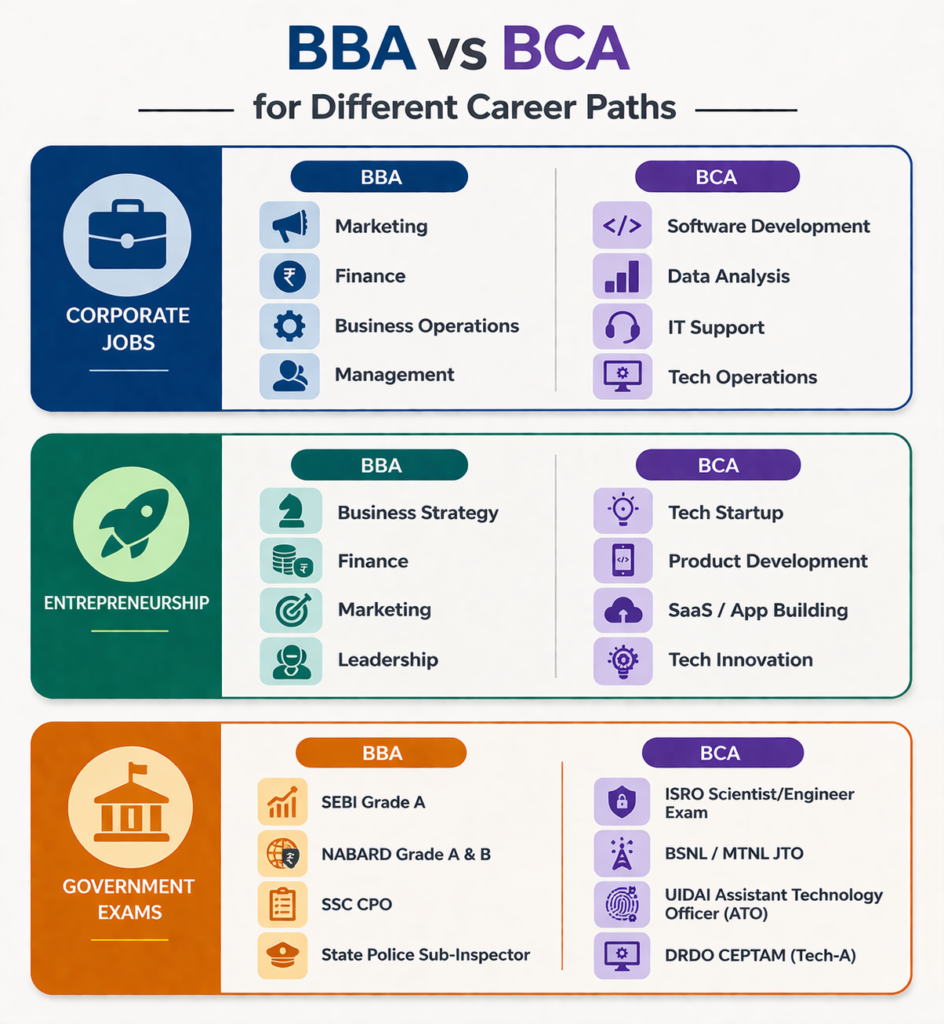
Both the BBA and BCA programs unlock different career pathways. The specialization you opt for largely depends on your overall career objectives. For instance, a BBA degree opens doors to rewarding roles in management, finance, marketing, and entrepreneurship. A BCA, on the other hand, is more suitable for lucrative careers in software development, IT, data analytics, and the like.
Listed below are the various career pathways to help you better make the BCA vs BBA choice:
For Corporate Jobs
A BBA is generally a more suitable choice for entry into the corporate sector as it directly develops essential skills in marketing, management, finance, and business operations. As such, it creates career pathways typically in marketing, management, and HR roles.
A BCA may also facilitate entry into the corporate world; however, it is generally more suited for IT-based roles such as data analysis, software development, and tech support.
| Parameters | BBA | BCA |
|---|---|---|
Job Roles | Business Analyst Marketing Executive Relationship Manager Management TraineeHR Assistant | Programmer Database Administrator IT Support Analyst Software Developer Web Developer |
Hiring Industries | Finance FMCG Retail Banking Consultancy | IT & Software Services BFSI Health Tech E-Commerce EdTech |
For Entrepreneurship
Learners aspiring to become entrepreneurs are likely to find more support from a BBA, as it builds a robust foundation in finance, business strategy, management, and marketing.
A BCA would be more suitable if you aspire to launch a tech startup; however, you may still require added business knowledge to manage the venture and scale it effectively.
| Parameters | BBA | BCA |
|---|---|---|
Job Roles | Business Development Executive Operations Coordinator Project Analyst Management Trainee Digital Marketing Executive | Programmer Database Administrator IT Support Analyst Software Developer Web Developer |
Hiring Industries | E-Commerce Consulting Technology ESG Management and Sustainability Event Management | SaaS Cybersecurity Data Analytics SEO Agencies Tech Consulting |
For Government Exams
To take competitive government exams for entry into government jobs, both BBA and BCA are equally suitable. This is because most government exams focus on reasoning, aptitude, and general knowledge rather than on the professional degree earned.
| Parameters | BBA | BCA |
|---|---|---|
Key Roles | Income Tax Inspector Probationary Officer (PO) Deputy Collector Assistant Audit Officer | Railway IT Junior Engineer Scientist Assistant Digital Forensic Expert Bank IT Officer Technical Assistant |
Hiring Industries | PSUs BFSI Civil Services SSC Government Finance | ITE-Governance Defense & Scientific Research Indian Railways UPSC |
BBA vs BCA: Course Duration, Eligibility & Top Job Roles
Taking a step further into answering the question: “BBA or BCA, which is better?”, let’s take a close look at the course duration for both, the admission requirements for each of them, and the leading job opportunities that they are likely to unlock after course completion.
| Parameters | BBA | BCA |
|---|---|---|
| Course duration | 36 months (3 years) / 6 semesters | 36 months (3 years) / 6 semesters |
| Eligibility criteria | Completion of 10+2 from a recognized national or state boardA 10+3 diploma from a recognized national or state instituteAt least 40% aggregate in 10+2/diploma (35% for students from reserved categories) | Completion of 10+2 from a recognized national or state boardA 10+3 diploma from a recognized national or state instituteAt least 40% aggregate in 10+2/diploma (35% for students from reserved categories) |
| Top job roles | Business Analyst Sales Executive SEO Executive Associate Product Manager Operations Analyst | Web Developer Software Developer System Administrator Mobile App Developer Game Programmer |
Skills Acquired through BBA and BCA
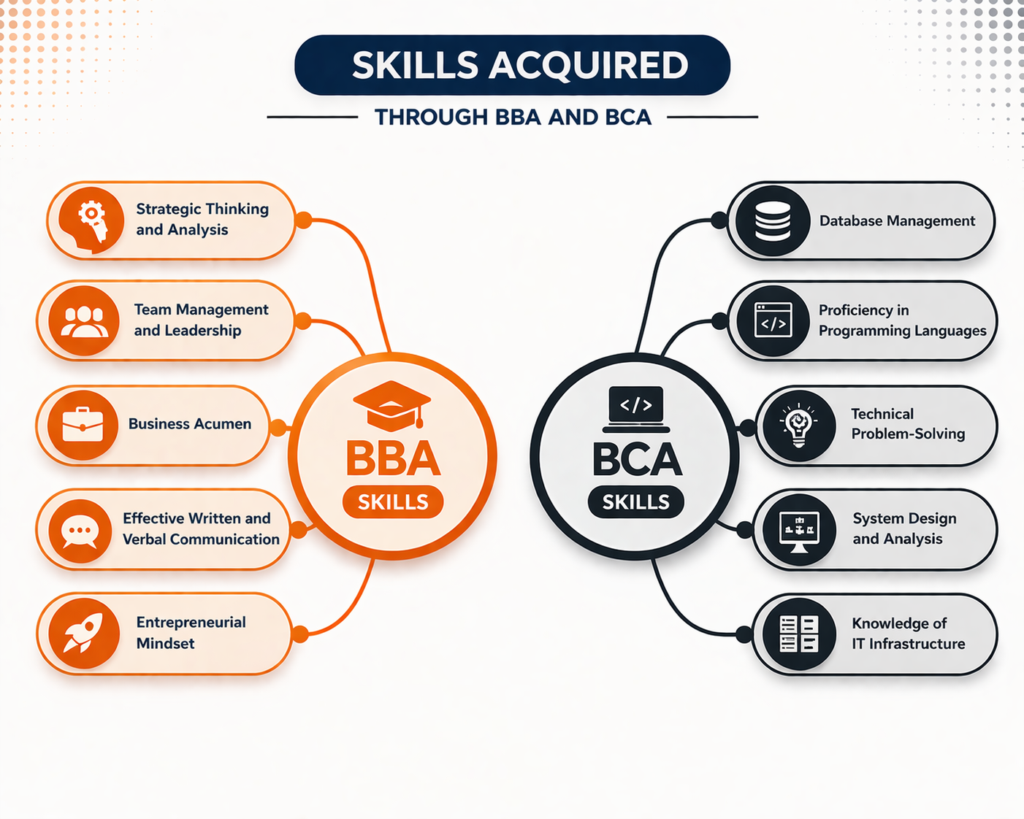
Both BBA and BCA programs are designed to equip learners with industry-relevant practical skills to help them excel in their careers. The skills that students learn in the course curriculum of each of these courses are outlined below for your reference:
Skills Imparted in BBA
- Strategic thinking and analysis
- Team management and leadership
- Business acumen
- Effective written and verbal communication
- Entrepreneurial mindset
Skills Imparted in BCA
- Database management
- Proficiency in programming languages
- Technical problem-solving
- System design and analysis
- Knowledge of IT infrastructure
Which Course Builds Job-Ready Skills Faster?
When deciding between a BBA and a BCA, the key is to identify which program helps you build the skills that are currently in high demand across industries — because those are the skills that will fast-track your path to the right career.
A BBA:
- Helps develop soft skills desirable across industries, such as teamwork, communication, and entrepreneurship fundamentals.
- It expedites entry into corporate roles such as marketing, sales, operations, and HR.
- The skills imparted in BBA programs are broader and transferable; however, they may require later specialization to pursue further career advancement.
Also Read: Best 10 Online BBA Courses in 2026
A BCA:
- Helps build hands-on skills in problem-solving and coding early on
- May need consistent practice, but paves the way for specialized, high-paying roles
- Faster route for entry into technical roles such as IT support, software development, and data analysis
- Helps meet the high demand for job-ready tech skills in the job market
Also Read: Best 10 Online BCA Courses in 2026
Role of Internships & Certifications in BBA and BCA
Internships and certifications play an integral part in equipping students with hands-on skills and providing them with sufficient exposure to the real industrial world. Here are some ways in which certifications and internships can help learners of BBA and BCA programs:
- Internships are particularly helpful to BBA students, providing real-world experience in HR, marketing, and finance. It also helps them develop desirable skills such as efficient management and effective communication.
- For BCA students, internships are an excellent chance to develop hands-on experience in software development, coding, and IT support roles.
- Pursuing certification programs such as data analytics, digital marketing, or programming languages further boosts employability prospects for both BCA and BCA graduates.
BBA vs BCA: Career Opportunities
BBA or BCA, which has more scope? To answer this question, we need to carefully assess the various career prospects that both these courses have the potential to unlock.
BBA Career Opportunities
A BBA typically leads to careers in business, management, and leadership, and is also ideal for entrepreneurial roles.
| Job Roles | Hiring Industries |
|---|---|
| HR Manager | HR |
| Marketing Executive | Retail & E-Commerce |
| Financial Analyst | Business Consulting |
| Entrepreneur | Real Estate |
| Brand Manager | Hospitality & Tourism |
Useful Read: Top Career Options After BBA to Pursue in 2026
BCA Career Paths
A BCA generally paves the way for a lucrative career path in the fields of IT and software development.
| Job Roles | Hiring Industries |
|---|---|
| Web Developer | E-Commerce |
| Software Developer | HR |
| Systems Analyst | Telecommunications |
| Network Administrator | Pharmaceuticals |
| Data Scientist | Tourism & Hospitality |
Also read: Career options after completing a BCA course
Salary Comparison: BBA vs BCA
It is helpful to analyze the BCA vs BBA angle not just in terms of the career path but also in terms of earning potential.
| Career Level | BBA Graduates | BCA Graduates |
|---|---|---|
| Entry-level / fresher (0-3 years) | INR 3 LPA – INR 5 LPA (approx) | INR 4 LPA – INR 8 LPA (approx) |
| Mid-level (3-6 years) | INR 8.6 LPA – INR 9.5 LPA (approx) | INR 5 LPA – INR 18.5 LPA (approx) |
| Senior-level (7-10 years) | INR 10.7 LPA – INR 18 LPA (approx) | INR 12 LPA – INR 24.6 LPA (approx) |
Sources: Glassdoor, AmbitionBox
Higher Studies After BBA and BCA
After completing a BBA or BCA program, graduates can pursue higher studies to further their learning in their respective fields. The type of options that both these courses provide for higher learning can help you decide which one to opt for, based on your overall academic goals.
Higher study options after BBA
- Postgraduate Diploma in Management (PGDM)
- Master of Business Administration (MBA)
- Chartered Financial Analyst (CFA)
Higher study options after BCA
- Master of Computer Applications (MCA)
- Master of Science (MSc/MS) in IT
- MBA in IT Management
Common Myths About BBA and BCA
Before you make the final decision on the BBA vs BCA question, let us help you bust a few common myths that several learners have about both these fields of study, and which may impact your overall decision.
| BBA Common Myths | BCA Common Myths |
|---|---|
| 1. BBA is the same as B.Com. 2. It is only suitable for students with a Commerce background or for aspiring entrepreneurs. 3. A BBA has low earning potential or fewer career prospects. | 1. It is only for students with a Science/Computer Science background. 2. Only aspiring programmers should pursue a BCA degree. 3. Pursuing only BCA without an MCA is incomplete. |
Conclusion
The final choice between BBA and BCA, and which is better, ultimately depends on your personal and academic interests and overall career aspirations. For students with a keen leaning toward business and management roles, a BBA typically offers a robust foundation. However, for those who enjoy coding, technology, and IT-oriented roles, a BCA is a better fit.
Whatever program you opt for, the Online Manipal platform allows you to learn it in the comfort of your home in 100% online mode. Manipal University Jaipur offers Online BBA and Online BCA courses on this platform to aspiring learners in both fields. Enroll for the one that best aligns with your career objectives and take your future trajectory in the right direction with Online Manipal.
FAQs
1. Which has the highest salary, BBA or BCA?
Among the two, a BCA degree generally paves the way for higher-paying career roles for eligible graduates. The average pay scale of a BCA graduate lies between INR 4 LPA and INR 24.6 LPA, depending on the number of years of work experience in the industry. This contrasts with BBA salaries, which range from INR 3 LPA to INR 18 LPA. The figures are indicative only.
Sources: Glassdoor, AmbitionBox
2. BCA vs. BBA, which is tougher?
BCA may feel more challenging for students who are less comfortable with coding, mathematics, and logical problem-solving, while BBA may feel easier for those inclined toward business and communication.
3. Which has better placement, BBA or BCA?
A BCA is generally believed to offer more lucrative, higher-paying job prospects after graduation than a BBA. This is attributed to the booming IT sector and the rapid evolution of technologies such as cloud computing, data analytics, and cybersecurity.
4. Is BBA or BCA better for future career growth?
BCA may offer faster early growth in technical careers, while BBA can lead to broader long-term leadership and business growth, especially after an MBA.
5. BBA or BCA, which is better for Science students?
Students with a Science background at the 10+2 level generally opt for BCA courses at the undergraduate level, as the program requires a strong background in coding, computer science, and mathematics.
Sources:
https://www.glassdoor.co.in/Salaries/business-analyst-fresher-salary-SRCH_KO0,24.htm
https://www.glassdoor.co.in/Salaries/entry-level-software-engineer-salary-SRCH_KO0,29.htm
https://www.ambitionbox.com/profile/business-analyst-salary
https://www.glassdoor.co.in/Salaries/mid-level-software-engineer-salary-SRCH_KO0,27.htm
https://www.glassdoor.co.in/Salaries/senior-business-analyst-salary-SRCH_KO0,23.htm
https://www.glassdoor.co.in/Salaries/senior-software-developer-salary-SRCH_KO0,25.htm
Prepare for your next career milestone with us