
Listen to this blog

Every passing year, several graduates across India and further, are often faced with the same crossroads:
Should I do an MBA?
Will an MCA make more sense?
What about an MA?
Though the decision feels like a herculean task, it is an indicator that you are at the right place. While charting the next progression of your life, it is very important to make sure that the postgraduate degree program you choose makes your journey to the career path easier. This is the catalyst for several important professional decisions in your life. The confusion between MBA vs MCA vs MA can simply arise from your friend’s recommendation, a salary figure you saw online, or a college brochure you reviewed.
How to erase these doubts then? A guide can be handy, providing details such as which PG degree might be best for career growth after graduation, the differences between MBA, MCA, and MA degrees, how to choose between MBA, MCA, and MA, and so on.
As you wished, we are delivering this article, which will be a great help to learners looking to make a career pivot or pursue higher studies. And by the end, we promise to give you a sensical and honest picture of which path is yours.
Something similar: MBA vs MCA: Which is Better for Your Career?
A Three-Scenario Case Study
Below are three fictional students. Their stories will be a great revelation to understand which PG degree will fit you the best.
The Future Business Leader – Arjun
- Strengths: Leadership, team coordination, client interaction, task management, and presentations
- Areas Less Focused On: Academic research and advanced programming
- Hobbies & Interests: Watching Shark Tank, reading startup news, and discussing market opportunities and consumer behaviour
- Personality Traits: Proactive, confident, and enjoys taking responsibility in group settings
- Ambition: To build a career in business management, entrepreneurship, or client-facing roles where leadership and strategic thinking are valued.
Best fit: MBA
Also read: The ROI of an MBA: Does it pay off in the long run?
The Tech Problem Solver – Revathy
- Strengths: Coding, logical problem-solving, technical development, and self-learning
- Areas Less Focused On: Management meetings, corporate presentations, and marketing-related subjects
- Hobbies & Interests: Building websites and apps, learning programming languages like Python, and exploring technology fields such as AI and cybersecurity
- Personality Traits: Curious, analytical, persistent, and enjoys solving complex technical challenges
- Ambition: To build a career at the technical forefront of fields like AI, cybersecurity, or software engineering by creating innovative systems and solutions
Best fit: MCA
Recommended reads: Frequently asked questions about MCA degree
The Creative & Research-Oriented Thinker – Nanda
- Strengths: Critical thinking, writing, communication, argument analysis, and understanding people and society
- Areas Less Focused On: Pure technical work and corporate management environments
- Hobbies & Interests: Reading literature, exploring psychology and history, analysing social issues, and discussing culture and communication
- Personality Traits: Thoughtful, curious, analytical, and people-oriented
- Ambition: To build a meaningful career in fields such as counselling, journalism, public policy, content strategy, or academia where ideas, communication, and social impact matter most
Best fit: MA
If one of these profiles felt uncomfortably accurate, that’s a good sign. Let’s now explore what each degree actually entails.
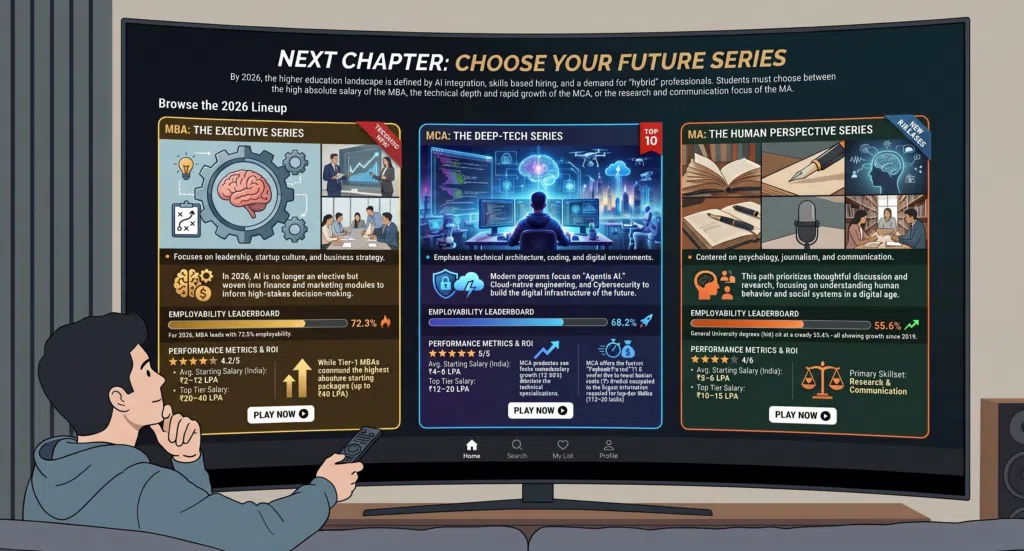
What Do These Degrees Actually Focus On?
MBA: Building Business & Leadership Skills
The Master of Business Administration is one of the most in-demand postgraduate degrees in the world, and for all the right reasons. Once the MBA degree benefits are understood, the entire ecosystem of how organizations operate becomes easier to comprehend.
Program Overview
A full-time MBA can be completed in 2 years and covers subjects such as managing people and organizations, managerial economics, business statistics, business communications, business leadership, and so on. Given that the pedagogy is heavily case study-based, most of the course time will be spent exploring business situations and defending your decisions in class discussions.
Popular Specialisations
Some of the popular specializations include:
- Finance
- Human Resource Management
- Analytics and Data Science
- Marketing
- Project Management
- Operations Management
- International Business
- Supply Chain Management
- BFSI
- IT & Fintech
- Information System Management
- Retail Management
- Digital Marketing
You may also like: A guide on choosing online MBA electives
Key Skills Developed
Some of the key skills that can be developed while pursuing MBA are as follows:
- Leadership and team management
- Strategic thinking
- Communication and presentation skills
- Problem-solving and decision-making
- Financial and business analysis
- Project management
- Negotiation and conflict resolution
- Networking and relationship building
- Marketing and consumer understanding
- Entrepreneurial and innovation mindset
MCA: Building Technical & IT Expertise
While doing a simple comparison between MBA vs MCA scope, the former creates business leaders, while the latter is responsible for the technical architects who design products and systems. MCA career opportunities span a wide range of roles, from software development to AI engineering.
Program Overview
The Master of Computer Applications is a two-year program that develops the learner’s technical skills. The curriculum consists of subjects such as Fundamentals of Computers and IT, Python Programming, Data Visualisation, Python Programming – Lab, Data Structure and Algorithms and so on. The MCA degree is oriented i making learners work-ready in the software industry from day 1.
Popular Specializations
Some of the popular MCA specializations are as follows:
- AI & Data Science
- Cloud Computing
- Cybersecurity
- Comprehensive Emerging Technologies
- AI & ML
- Full Stack Development
Key Skills Developed
The key skills developed by after an MCA degree are as follows.
- Programming and coding proficiency
- Software development skills
- Database management
- Problem-solving and logical thinking
- Web and application development
- Cybersecurity awareness
- Artificial Intelligence and machine learning fundamentals
- System design and architecture
- Data structures and algorithms
- Technical project management
Explore related guides: 10 best career options after MCA degree
MA: Building Analytical & Creative Thinking
Claiming to be the oldest and the most diverse degree discussed here, the MA degree’s scope is humongous. Especially in the age of AI, several MA disciplines are in demand right now, as they help develop deep expertise in exploring human behaviour, culture, communication, and society. Further MA career opportunities are branched out in several domains such as journalism (journalist, PR), hospitals (counsellors/therapists), education (academicians, researchers), and many more.
More to explore: Why the Humanities Are More Important Than Ever in the Age of AI
Program Overview
A Master of Arts is a two-year PG program where a learner can get his degree after a bachelors in humanities, arts or social sciences. There are several specializations in MA, with each having its own flavour, methodology and career trajectory. For instance, an MA in Psychology will look very different from an MA in Journalism.
Popular Specialisations
Below are the popular specializations in an MA degree.
- English
- Political Science
- Sociology
- Journalism and Mass Communication
Next read: MA in English vs Political Science vs Sociology
Key Skills
Given below are the key skills for an MA degree
- Critical thinking and analysis
- Research and academic writing
- Communication and presentation skills
- Problem-solving and interpretation
- Creative and strategic thinking
- Cultural and social awareness
- Argument evaluation and reasoning
- Content creation and storytelling
- Public speaking and interpersonal skills
- Analytical reading and comprehension
MBA vs MCA vs MA: Key Differences at a Glance
The below table will erase the confusion of MBA vs MCA vs MA career comparison at a high level. This can be used as a quick reference as it captures all the important dimensions. For those specifically weighing MBA vs MCA salary prospects, notice that the starting salary ranges differ considerably based on college tier, specialisation, and the industry you enter.
| Feature | MBA | MCA | MA |
| Core Focus | Business, management & leadership | Computer applications & software development | Humanities, social sciences & research |
| Ideal Background | Any graduate (commerce preferred but not required) | BCA, B.Sc. Computer Science, or related technical degree | BA or BSc in humanities/social sciences |
| Typical Duration | 2 years | 2–3 years | 2 years |
| Learning Style | Case studies, group projects, presentations | Technical labs, coding, applied projects | Reading, research, essays, seminars |
| Key Skills Developed | Leadership, strategy, communication, financial acumen | Programming, system design, data analysis, problem-solving | Critical thinking, research, writing, communication |
| Placement Sectors | Finance, consulting, FMCG, startups, operations | IT services, product companies, tech startups | Education, media, government, NGOs, content, counselling |
| Starting Salary Range (India) | ₹5–20 LPA (varies widely by college and specialisation) | ₹3.5–12 LPA (higher in product/tech roles) | ₹2.5–8 LPA (higher in premium niches like policy, clinical psychology) |
| Best Suited For | Future managers, entrepreneurs, business strategists | Developers, data scientists, software engineers | Researchers, educators, communicators, counsellors |
| Global Recognition | Very high — MBA is universally understood | High in IT and tech industry globally | Varies by specialisation; strong in academia and public sector |
| Entrepreneurship Path | Strongly oriented toward business ownership | Strong for tech startups and product companies | Possible in media, consulting, counselling, and content |
Which Degree Matches Your Personality?
So – which is better: MBA, MCA, or MA?
While objectively viewing choices, each one will look like a treasure trove. But that is not enough. Here’s a more detailed breakdown of the personality traits and preferences that correlate with success and satisfaction in each path.
Choose MBA If You:
- have a knack to lead people and do a great job in co-ordinating teams.
- love to network and great at social dynamics.
- are interested in discussing about business strategy, competition, and markets
- have confidence to present meetings and have a compelling negotiation skill.
- are fired up with motivation while viewing visible business outcomes.
- Want access to a wide range of industries and roles
- Are interested in eventually starting your own venture or reaching senior leadership
Choose MCA If You:
- love to code different programming languages.
- are interested in systems and processes.
- find a great deal of satisfaction in building apps, algorithms, scripts and many more.
- Are excited by how technology is changing the world (AI, cloud, security, data)
- looking for environments where the output is quantifiable.
- Are willing to keep learning continuously as technology evolves quickly
Choose MA If You:
- Are intellectually curious about people, society, culture, and ideas
- Write and communicate well, and find those skills deeply satisfying to use
- Enjoy research such as reading deeply, synthesising information, forming arguments
- Are drawn to fields like psychology, education, journalism, public policy, or literature
- Want to make a difference in people’s lives through counselling, teaching, or advocacy
- Are comfortable with a less linear career path that often involves building a personal brand or reputation
- Value intellectual freedom, even if it means a more uncertain early career
- Are interested in academia, civil services, or social impact organisations
Final Thoughts: Don’t Choose the Popular Degree; Choose the Right Fit
If you have reached the bottoms-up of this blog, then it can be understood that the difference between MBA, MCA and MA degrees would be known by now. Career satisfaction is deeply correlated with alignment between your natural strengths and the demands of your work
Hence the degree that will serve you best is not the one that sounds impressive at a dinner party. It’s the one that puts you in environments where your strengths are assets rather than liabilities, where you’re solving problems, you find genuinely interesting, building skills you’re actually motivated to develop, and growing toward goals that feel worth pursuing.
Whether you are comparing MBA vs MCA vs MA based on salary, career growth, technical interests, or long-term goals, the right degree depends on your strengths and aspirations.
Still unsure how to choose between MBA, MCA, and MA? Maybe Online Manipal’s course page might be of great help. Click here to know more.
Found this guide helpful? Share it with someone who’s navigating the same decision. The right information at the right time can change the course of a career.
Become future-ready with our online MBA program