Blogs
Blogs 

Listen to this blog

According to the NIIT Skill Gap Report 2026, India’s challenge is no longer producing graduates but producing graduates who are truly job-ready for rapidly evolving industries.
As the above statistics emphasize, academic learning of a student is increasingly becoming negligible due to a lack of practical experience in the workplace. There are definite signs that this disconnect is occurring in programs such as BCA, BBA, and MBA. While students may learn theoretical concepts, they do not gain enough experience for practical applications.
Today, we need to understand that all industries increasingly value applied skills, problem-solving, and adaptability. Hence, education models are also beginning to shift towards more practical and industry-focused learning. This will help students adept to any work environment that requires them to actually apply what they learnt.
In this blog, we will see the gap between academic learning and applied skills in BCA, BBA, and MBA and the required skills to upskill yourself.
What Is the Academic–Industry Skill Gap?
Why do we speak so much about the academic-industry skill gap? Is it really important?
The answer is, absolutely, yes!
Earlier, students were mainly expected to study well, secure admission into a good college, complete their degree, and eventually land a stable job. A degree itself was often considered enough proof of capability.
But today, the real challenge starts only after you’ve crossed the graduation stage. Employers aren’t simply ticking boxes next to your degree anymore, but they want to see what you can actually do. Can you adapt when things don’t go as planned? Can you walk into a messy, real problem and find your way through it? Do you bring experience that goes beyond what a textbook taught you?
And that’s where a lot of graduates quietly struggle. Subject knowledge might be there but sometimes translating it into a workplace setting is a different game entirely. Knowing the theory and living the theory are two very different things.
We call this the academic–industry skill gap. The gap between what a classroom prepares you for and what an employer actually needs from you on day one.
As technology and industry needs continue to change rapidly, students today need more than just academic knowledge. They also need the skills and real-world exposure to survive confidently and succeed in today’s workplaces.
An Interesting Find: Importance of a T-Shaped Professional in Emerging Workplaces
The Difference: Academic Learning and Applied Skills in BCA, BBA, and MBA Programs
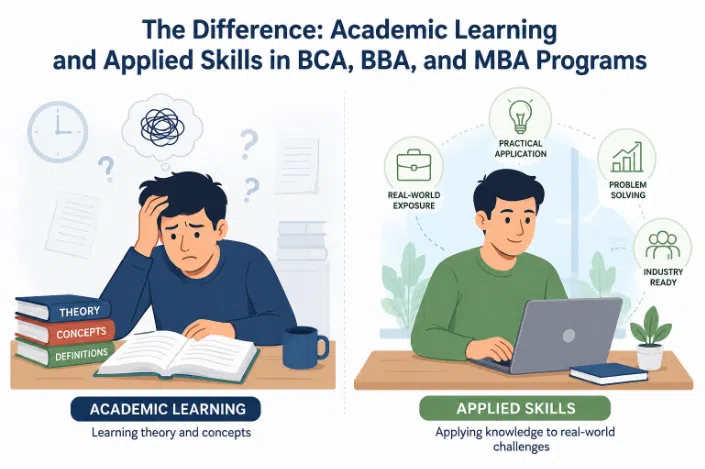
Graduating today means stepping into a world that expects more than a degree. Industries don’t just want someone who studied the subject, but they want someone who can use it. The table below breaks this down simply with a few key subjects from each course, and what the gap looks like in practice.
| Program | Skill Area | What’s Taught | What Employers Expect | The Gap |
|---|---|---|---|---|
| BCA | Programming | Theory of algorithms, syntax of C/Java in lab exercises | Write clean, production-ready code; debug independently; use Git | Lab code ≠ real codebase |
| BCA | Software development | Waterfall model, SDLC concepts from a textbook | Agile/Scrum, sprint planning, CI/CD pipelines | Agile rarely practiced in class |
| BCA | Databases | Normalization, ER diagrams, basic SQL queries | Optimize queries, work with NoSQL, handle large datasets | Performance tuning untouched |
| BCA | AI & emerging tech | Brief intro to AI/ML as theory or elective | Prompt engineering, API integration, ML pipelines in real projects | Exposure without hands-on use |
| BCA | Communication | Technical writing module, occasional presentations | Explain technical work clearly to non-technical stakeholders | Cross-functional communication gap |
| BBA | Marketing | 7Ps framework, case studies from textbooks | Run digital campaigns, read analytics dashboards, SEO/SEM basics | Digital marketing skills missing |
| BBA | Finance | Financial statements, ratio analysis, manual calculations | Work with Excel/ERP tools, interpret live data for decisions | Tool proficiency rarely taught |
| BBA | Operations | Supply chain theories, inventory models in isolation | Manage vendor relationships, adapt to disruptions in real time | Scenario adaptability missing |
| BBA | Entrepreneurship | Business plan template, theory of startups | Validate ideas quickly, build MVPs, handle rejection and pivoting | Execution vs. planning |
| BBA | Leadership & teamwork | Group assignments, management theory (Maslow, Herzberg) | Lead cross-functional teams under pressure with accountability | Theory-driven, low real stakes |
| MBA | Strategy | Porter’s Five Forces, SWOT, Harvard case discussions | Build and execute strategy in ambiguous, fast-moving markets | Case ≠ live market complexity |
| MBA | Data & analytics | Basic stats, Excel, occasional Tableau module | Derive insights from dashboards, interpret AI-generated reports | Data fluency gap at leadership level |
| MBA | Change management | Kotter’s model, theoretical change frameworks | Lead people through real uncertainty, resistance, and cultural shifts | Frameworks without lived experience |
| MBA | Negotiation | Win-win theory, role-play exercises in class | Negotiate with clients, vendors, investors under real pressure | Stakes in class are always low |
| MBA | People management | HR theory, performance appraisal models | Have hard conversations, hire, coach, and let go of real people | Emotional skills can’t be lectured |
Why Emphasize BCA, BBA, and MBA?
Many people may wonder, when there are so many degree programs available today, why focus specifically on BCA, BBA, and MBA?
Here’s why these programs are important when discussing the academic–industry skill gap:
These are among the most career-oriented and industry-driven degree programs in India.
- BCA, BBA, and MBA are among the most career-focused degree programs in India which are built for industries that move at a rapid pace every year.
- Students from these programs step into sectors being reshaped daily by AI, automation, digital transformation, and shifting market demands.
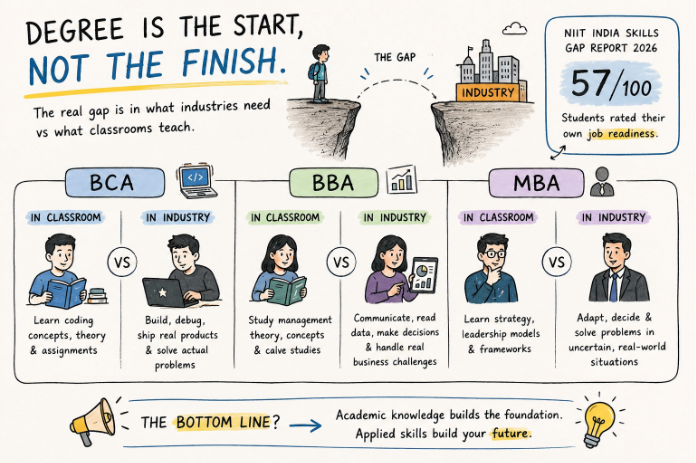
- The 2026 NIIT India Skills Gap Report confirms what many already sense: industries are increasingly prioritizing digital fluency, AI awareness, data skills, cybersecurity, and the ability to solve real problems.
- What’s striking is that students themselves rated their own job readiness at just 57 out of 100, which is an honest signal that classroom learning and workplace expectations are still far apart.
- BCA students may know how to write code, but industries want someone who has actually built something, debugged something, and shipped something.
- BBA students can walk you through management theory, but employers are looking for people who can communicate clearly, read data, and make decisions that hold up under pressure.
- MBA graduates often have a strong grasp of strategy and leadership frameworks- but what industries actually test is whether you can adapt, decide, and solve problems when the situation doesn’t follow the textbook.
- Across all three programs, the message from industry is consistent: academic qualifications matter, but applied learning and real-world exposure matter just as much; If not more!
Read More: Navigating the Future: AI Trends and Opportunities in 2026
How Online Manipal Stands Out?
As industries keep raising the bar for hiring, learning platforms can’t afford to stay stuck in the old way of doing things. Online Manipal is one platform that tries to attempt to connect academic learning with what industries are looking for today.
- The curriculum isn’t built around what was relevant five years ago, but it’s actively shaped around where industries and technology are heading right now.
- Learning doesn’t stop at theory. Students work through real projects, case studies, and live webinars that push them to apply what they’re studying, not just remember it.
- Getting a degree is one thing, landing a job is another. Online Manipal supports students through interview preparation, mentoring, and resume building which make that transition smoother.
- Not everyone can sit in a classroom from nine to five. The flexible online model, with both live and recorded sessions, is built around real lives, whether you’re a working professional or a full-time student.
- Beyond the core program, students get access to additional certifications and Coursera resources, giving them something extra to show employers when it matters most.
- Regular sessions and webinars keep students connected to what’s actually shifting in the market, so they’re not caught off guard when they step into the workforce.
Conclusion
Degrees may open doors, but applied skills decide how far students can go once they step inside. In a world shaped by constant technological and industry change, the real challenge is no longer just graduating but staying relevant. So, are students truly preparing for jobs, or only preparing for exams? That is something we need to seriously think about.
Reference:
Prepare for your next career milestone with us


Explore Similar Blogs
View All
 19 Oct 2026
 16 mins
 14 Oct 2026
16 mins
14 Oct 2026
16 mins
 08 Oct 2026
17 mins
08 Oct 2026
17 mins
 08 Oct 2026
16 mins
08 Oct 2026
16 mins