
Listen to this blog

Introduction
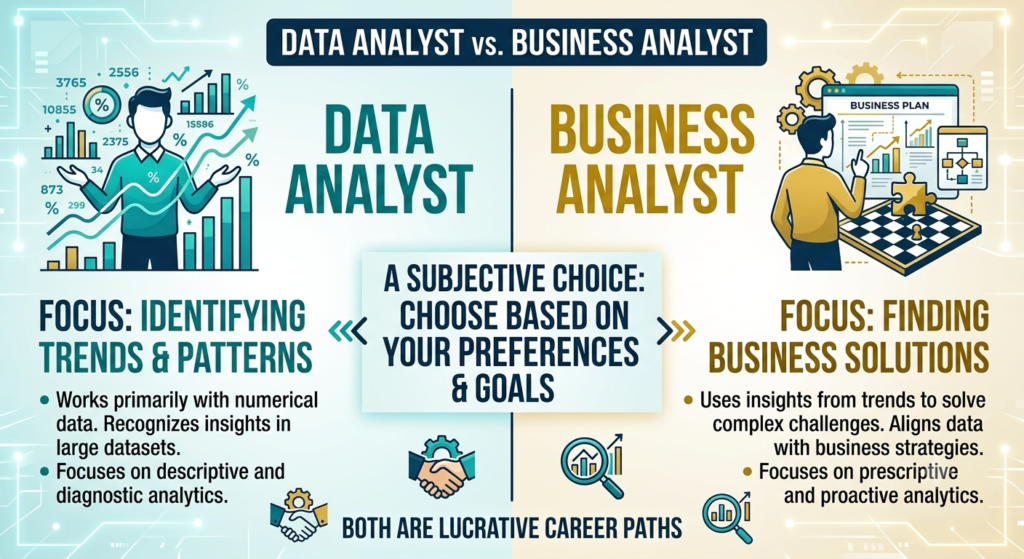
Choosing between two in-demand industry roles—Data Analyst and Business Analyst—can be confusing for aspiring learners seeking lucrative career paths. While a Data Analyst works with numbers and identifies trends and patterns, a Business Analyst uses insights from those patterns to find solutions to complex challenges.
It would be wrong to say that either of the two roles is “better” than the other. It is a subjective choice that largely depends on your personal preferences and overall career goals. However, we help you simplify this choice by discussing the Data Analyst vs. Business Analyst debate in detail in this blog.
Why the Data Analyst vs Business Analyst Decision Matters Today
Understanding the key difference between Data Analyst and Business Analyst roles is crucial for companies today; the roles require different focuses on everyday operations.
- Different skill sets: Data Analysts tend to use more Python, SQL, and data visualization tools, while Business Analysts’ focus is on requirements gathering, effective communication, and process optimization. Knowing this significantly helps with the recruitment process.
- Clarity in career path: Not just for employers, but knowing the distinction between the two roles is helpful for aspiring professionals as well. It helps clarify the future career path they intend to pursue. Data Analysts can focus on roles that require data interpretation, while Business Analysts focus on blending business strategy with data.
- Direct influence on job roles and salaries: Different roles have different corresponding earning potential for graduates. Knowing which one to pick would help you build a stronger professional portfolio and avoid career misalignment.
Data Analyst Syllabus vs Business Analyst Syllabus
When analyzing which is better: Business Analyst or Data Analyst, it helps to take a close look at the curricula of both courses to make an informed decision.
Note: For BBA (Hons) courses, students who meet the graduation requirements at the end of Year 3 with a CGPA of 8.0 or higher are eligible to pursue Year 4, subject to additional costs.
| Semesters | BBA in Data Analytics | BBA (Hons) in Business Analytics |
|---|---|---|
| 1st Semester | Business and Management Functions Financial Accounting Microeconomics Entrepreneurship and Innovation Management Universal Human Values Office Automation Tools | Principles of Management Business Communication Accounting for Managers Statistics for Managers Managerial Economics |
| 2nd Semester | Macroeconomics Financial Management Organizational Behavior Community Development Introduction to Python Statistics for Managers Business Communication | Managing People and Organization Marketing Management Cost and Management Accounting Analytics using Computer Applications Environmental Studies Media Literacy and Critical Thinking |
| 3rd Semester | Operations Management Human Resource Management Marketing Management Cost & Management Accounting Interview Skills and Etiquette Business and Corporate Laws Business Environment | Operations Management Corporate Finance Research Methods in Management Business Law Health and Wellness Open Elective (Coursera/Swayam) |
| 4th Semester | Indian Financial System Business Research Methods Supply Chain Management E-Commerce Design Thinking (MLC) Environmental Science Technology Management | Entrepreneurship and Startup Ecosystem Enterprise Resource Planning Design Thinking and Innovation Emerging Technologies and Applications Strategic Management Logistics and Supply Chain Management |
| 5th Semester | Core Subjects Fundamentals of Business Analytics International Business Management 3 subjects from the chosen elective Electives/Specializations Database Management System Digital Marketing Business Analytics for Decision Making | Core Subjects Project Management Business Taxation 4 modules as per chosen elective Electives/Specializations Econometrics Analytics for Business Database Management System |
| 6th Semester | Core Subjects Strategic Management Management Information System Project 3 subjects from the chosen elective Electives/Specializations Social media and Web Analytics Data Mining and Warehousing Data Visualization with R | Core Subjects Corporate Governance and Business Ethics International Business Management Major Project 4 modules as per chosen elective Electives/Specializations Visual Analytics Optimization and Quality Control Techniques |
| 7th Semester | – | Core Subjects Behavioral Economics and Decision Making Business Analysis Sustainable Business Models and Circular Economy 4 modules as per chosen elective Electives/Specializations Programming for Analytics Marketing Analytics |
| 8th Semester | – | Core Subjects Artificial Intelligence Cultural Intelligence and Diversity in Organizations Dissertation /Capstone4 modules as per chosen elective Electives/Specializations Financial Analytics Basics of HR Analytics |
Data Analyst vs Business Analyst Career Paths
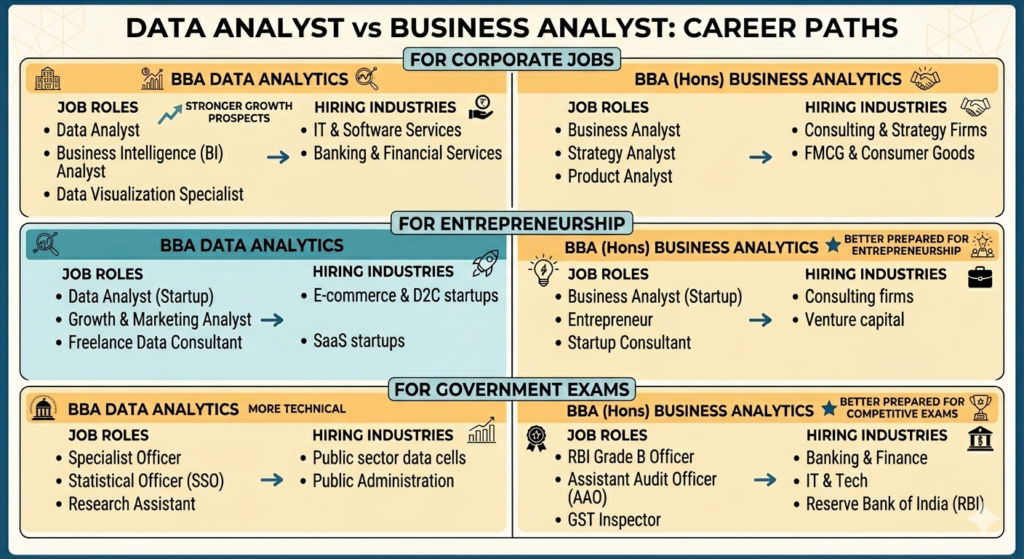
Opting for Data Analyst or Business Analyst courses can shape your career trajectory in different ways. This is because Data Analysts primarily focus on deriving valuable insights from large, complex datasets, while the role of Business Analysts is to serve as a bridge between data and business strategy and to enhance overall decision-making for an organization. Below are the various career paths available to graduates, depending on the path they choose.
For Corporate Jobs
Both Data Analysts and Business Analysts are in high demand in the corporate sector. However, Data Analysts offer relatively strong growth prospects for professionals, owing to the steadily increasing need for data-backed decision-making across industries today.
| Career Paths | BBA Data Analytics | BBA (Hons) Business Analytics |
|---|---|---|
| Job Roles | Data Analyst Business Intelligence (BI) Analyst Data Reporting Analyst Junior Data Scientist Data Visualization Specialist | Business Analyst Management Analyst Market Research Analyst Strategy Analyst Product Analyst |
| Hiring Industries | IT & Software Services Banking & Financial Services Consulting Firms Retail & E-Commerce Healthcare & Pharma Analytics | Consulting & Strategy Firms FMCG & Consumer Goods Telecom & Digital Services Banking & Insurance Logistics & Supply Chain Management |
For Entrepreneurship
Business Analysts generally make better entrepreneurs, as they learn to focus on market demands, business strategy, and decision-making. Data Analysts, on the other hand, specialize in data interpretation tasks.
| Career Paths | BBA Data Analytics | BBA (Hons) Business Analytics |
|---|---|---|
| Job Roles | Data Analyst (Startup) Growth & Marketing Analyst Freelance Data Consultant BI Analyst Product Data Associate | Business Analyst (Startup) Operations Analyst Entrepreneur BI Strategist Startup Consultant |
| Hiring Industries | E-commerce & D2C startups Digital marketing & advertising agencies EdTech platforms FinTech SaaS startups | Consulting firms Insurance Tech Venture capital Management consulting E-commerce |
For Government Exams
For students aspiring to write competitive exams for government services, a BBA (Hons) in Business Analytics is considered better. This is because the program offers a broader overview of reasoning, business, and management concepts that better prepare students for competitive exams than the BBA in Data Analytics, which is a bit more technical.
| Career Paths | BBA Data Analytics | BBA (Hons) Business Analytics |
|---|---|---|
| Roles | Probationary Officer Specialist Officer Assistant Section Officer Statistical Officer (SSO) Research Assistant | Assistant Audit Officer (AAO) GST Inspector RBI Grade B Officer Specialist Officer (SO) Management Trainee |
| Hiring Industries | Public sector data cells Banking Digital administration Management Consulting FinTech | Banking & Finance IT & Tech Public Administration Public Sector Banks (PSBs) Reserve Bank of India (RBI) |
Data Analyst vs Business Analyst: Course Duration, Eligibility & Top Job Roles
Continuing the analysis on Data Analyst vs. Business Analyst: Which is better, we look at the course duration for each, their respective eligibility criteria, and the top jobs available after graduation.
| Parameters | BBA Data Analytics | BBA (Hons) Business Analytics |
|---|---|---|
| Course duration | 36 months (3 years) / 6 semesters | 36 months (3 years) / 6 semesters or 4 years / 8 semesters |
| Eligibility criteria | At least 40% at the 10+2 level | At least 50% aggregate in 10+2 |
| Top job roles | Data Analyst Business Administrator Data Visualizer Business Intelligence Analyst Market Research Associate | Business Analyst Data Analyst Market Research Analyst Risk Analyst Financial Analyst |
Skills Acquired Through BBA Data Analytics and BBA (Hons) Business Analytics
Assessing the specific skill sets imparted in both courses further helps us navigate through the Data Analyst vs Business Analyst debate. Here are some key skills that both programs equip learners with, which can help you decide which career path to opt for:
Skills Acquired Through BBA Data Analytics:
- Statistical Analysis
- Programming
- Data Gathering
- Data Visualization
- Predictive Analytics
Skills Acquired Through BBA (Hons) Business Analytics:
- Problem Solving
- Business Intelligence
- Effective Communication
- Strategic Decision-Making
- Prescriptive Analytics
Read more: Top Skills You Need to Build a Career in Business Analytics
Which Course Builds Job-Ready Skills Faster?
Whether you opt for BBA Data Analytics or BBA (Hons) Business Analytics largely depends on your desire to adapt to industry-relevant, hands-on skills in the job market. While both programs prepare you for careers focused on data, the focus of learning and application of skills learned differs considerably.
Also note that sometimes the transition from Business Analyst to Data Analyst is also possible through reskilling. Hence, make your course choice wisely based on which of the two better prepares you for the job market.
BBA Data Analytics
- Practical exposure to tools such as SQL, MS Excel, Python, Power BI, and a data visualization platform.
- Strong technical proficiency in data gathering, cleaning, statistical analysis, and visualization
- Facilitates jobs in entry-level roles such as Reporting Analyst, Data Analyst, and Business Intelligence Executive
BBA (Hons) Business Analytics
- Emphasis on forecasting, problem-solving, market analysis, and business decision-making frameworks
- Blends business strategy with analytics, enabling students to understand better the role of data in improved decision-making in organizations
- Roles such as Operations Analyst, Business Analyst, and Strategy Analyst are unlocked for eligible graduates who have a broader business perspective.
Data Analyst vs Business Analyst: Career Opportunities
One of the key differences between Data Analyst and Business Analyst careers lies in the types of roles available to graduates, with distinct responsibilities and functions for each. Here’s a detailed overview of both for your reference:
Data Analyst Career Opportunities
| Job Roles | Hiring Industries |
|---|---|
| Market Analyst | Retail |
| Financial Data Analyst | Finance & Banking |
| Operations Analyst | Healthcare |
| E-Commerce Manager | E-commerce |
| Product Data Analyst | IT & ITES |
Business Analyst Career Opportunities
| Job Roles | Hiring Industries |
|---|---|
| Data Scientist | Telecommunications |
| Operations Analyst | BFSI |
| Product Analyst | Information Technology & Software |
| Predictive Modeler | Healthcare & Pharmaceuticals |
| Business Intelligence Analyst | Retail & E-Commerce |
Salary Comparison: Data Analyst vs Business Analyst
A comparative analysis of both roles also provides students with a clear picture of which course to opt for at the study level, one that paves the way for lucrative future career opportunities.
| Career Level | Data Analyst | Business Analyst |
|---|---|---|
| Entry-level / fresher (1-3 years) | INR 5.2 LPA – INR 9.4 LPA (approx) | INR 6.9 LPA – INR 7.6 LPA (approx) |
| Mid-level (3-6 years) | INR 7.2 LPA – INR 13.8 LPA (approx) | INR 8.7 LPA – INR 9.6 LPA (approx) |
| Senior-level (6-9 years) | INR 7.7 LPA – INR 28 LPA (approx) | INR 11.2 LPA – INR 12.4 LPA (approx) |
Source: AmbitionBox
Common Myths About Data Analyst vs Business Analyst
It helps uncover some common myths surrounding both roles so you can make a clear, informed career decision for your future. Listed below are some myths and their actual realities to help you choose wisely.
| Data Analyst Common Myths | Business Analyst Common Myths |
|---|---|
| Data Analysts don’t need business understanding. Reality: Using raw data alone, in the absence of an appropriate business context, is completely futile. Data Analysts do mostly analysis all day. Reality: A large part of an analyst’s day is involved in preparing for data analysis. This includes data cleaning, number validation, and the identification of the specific required metrics. It’s just a Math and numbers job. Reality: While Data Analysts primarily crunch numbers all day, the job also requires additional knowledge and skills in advanced calculus, along with a core statistics background. | They can only find work in giant tech companies. Reality: Business Analytics is a critical requirement today across all industries and organizations, regardless of size. There is a dire need to leverage data to improve productivity and make informed decisions in businesses. You need to be a technical programmer for a Business Analyst role. Reality: Technical skills do help Business Analysts perform their jobs better; however, other skills are also required, such as problem-solving and translating business goals into actionable plans. Business Analysts only create dashboards. Reality: Dashboard creation is just the output of the work done. Their primary role involves facilitating with stakeholders, analyzing the root cause of the problem, improving processes, and actively solving real-world challenges. |
Final Thoughts
The final choice between opting for a career path as a Data Analyst or a Business Analyst is only yours to make. There is no single definitive path for everyone, and you should opt for the one that best fits your strengths, skill set, and career goals. Once you have made up your mind about the trajectory you want your career to take, equip yourself with industry-relevant skills and specialized knowledge in both fields on Online Manipal.
The platform offers UGC-entitled online courses through NAAC-accredited universities that are in high demand and recognized by employers worldwide. Manipal University Jaipur (MUJ) offers an Online BBA in Data Analytics, and Manipal Academy of Higher Education (MAHE) offers Online BBA (Hons) in Business Analytics—both on the Online Manipal platform. Enroll for the one that aligns with your career objectives and take on the industry with confidence and pride.
FAQs
1. What is the difference between a Data Analyst and a Business Analyst?
The key distinction between a Data Analyst and a Business Analyst is that the former focuses on analyzing historical data to identify current trends and patterns in large, complex datasets. The latter, on the other hand, emphasizes business strategy and uses insights from Data Analysts to suggest improvements to business processes.
2. Which is better: a Business Analyst or a Data Analyst?
There is no single universal answer to this. The choice is highly subjective and depends on various factors—an individual’s academic interests, strengths and skills, and long-term career goals.
3. Can a Business Analyst transition to a Data Analyst role?
Absolutely! It is a natural and lucrative career transition for most Business Analysts and can be achieved seamlessly through upskilling with the right courses and credentials.
4. What skills are required for a Data Analyst compared to a Business Analyst?
Data Analysts require the following skill sets:
- Knowledge of Math and Statistics
- Programming
- Statistical skills
- Data visualization
- Data interpretation
5. Who earns more: a Data Analyst or a Business Analyst?
Individual salary packages may vary based on a candidate’s academic and professional experience. However, on average, Data Analysts tend to earn more than Business Analysts.
6. How do I choose between a career as a Data Analyst and a Business Analyst?
When choosing a career path, consider your strengths, existing skill sets, personal interests, academic background, and long-term career aspirations.
Sources:
https://www.ambitionbox.com/profile/data-analyst-salary
https://www.ambitionbox.com/profile/business-analyst-salary
Prepare for your next career milestone with us