Blogs
Blogs 
Fake Universities in India: Complete UGC Checklist for Students

Listen to this blog

Earning a degree is a significant investment of time and money which is exactly why identifying fake universities in India matters before you enrol anywhere. According to the University Grants Commission (UGC) the statutory body responsible for maintaining standards of higher education in India said 32 institutions were operating without valid recognition as of February 2026, a sharp rise from 21 the previous year, with Delhi alone accounting for 12 of them. Degrees from these institutions hold no legal or academic value, putting years of effort and fees at risk.
This guide gives you the complete UGC checklist to verify a university’s recognition, spot the common warning signs, and check the current UGC fake university list 2026 before you apply.
Also read: Types of Universities in India: State, Private, Deemed & More
How to Identify a Fake University in India
Learners can identify a fake university in India by checking its UGC recognition status, confirming it does not appear on the official UGC fake university list, reviewing its NAAC or AICTE accreditation, examining its official website and faculty details, evaluating its admission claims, and confirming its approved programs on the UGC-DEB portal.
The sections below break each of these checks down in detail, including how to check if a university is recognized by UGC.
UGC Checklist to Verify a University
| Check | Why It Matters |
|---|---|
| UGC Recognition | Confirms the university is legally authorised to award degrees in India |
| NAAC Accreditation | Indicates the quality benchmark and academic standards of the institution |
| AICTE Approval (where applicable) | Required for technical, management, and professional programs |
| Official Website | Reflects authentic communication, course details, and transparency |
| Faculty Profiles | Shows genuine academic credentials, publications, and experience |
| Student Reviews | Offers real, first-hand accounts of the learning experience |
| Contact Details | Confirms the institution is reachable through official channels |
Tip: Never rely solely on a university’s marketing materials. Always verify its recognition directly through the official UGC and UGC-DEB portals before paying any admission fees.
Common Signs of Fake Universities in India
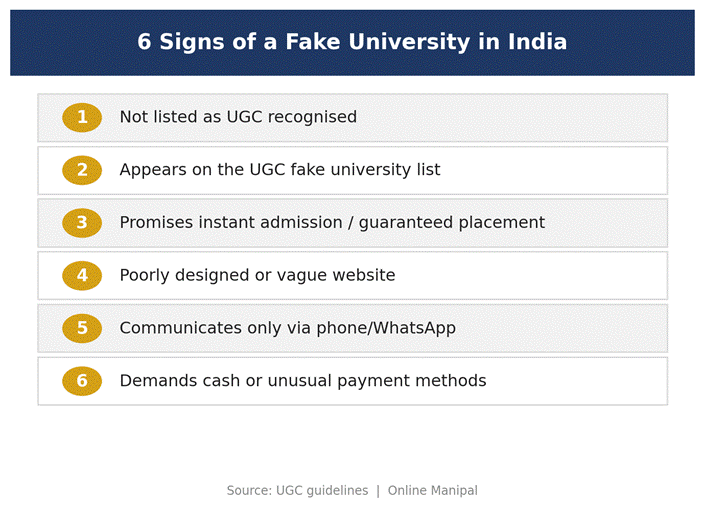
- Non-recognition by UGC: Every legitimate university in India must be recognized by the UGC. Check the official UGC list of recognised universities. If the university isn’t listed, it’s a major red flag.
- Appears on the UGC fake university list: UGC has compiled a full, state-wise list of fake universities on its website. If the university you’re considering appears here, stop the admission process immediately. This list is updated periodically, so check it again close to your admission date. UGC’s own terminology for these is “fake” or “unrecognized” institutions, though the phrase UGC blacklisted universities is also commonly used to search for the same list.
- Unrealistic promises: Beware of universities promising instant admissions, guaranteed placements, or degrees without rigorous coursework. Legitimate universities have established admission processes, academic standards, and placement procedures.
- Misleading website and infrastructure: A professional website with clear information about faculty, courses, and accreditation is a good sign. Be wary of poorly designed websites with limited information, or those claiming affiliation with prestigious institutions they aren’t actually associated with. If possible, visit the campus in person. A dilapidated campus or lack of proper infrastructure is a warning sign.
- Unconventional modes of communication: Legitimate universities typically use official communication channels, such as email addresses on their own domain. Be cautious of universities relying solely on phone calls, texts, or WhatsApp/Telegram messages.
- Exorbitant fees and unusual payment methods: While costs vary, be wary of universities demanding exceptionally high fees or pressuring you into unusual payment methods, such as cash deposits.
Must read: Revolutionizing admissions: UGC introduces biannual admission in HEI
How to Check if a University is UGC Approved
Here’s exactly how to verify university recognition in India, step by step:
- Visit the official UGC website and search for the current list of recognized universities.
- Visit the UGC-DEB portal to confirm the university is entitled to offer Open and Distance Learning (ODL) or online programs.
- Verify the university’s NAAC grade and any relevant accreditation (AICTE, for technical/professional programs).
- Cross-check the institution’s name against the official UGC fake university list.
- Read verified student reviews and check placement records before enrolling.
UGC Fake University List & Where to Find It
UGC maintains a complete, state-wise list of fake universities on its official website, updated periodically. If the institution you’re researching appears on it, treat that as disqualifying and stop the admission process as no further verification is needed once a university is officially flagged.
As of February 2026, the list included 32 institutions across 12 states that were up 52% from 21 the year before with Delhi accounting for 12 of them, followed by Uttar Pradesh with 4. Past UGC notices have named institutions such as “Commercial University” and “United Nations University,” both operating out of Delhi without any legal authority to award degrees.
If you’d like broader context, our related article on the state of higher education in India covers how accreditation and recognition standards have evolved.
Are Online Universities in India Legitimate?
Not all online programs from Indian universities are fake, but some fake universities do operate in the online space, so caution before enrolling is essential. Here’s how to choose a legitimate online program:
- UGC regulations: Since 2020, India has allowed recognised universities to offer online degrees under UGC regulations. These universities must meet specific criteria, including accreditation and ranking.
- Recognition status: The year-wise and session-wise status of institutions recognised to offer ODL and/or online programs is published on the UGC website.
- Entitlement status: The list of institutions entitled to offer ODL/online programs, along with approved program names, is available on the UGC-DEB website.
- Notice board: Read UGC’s notifications before taking admission. These often carry specific precautions for online-mode enrolment.
- University website: Look for accreditation details, faculty credentials, fees, eligibility, and rankings clearly listed on the program page.
- Reviews: Research online reviews with caution, focusing on consistent themes across many students rather than single experiences.
As one example, Online Manipal, the platform of the online degrees of Manipal group of universities, they publish full accreditation, ranking, fee, and faculty details for each program, which is the standard of transparency worth checking for on any platform before you apply.
Read more: Is online learning effective?
Additional Tips to Verify University Legitimacy
- Research the faculty: Look beyond a name on the website. Check published research and citations, faculty LinkedIn profiles, years of teaching experience, and whether a professor is permanent or visiting staff. Universities with qualified, active faculty are far less likely to be fraudulent.
- Check student reviews: While online reviews can be subjective, reading student testimonials across multiple platforms can offer valuable insight.
- Contact the UGC directly: If you have any doubts, reach out to the UGC helpline or email them for verification. Below are the contact touchpoints.
- Phone:011-23604446, 011-23604200
- Email: contact.ugc@nic.in
- Use search engines and social media: Search terms like “is [university name] legit” or “value of [university name]” surface responses from forums, aggregators, social media, and video reviews.
An interesting read: Online learning from universities vs. individual learning from free resources
Conclusion
Checking a university against the official UGC records is the single most reliable way to avoid fake universities in India. The ever-expanding online education landscape offers exciting possibilities for students seeking flexibility and convenience, but staying vigilant against institutions disguising themselves as legitimate universities is crucial.
Before you apply anywhere, confirm UGC recognition, cross-check the fake university list, verify accreditation, and review faculty and student feedback. A little extra effort now can safeguard your educational investment and open doors to a brighter future.
Frequently Asked Questions
Is there an official list of fake universities in India?
Yes. The UGC publishes and periodically updates a state-wise list of fake universities on its official website.
How can I check whether a university is UGC approved?
Search for the university on the UGC’s list of recognized universities, and check the UGC-DEB portal if it offers online or distance-learning programs.
Are all online universities in India fake?
No. Most online universities in India are legitimate and UGC-recognized, but a small number of fake institutions do exist, so verification before enrolling is essential.
Is UGC approval mandatory for a university to operate?
Yes. A university must be recognized by the UGC to legally award degrees in India.
Can fake universities issue valid degrees?
No. Degrees issued by universities not recognized by the UGC hold no legal or academic value and are not accepted by employers or other institutions.
How do I verify a university before taking admission?
Check its UGC recognition and accreditation, confirm it isn’t on the fake university list, review its website and faculty, and contact the UGC helpline if you have doubts.
Is Manipal University Jaipur fake?
No. Manipal University Jaipur (MUJ) is a UGC-recognized, NAAC-accredited university and is entitled by the UGC-DEB to offer online and distance-learning programs. It does not appear on the UGC’s fake university list, and its accreditation, faculty, and program details are published on its official website and on Online Manipal.
What happens if I get a degree from a fake university?
A degree from a fake or unrecognized university has no legal or academic standing. It can’t be used for government jobs, further studies, or most private-sector roles, and any fees or years spent earning it are effectively lost.
Can employers verify whether a university is fake?
Yes. Employers and background-verification agencies routinely cross-check a candidate’s university against the UGC’s list of recognized institutions and its fake university list before accepting a degree.
Is NAAC accreditation enough to prove a university is legitimate?
Not on its own. NAAC accreditation indicates quality, but a university must first be UGC-recognized (and UGC-DEB entitled, for online or distance programs) to legally award valid degrees. Check recognition and accreditation together, not accreditation alone.
Prepare for your next career milestone with us



Explore Similar Blogs
View All
 06 Oct 2026
 5 mins
 25 Sep 2026
7 mins
25 Sep 2026
7 mins
 23 Sep 2026
6 mins
23 Sep 2026
6 mins
 18 Sep 2026
7 mins
18 Sep 2026
7 mins