Blogs
Blogs 
What is CUET? How does it help students?

Listen to this blog

The Common University Entrance Test (CUET) is a national-level entrance exam conducted by the National Testing Agency (NTA) for admission to undergraduate, postgraduate, and doctoral programs across central, state, deemed, and private universities in India. Launched in 2022, the CUET exam has quickly grown into one of the largest entrance exams in the country, sitting right behind JEE Main and NEET in terms of candidate numbers.
Before 2022, getting into a central university meant navigating a different process for every institution, separate applications, separate fees, separate criteria. For students from smaller towns or low-income backgrounds, this was an expensive and exhausting process.
CUET changed all of that. One exam, one platform, access to hundreds of universities. The exam is held in Computer-Based Test (CBT) mode across 500+ cities in India and abroad, making it genuinely accessible to students from all backgrounds and boards.
The Common University Entrance Test has also evolved significantly since its launch. In 2026, the NTA introduced several key changes, the total number of exam subjects was reduced from 63 to 37, students can now choose any subject combination regardless of their Class 12 stream, and each subject paper now has a standardised duration of 60 minutes with 50 MCQs and no optional questions. Candidates can appear for up to 5 subjects.
How has CUET Evolved Over the Years?
The CUET exam didn’t appear out of nowhere. Its roots go back to 2010, when the Central Universities Common Entrance Test (CUCET) was first introduced for admission to seven newly established central universities. At the time, it was a modest initiative, just 1,500 seats across 41 undergraduate, postgraduate, and integrated programmes.
For over a decade, CUCET remained relatively limited in scope. That changed in 2021, when the National Testing Agency (NTA) took over its administration and rebranded it as CUET. By 2022, it became compulsory for all 45 central universities, and the response was immediate. Word spread fast, and state, deemed, and private universities began accepting CUET scores too, expanding its reach well beyond central universities.
Today, the Common University Entrance Test is one of India’s largest entrance exams, sitting right behind JEE Main and NEET, with hundreds of universities accepting its scores across disciplines ranging from law and commerce to humanities and computer applications.
| Feature | Details |
|---|---|
| Full Name | Common University Entrance Test (CUET UG) |
| Conducting Body | National Testing Agency (NTA) |
| Exam Mode | Computer-Based Test (CBT) only |
| Frequency | Once a year |
| Sections | Section 1: Languages (13 languages)Section 2: Domain Subjects (23 subjects)Section 3: General Aptitude Test |
| Total Subjects Available | 37 (reduced from 63) |
| Maximum Subjects a Candidate Can Choose | 5 |
| Questions per Subject | 50 MCQs |
| Duration per Subject | 60 minutes |
| Marking Scheme | +5 for each correct answer, -1 for each incorrect answer, 0 for unattempted questions |
| Eligibility | Class 12 passed or appearing candidates |
| Age Limit | No age limit |
| Stream Restriction | None — candidates can choose any subject combination |
| Exam Centres | 500+ cities in India and abroad |
| Official Website | cuet.nta.nic.in |
How Is the CUET Exam Conducted?
Check Eligibility & Course Requirements
- Verify the eligibility criteria for your preferred course and participating university before applying. Universities may have different subject requirements.
Register Online
- Visit the official CUET website, create an account, and complete the application form with your personal and academic details.
Choose Subjects
- Select subjects according to the programme requirements of the universities you wish to apply to. Subject selection is based on university eligibility, not necessarily your Class 12 stream.
Upload Documents & Pay the Fee
- Upload the required documents (photograph, signature, category/PwBD certificate, if applicable) and pay the application fee online.
Download the City Intimation Slip & Admit Card
- NTA first releases the exam city intimation slip, followed by the admit card containing the exam date, shift, and centre details.
Appear for the Computer-Based Test (CBT)
- Take the exam at the allotted centre. CUET is conducted in multiple shifts over several days in CBT mode.
Check the Answer Key & Result
- NTA publishes a provisional answer key for challenges, followed by the final answer key and scorecard.
Apply Through University Counselling
CUET does not have a centralized counselling process. After results, candidates must register separately on the admission portal of each participating university (e.g., DU’s CSAS, BHU, JNU) for seat allocation
CUET UG Exam Details
If you are wondering what CUET is, it is the Common University Entrance Test (CUET) conducted for admission to undergraduate programmes offered by participating universities across India. The CUET exam consists of three sections: Languages, Domain Subjects, and the General Aptitude Test (GAT). The domain subjects are primarily based on the NCERT Class 12 syllabus, while the General Aptitude Test assesses areas such as general knowledge, current affairs, numerical ability, quantitative reasoning, logical reasoning, and analytical skills. Each test paper is conducted for 60 minutes and follows a multiple-choice question (MCQ) format.
| Particulars | Details |
|---|---|
| Mode of Examination | Computer-Based Test (CBT) |
| Medium / Languages | English, Hindi, Assamese, Bengali, Gujarati, Kannada, Malayalam, Marathi, Odia, Punjabi, Tamil, Telugu, and Urdu |
| Sections | Section I – Languages (13)Section II – Domain Subjects (23)Section III – General Aptitude Test (GAT) |
| Type of Questions | Multiple Choice Questions (MCQs) |
| Total Subjects Available | 37 (13 Languages + 23 Domain Subjects + 1 General Aptitude Test) |
| Maximum Subjects a Candidate Can Choose | 5 |
| Questions per Subject | 50 (All questions are compulsory) |
| Duration per Subject | 60 minutes |
| Marking Scheme | +5 for each correct answer-1 for each incorrect answer0 for unattempted questions |
| Maximum Marks per Subject | 250 |
| Domain Subjects | 23 |
| Domain Subject Syllabus | Based primarily on the NCERT Class 12 syllabus |
| General Aptitude Test Topics | General Knowledge, Current Affairs, General Mental Ability, Numerical Ability, Quantitative Reasoning, Logical and Analytical Reasoning |
| Eligibility | Class 12 passed or appearing candidates |
| Age Limit | No age limit (subject to university-specific eligibility criteria) |
CUET PG Exam Details
The CUET PG exam assesses candidates on the subject they choose for postgraduate admission. The question paper primarily consists of domain-specific multiple-choice questions designed to evaluate a candidate’s knowledge and understanding of the selected discipline. The exam is conducted in computer-based mode and follows a negative-marking scheme, with four marks awarded for every correct answer and one mark deducted for every incorrect response.
| Particulars | Details |
|---|---|
| Mode of Examination | Computer-Based Test (CBT) |
| Medium / Language | English and Hindi (except for language-specific papers) |
| Duration of Examination | 90 minutes |
| Frequency of Exam | Once a year |
| Type of Questions | Multiple Choice Questions (MCQs) |
| Total Number of Questions | 75 |
| Total Marks | 300 |
| Marking Scheme | +4 for each correct answer-1 for each incorrect answer |
| Question Paper Structure | Subject-specific/domain-based questions |
| Number of Test Papers | Varies by programme and subject offered by participating universities |
After the declaration of result, the participant universities would prepare a merit list, and they would conduct counseling based on the score card of CUET provided by NTA.
You may also like to know more about the dual degrees and its prospects.
How Many Universities Accept CUET?
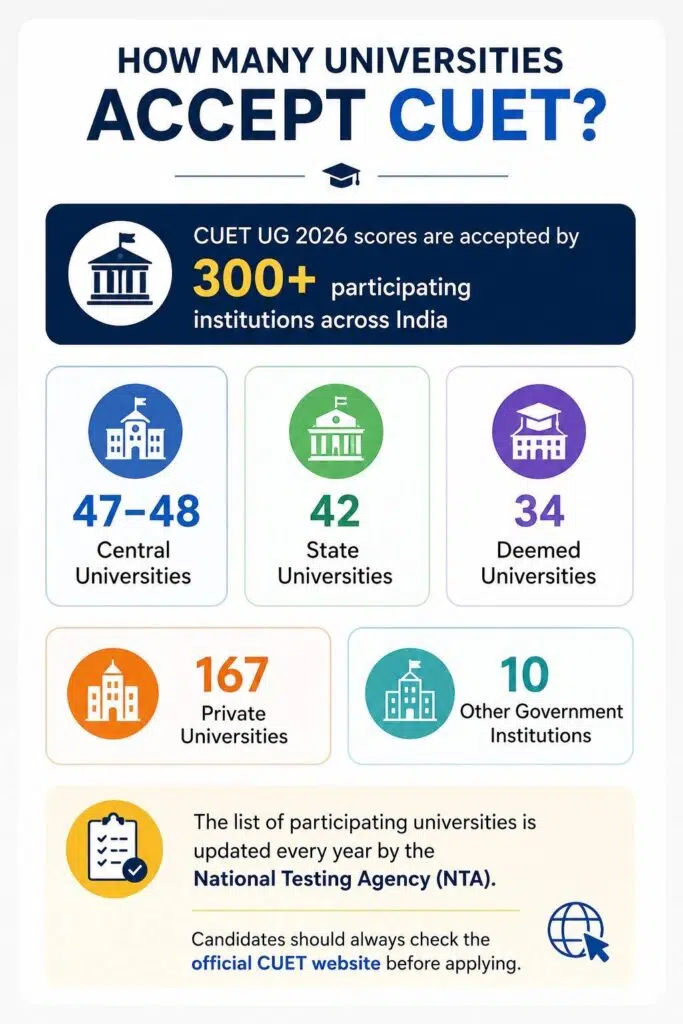
CUET UG 2026 scores are accepted by over 300 participating institutions across India, including Central, State, Deemed, Private, and Other Government institutions. This includes around 47–48 Central Universities, 42 State Universities, 34 Deemed Universities, 167 Private Universities, and 10 Other Government Institutions. The list of participating universities is updated every year by the National Testing Agency (NTA), so candidates should always check the official CUET website before applying.
How Does CUET Help Students?
The implementation of CUET brings several benefits for students and the education system as a whole.
A common platform for university admissions:
One of the biggest advantages of the Common University Entrance Test (CUET) is that it provides a single admission platform for students applying to multiple universities. Instead of appearing for several entrance tests, candidates can use a single score for admission to participating institutions, saving both time and costs.
Fair and standardized evaluation:
The CUET exam offers a uniform method of assessing students’ knowledge and aptitude. Since the syllabus is largely based on NCERT curricula, students from different educational boards have a common benchmark for evaluation, ensuring greater transparency and fairness in admissions.
Helps strengthen language proficiency:
The language section of the CUET exam evaluates reading comprehension and language skills through passages and objective questions. This helps students improve their communication abilities while preparing for the test.
Encourages analytical and problem-solving skills:
Beyond subject knowledge, CUET assesses critical thinking, logical reasoning, and problem-solving abilities through the General Aptitude Test, helping students develop skills that are valuable in both higher education and future careers.
Accepted by universities across India:
For students wondering what is CUET and why it matters, its widespread acceptance is a key reason. CUET scores are recognized by hundreds of universities and institutions across India, giving candidates access to a wide range of undergraduate and postgraduate programmes through a single entrance examination.
What If a Student Has No CUET Score?
While CUET is compulsory for taking admission to central universities, state, deemed, and private universities may also consider candidates without a CUET score, although some of them are participating institutions. For admission to distance and online programs, CUET is not mandatory, but students who have a valid CUET score may have a smoother admission process.
Manipal University Jaipur (MUJ) accepts CUET score for admission
Manipal University Jaipur (MUJ), located in Rajasthan, is one of the participating institutions in CUET UG, and it accepts CUET scores as a criteria for admission in undergraduate programs. The university prepares a merit list based on the scores obtained in CUET, and students who wish to take admission in a UG course at Manipal University Jaipur can appear for the CUET UG exam.
Get the details of online degree programs offered by Manipal University Jaipur.
Is CUET mandatory for taking admission in online degrees?
Is it mandatory for students to have a CUET score to enroll in an online degree program? While a CUET score is not mandatory for online programs, having one can help universities understand the student’s abilities and make the admission process smoother. All universities at Online Manipal accept students with or without a CUET score for their online degree programs.
Conclusion
The Common University Entrance Test (CUET) has transformed the university admission process by providing a standardized and transparent evaluation system for students across India. Whether you are exploring what is CUET or preparing for the CUET exam, understanding its structure, eligibility, and benefits can help you make informed academic decisions. With hundreds of universities accepting CUET scores, the examination serves as a gateway to a wide range of undergraduate and postgraduate programs, enabling students to pursue their preferred courses and career goals through a single entrance test.
Prepare for your next career milestone with us



Explore Similar Blogs
View All
 06 Oct 2026
 5 mins
 18 Sep 2026
7 mins
18 Sep 2026
7 mins
 18 Aug 2026
8 mins
18 Aug 2026
8 mins
 18 Aug 2026
9 mins
18 Aug 2026
9 mins