Listen to this blog

How worse do you think about the job market these days?
According to Job Market Skills Gap Statistics and Facts (2026) by MarketBiz, nearly 50% of employers globally report difficulty finding candidates with the right skills.
Now, this clearly is not a hiring problem. It denotes what counted as ‘qualified’ is moving much faster than most people can keep up with. Ten years ago, a computer science degree could carry you through most of your career. A certification renewed every few years was enough to stay employable. That math doesn’t hold anymore. The half-life of skills, which means the time it takes for half of what you know to lose its value, has been shrinking for decades.
Moreover, the introduction of AI has only fastened things up.
If you feel like you’re constantly learning just to keep up, you are not alone. This is the skill half-life problem; skills are changing so quickly that what you learn today may not stay relevant for long. Understanding this is the first step to staying ahead.
Let us read about it more in this blog.
Where the Idea of Half-Life of Skills Comes From?
This is an interesting story. So, the term borrows from nuclear physics, where half-life describes how long it takes half of a radioactive substance to decay. Applied to careers, the half-life of skills refers to the time it takes for half of a learned skill’s value to become outdated due to new tools, processes, or industry shifts.
Did you know that the global skills gap could cost $8.5 trillion annually by 2030 due to lost economic growth?
That number isn’t just about hiring gaps. It’s what happens when the value of a skill quietly expires faster than people, or companies, can replace it. In fast-moving fields like AI and data science, some skills lose half their relevance in a year or two and multiplied across an entire workforce. That’s exactly the kind of decay that adds up to trillions.
Compare it to the 1960s, when an engineering degree stayed useful for roughly a decade before needing a serious update. Forty years before that, it lasted over three decades. The shrinking shelf life of skills isn’t a one-off trend. It’s been accelerating with every wave of technological change, and each wave has come faster than the last.
Read More: How Micro-Credentials Are Reshaping Hiring Alongside Degrees
Why Is Half-Life of a Skill Shrinking?
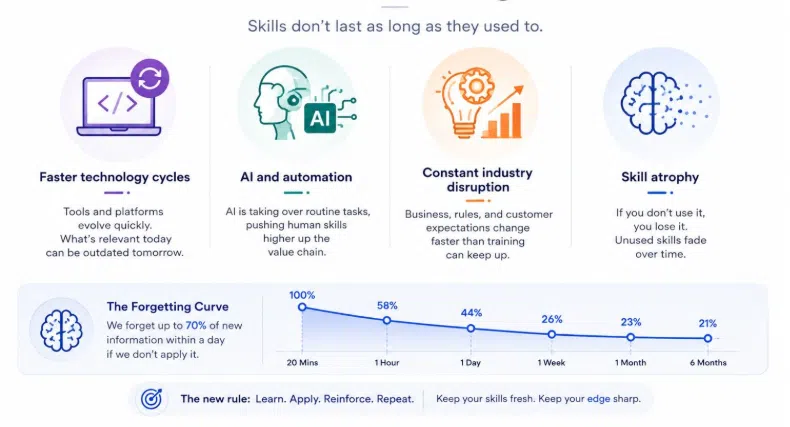
A few forces are driving this compression:
Faster technology cycles:
Software, tools, and platforms get replaced or majorly updated within a year or two. A skill built around one version of a tool can lose relevance the moment the next version ships.
AI and automation:
Generative AI is reshaping roles that once felt stable, from content creation to data analysis to customer support. Things that took specialized training to do just a few years ago are now done in seconds by AI, pushing the human skill set required for the same job to further up the value chain.
An Interesting read: How AI remains fastest growing skills across domains
Ongoing industry disruption
Training programs lag behind fast changing business models, regulations, and customer expectations. What was best practice in one quarter can be out of date the next.
Skill atrophy:
Even skills that have not technically become obsolete can atrophy from lack of use. The Ebbinghaus Forgetting Curve, a well-known concept in learning science, shows that people forget a large share of new information within a day if they don’t apply it. Combine that with a shrinking skill half-life, and the pressure to keep practicing what you know becomes just as important as learning something new.
Not All Skills Decay at the Same Rate
One useful way to think about how long skills stay relevant is to sort them into three broad categories.
Short half-life skills include specific programming languages, software tools, and platform-specific know-how. These can lose half their value in under two or three years. Learning a particular framework or tool today doesn’t guarantee it will still be industry standard by the time you’ve mastered it.
Agile project management, financial modeling, or digital marketing strategy are medium half-life skills, which are frameworks, methodologies or applied knowledge. They, too, evolve, but more slowly, often taking five to seven years before they need a major refresh.
Long half-life skills are the ones that barely decay at all. Communication, critical thinking, leadership, negotiation, and problem-solving fall into this bucket. These are sometimes called durable skills, and they tend to hold their value for a decade or longer because they aren’t tied to a specific tool or technology.
Most people pour their learning time into the first category, the one with the short half-life skills, and barely touch the third. It’s understandable; the short-term skills feel more immediately useful. But it also means a lot of professional development ends up chasing a shelf life it can never outrun.
How to Stay Ahead of the Curve
Formal education still has a role to play, but the model has shifted. Instead of one large investment early in a career, professionals now need smaller, more frequent updates to their skill set. This is part of why online postgraduate programs, especially in fast-evolving areas like data science, business analytics, and digital business, have grown so quickly. They let working professionals refresh or deepen their expertise without stepping away from their careers, which matters when the half-life of skills in these fields is measured in a couple of years rather than a decade.
Reskilling and upskilling are not just HR buzzwords anymore. They are a practical response to a job market where expertise has an expiry date. The professionals who treat learning as continuous, rather than a box to check once every few years, are the ones who stay ahead of the curve instead of catching up to it.
An interesting read: Can Online Education Stay Relevant in an AI-Driven Job Market?
How Online Manipal Can Help You?
As we now know, learners can no longer afford to wait until graduation to become job-ready. By the time a degree is completed, the skills employers demand may have already changed. That’s why it’s important to choose a program from a recognized university that continuously evolves with industry needs, ensuring you graduate with knowledge and skills that remain relevant in a fast-changing job market. That’s why one can choose Online Manipal, without any doubt!
Here are few reasons:
- MAHE’s online MBA comes with a credit-linked IRM certification. The program integrates the Level 1 Enterprise Risk Management certification from the Institute of Risk Management (IRM). Risk management is a program which all learners can consider since it’s one of the most sough-after programs these days and its relevance will never die out.
- MAHE’s MSc in Data Science and MSc in Business Analytics are IoA-accredited. The Institute of Analytics (IoA) accreditation covers both programs (plus the PGCP versions), giving graduates a fast-tracked path to relevant membership and a professional network that keeps updating long after graduation.
- MUJ’s online MBA offers 13 specializations, including Analytics & Data Science, IT & FinTech, and International Business, so you can pick a track that matches exactly where your field is heading.
- MCA specializations across MAHE, MUJ, and SMU cover AI & Data Science, Cybersecurity, Cloud Computing, and Full Stack Development, letting you go deep into whichever tech track is decaying fastest in your industry.
- SMU’s programs build fast-moving tools directly into the syllabus (AI, Cloud Computing, Machine Learning), so the curriculum itself gets refreshed rather than going stale between updates.
None of these replace durable skills like communication, critical thinking, and adaptability, which hold their value regardless of what technology does next. But for the parts of your skill set that decay fast, having an accredited, flexible way to refresh them regularly is what keeps you from falling behind the market.
The Bottom Line
The half-life of skills is a reminder that expertise isn’t a one-time achievement. It’s a moving target. Technical skills will keep decaying faster as tools and platforms evolve, but durable skills like critical thinking, communication, and adaptability will keep paying off for years. The professionals who understand this difference, and who build a habit of continuous learning around it, are the ones who won’t need to worry about their skills expiring quietly in the background.
The question isn’t whether your skills will lose value over time. They will.
The real question is whether you are refreshing them faster than they decay.
References:
https://market.biz/job-market-skills-gap-statistics
https://www.linkedin.com/pulse/shelf-life-skills-michael-hanegan-7ewgc
Prepare for your next career milestone with us