
Listen to this blog

This is a blog that is drawn from Coursera’s 2026 global survey of 3,500+ students, employers, and higher education leaders on what is the critical asset for career readiness in today’s competitive markets.
The rules of hiring are changing. Across industries and geographies, employers are no longer evaluating candidates solely on their degrees, institution names, or GPAs. What increasingly matters is proof of job-ready skills; that is, capabilities that graduates can demonstrate from day one.
This shift has given rise to micro-credentials: short, focused certifications that validate specific, industry-relevant skills. For learners, they provide evidence of practical expertise. For employers, they offer a clearer signal of workplace readiness.
Coursera’s Micro-Credentials Impact Report 2026, based on insights from more than 3,500 students, employers, and higher education leaders across seven countries, reveals how rapidly this transformation is reshaping hiring and higher education.
Skills-first Hiring is No Longer a Trend, it’s the Standard
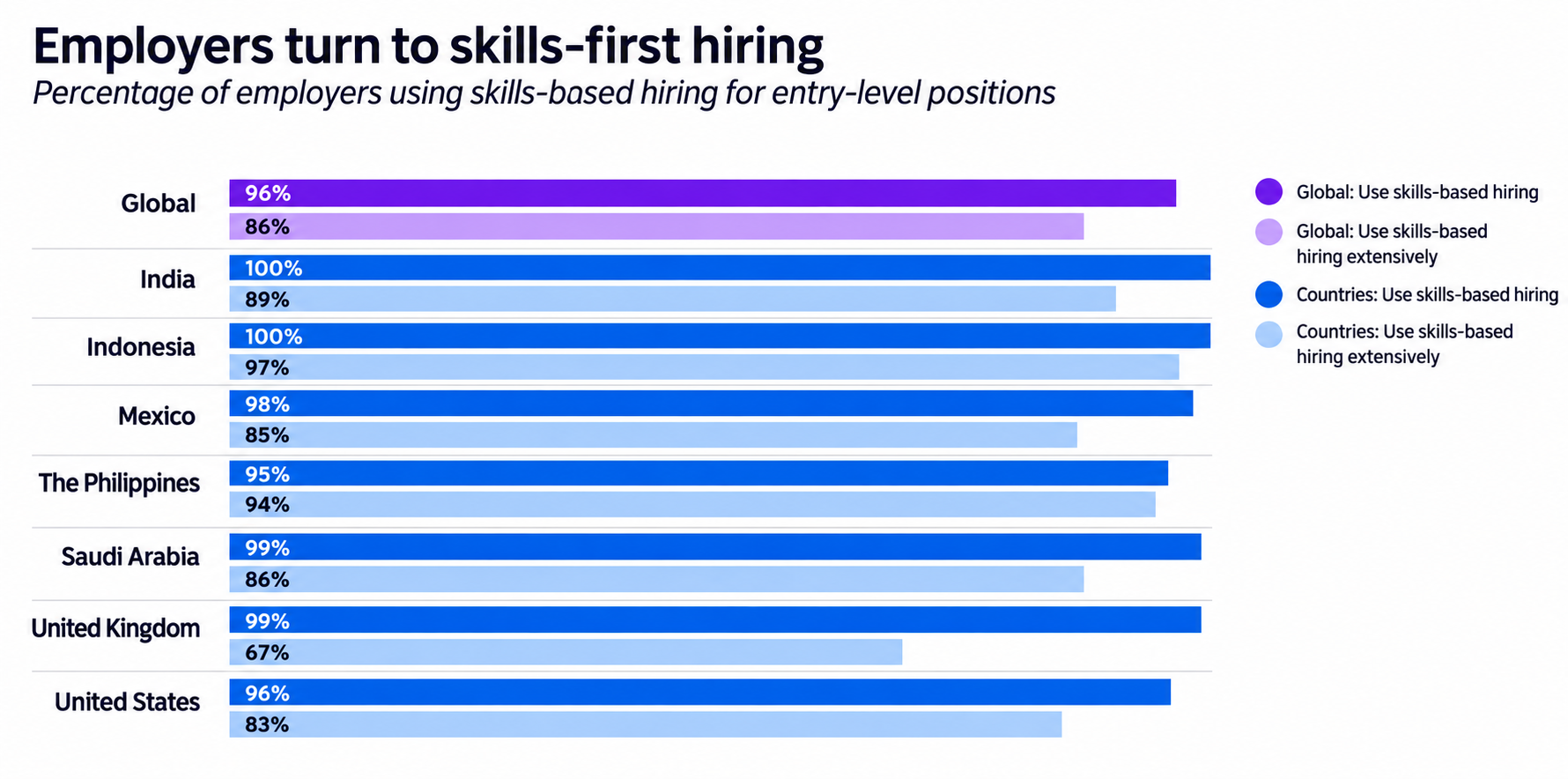
Source: Coursera/Rep Data survey, Feb–Mar 2026 · ~300 students/graduates, 100 employers, 100 higher ed leaders per country
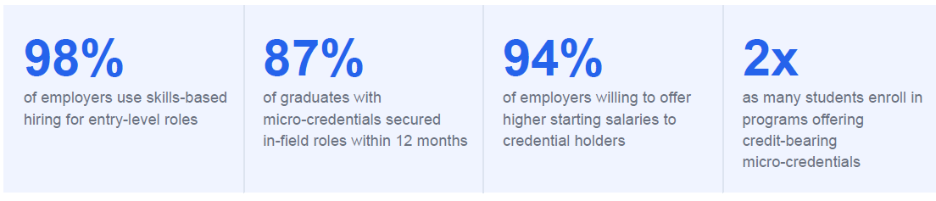
Globally, 98% of employers now use skills-based hiring in some form, while 86% rely on it extensively when recruiting entry-level talent. India leads the way, with every surveyed employer reporting the use of skills-based hiring.
As employers place greater emphasis on demonstrated capabilities, micro-credentials are gaining prominence. In fact, 95% of employers believe they help differentiate candidates, and 87% consider them highly important in hiring decisions – ranking them above traditional indicators such as GPA and alma mater.
Looking ahead, the need for continuous upskilling will only grow. By 2030, most employers expect roughly one-third of core job skills to change, making verifiable learning and ongoing skill development increasingly important.
| “In a skills-first economy, degrees must prove what graduates can do- not just what they studied.” |
Micro-credentials: What Accelerate Today’s Careers

Students are responding to this shift in employer expectations.
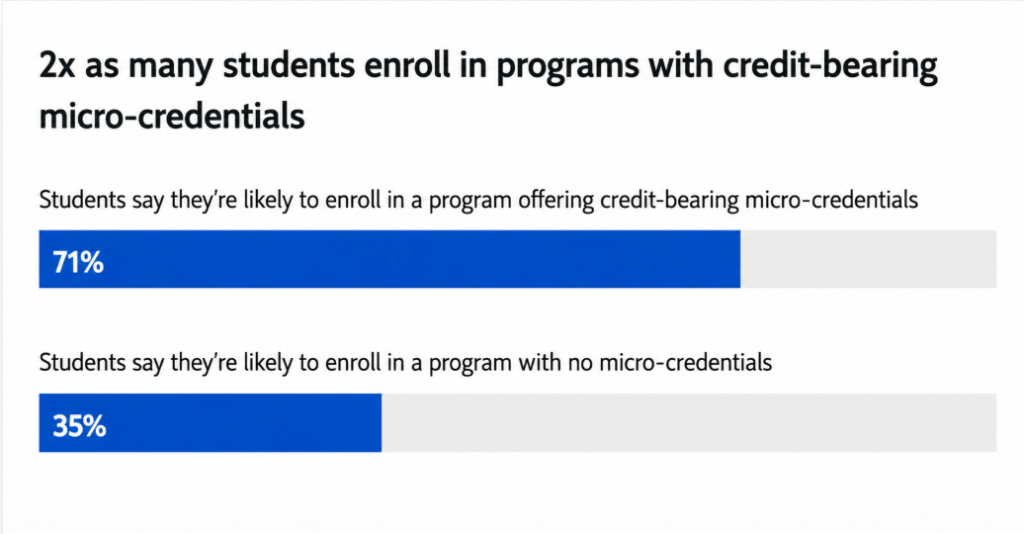
When degree programs include credit-bearing micro-credentials, 71% of students say they are likely to enroll, compared to just 35% for programs without them. Engagement follows a similar pattern: 74% of students are likely to remain engaged in programs with embedded credentials, versus only 32% in programs without them.
The impact extends beyond enrollment. Ninety-one percent of students report greater motivation when their coursework leads to industry-recognized credentials, highlighting the value of connecting academic learning with tangible career outcomes.
For institutions, the implications are significant. Programs that offer formal credit recognition attract substantially greater learner interest. In India, 73% of students prefer micro-credentials with credit recognition, compared to only 21% for those without it.
| “6 in 10 higher education leaders report moderate or significant strategic risk for institutions lacking micro-credentials embedded in degree programs.” |
Why This Matters for Online Manipal learners
India stands out as one of the strongest markets for skills-first hiring and micro-credential adoption.
Every surveyed employer in India uses skills-based hiring, and 89% do so extensively for entry-level recruitment. The career outcomes are equally compelling: 91% of Indian graduates with micro-credentials report securing a role aligned with their field of study within 12 months.
Demand for credit-bearing credentials is also particularly strong. Indian students are 3.4 times more likely to pursue micro-credentials that carry formal credit recognition (73%) than those that do not (21%).
For Online Manipal learners, the message is clear: combining a degree with industry-recognized, credit-bearing credentials can strengthen employability and align learning more closely with evolving employer expectations.
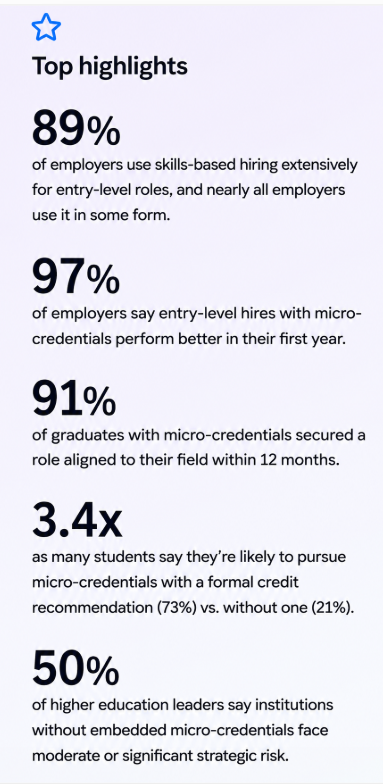
Source: Coursera/Rep Data survey, Feb.–Mar. 2026. Sample size: ~300 students and graduates, 100 employers, 100 higher ed leaders.
“Enrolling in the Data Science and Analytics micro-credential on Coursera through Online Manipal was the catalyst for my career switch into data. The industry-relevant curriculum gave me practical, job-ready skills, and soon I was receiving interview calls for analytics roles that once felt out of reach.” –
Ranveer Kumar, Data Science and Analytics, Manipal University Jaipur
The New Currency of Employability
The report identifies three characteristics that consistently make micro-credentials more valuable in today’s skills-first job market:
Credit-bearing
82% of graduates with credit-bearing credentials report salary increases of 10% or more, while 76% of higher education leaders associate them with stronger student retention. Credit adds academic recognition to workplace-ready skills.
Industry-partnered
82% of employers place significantly greater value on credentials developed with industry partners. These credentials signal that learners have acquired skills that align with real-world job requirements.
Assessment-based
82% of students and 88% of graduates prefer project- or industry-based credentials over content-only alternatives. Practical assessments provide tangible evidence of skills and help learners build portfolio-ready work.
Together, these three elements make micro-credentials more than just certificates; they become credible proof of capability in an increasingly skills-driven economy.
Prepare for your next career milestone with us