
Listen to this blog

If you’re exploring types of MBA courses, you have probably already noticed there isn’t one single path anymore. The MBA has splintered into formats built for very different people: a 22-year-old fresh out of college, a 35-year-old team lead who can’t take a career break, and everyone in between. The CAT remains one of the most common entrance tests for management programs in India, which says something about how many people are chasing this degree every year, but the format they choose matters just as much as the college they get into.
An MBA is a postgraduate degree that builds management and leadership skills across the core business functions, finance, operations, marketing, HR, and more, with specializations layered on top so you can lean into whichever area fits your goals. Programs come in full-time, part-time, executive, online, and distance formats, each built for a different kind of student. Understanding the mba types in india available to you is really the first real decision you make in this journey, before you even get to picking a specialization.
Why the format you choose actually matters?
Picking the right MBA format shapes your career trajectory as much as the college name on your degree. After all, a full-time residential program signals something very different to recruiters than an executive MBA completed in eighteen months. Moreover, each MBA category comes with its own trade-offs in terms of cost, time commitment, flexibility, and the kind of roles it prepares you for. So, before making a decision, it’s important to understand what each option offers. In this guide, we’ll walk through the different types of MBA courses in India, explain what each one actually involves, and help you determine which format best fits your career goals and circumstances.
Read More: Best 12 Online Universities Offering MBA Programs in India 2026
Why Choosing the Right Type of MBA Matters
It is very important to choose the right kind of MBA program as it has a direct impact on one’s career trajectory and skill development. It also affects how competitive they can be in the job market.
The MBA degree value in India remains strong. This blog will discuss the different types of MBA programs that students can opt for in India and also highlight the factors that they must focus on to make the right choice in this regard.
Types of MBA Courses in India: Quick Comparison
The various types of MBA programs in India can be categorized based on several factors, including the amount of time students must devote to the program, the intended students, and the mode of delivery, among others.
| MBA Type | Ideal For | Duration | Learning Mode | Eligibility |
|---|---|---|---|---|
| Full-Time MBA | Fresh graduates and early-career professionals | 2 years | Full-time, residential | Entrance exam + Bachelor’s degree |
| Part-Time MBA | Professionals advancing without a career break | 2–3 years | Weekend or evening classes | Bachelor’s degree; 1–2 years of work experience may be preferred or required |
| Executive MBA (EMBA) | Experienced professionals aiming for leadership or C-suite roles | 1–1.5 years | Full-time, weekend, or modular | Bachelor’s degree + typically 5–10 years of work experience |
| Online MBA | Working professionals seeking flexible career growth | 2 years (up to 4 years, as per UGC-DEB norms) | Fully online (live and recorded classes) | Bachelor’s degree; some programmes may prefer work experience |
| Distance MBA | Students with time constraints or those in remote locations | 2 years (up to 4 years) | Self-paced, remote learning | Bachelor’s degree |
| Dual/Integrated MBA | Students seeking an early start in management after Class 12 | 5 years | Full-time, integrated | Class 12 (typically through IPM or integrated MBA programmes) |
| Global MBA | Professionals aspiring for international business careers | 1–2 years | Full-time (some programmes also offer hybrid delivery) | Bachelor’s degree + typically 2–5 years of work experience |
| One-Year MBA (Accelerated) | Mid- to senior-level professionals seeking rapid career progression or industry transition | 1–1.5 years | Full-time, residential | Bachelor’s degree + typically 4–5 years of work experience |
Read More: Is an MBA worth it in 2026? Pros & cons explained
Categories of MBA Explained
Full-Time MBA
These programs are the most common of all the types of mba courses in the country, and by default, they run for two years, foundational business disciplines in year one, specializations and electives in year two, plus internships built in for hands-on experience.
Part-Time MBA
Part-time MBA programs let working professionals pursue the degree without quitting their jobs, classes typically run in the evenings or on weekends.
EMBA programs
These programs target mid-level and senior professionals. Unlike part-time programs, they’re built to fast-track people into leadership roles, which is why they’re compressed and intensive rather than spread out.
Online MBA programs
Online programs have picked up serious momentum, accelerated further by how EdTech evolved after the pandemic. These run entirely online through recorded lectures, live sessions, and virtual assessments.
Distance MBA programs
These can let you study at your own pace using a mix of digital and printed material. There’s little to no live interaction, which makes them more self-directed than online MBAs.
Integrated or dual-degree MBA programs
They combine an undergraduate degree, usually a BTech or BBA, with an MBA, letting students enter management education straight after Class 12 instead of waiting to finish a separate bachelor’s first.
Global or International MBA programs
Global or international MBA programs are pursued through Indian institutes with international B-school tie-ups, or sometimes fully abroad. These focus on global business perspectives, often with exchange program options built in.
One-Year MBA programs
These are accelerated tracks for experienced professionals, condensing the full syllabus into 12-15 months with a heavy focus on leadership and strategy. It’s worth noting this isn’t a separate category so much as a compressed variant of the full-time MBA, same degree, shorter timeline, aimed at a different kind of candidate.
Format Comparisons That Come Up a Lot
Full-time MBAs give you a more immersive experience, better suited to a real career pivot. Part-time MBAs work better if you need to keep earning while you study. Executive MBAs are built specifically for people who’ve already put in years of leadership groundwork and are ready to move up faster.
Online MBA vs. Distance MBA: Online MBAs give you interactive learning through live and recorded sessions; distance MBAs are largely self-paced with minimal interaction.
EMBA vs. Regular MBA: EMBAs are for professionals with 5+ years of experience; regular MBAs suit freshers and early-career candidates.
Full-Time vs. Part-Time MBA: Full-time demands total commitment; part-time lets you keep working while attending evening or weekend classes.
Accelerated (one-year) vs. traditional (two-year) full-time MBA: This isn’t two separate categories so much as a duration choice within the full-time MBA itself. The one-year route is intensive and built for experienced professionals who already know their focus area; the traditional two-year route offers broader learning, electives, and internship opportunities, which is why it remains the default for fresh graduates.
How to choose the right MBA type for you
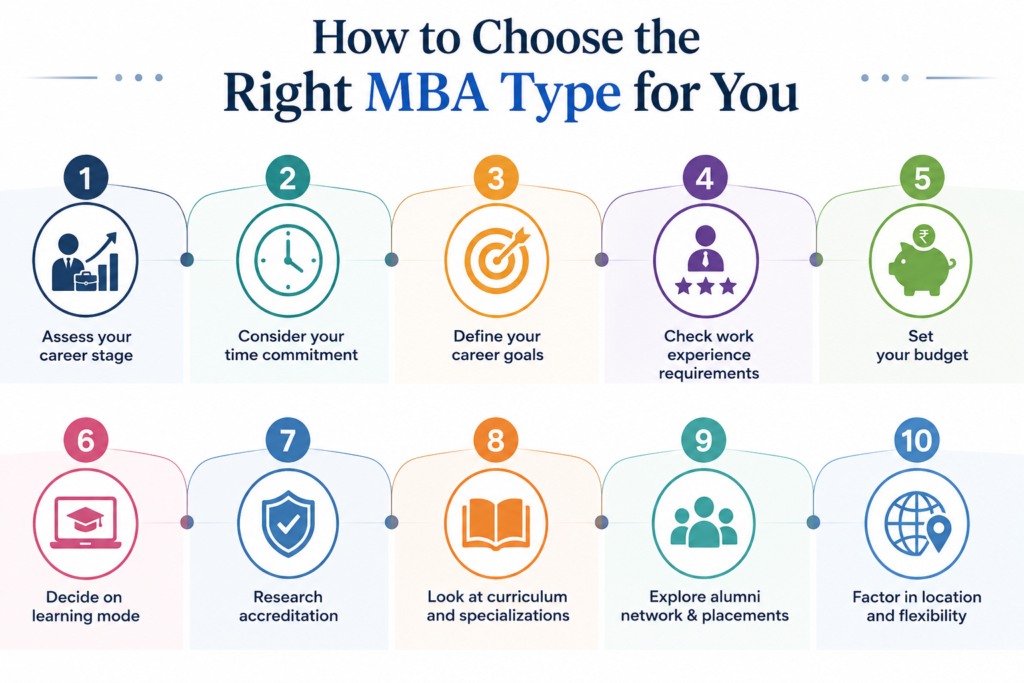
Picking the right one among these categories of mba comes down to your career stage, how much time you can realistically commit, and where you want to end up. Here’s a checklist that helps:
- Assess your career stage — fresh graduate or working professional?
- Consider your time commitment — can you go full-time, or do you need flexibility?
- Define your career goals — switch, promotion, or eventually starting your own venture?
- Check work experience requirements — Executive MBAs typically need 5-10 years.
- Set your budget — weigh tuition against expected ROI and salary growth.
- Decide on learning mode — offline, online, or hybrid.
- Research accreditation — confirm the institute is UGC/AICTE approved.
- Look at curriculum and specializations — match it to your actual interests, not just what’s trending.
- Explore alumni network and placements — strong networks shape opportunities long after graduation.
- Factor in location and flexibility — local campus, global exposure, or fully remote?
What are the Popular MBA Specializations in India?
Among all the types of mba courses, the specializations that consistently see the strongest demand are finance, marketing, HR, operations management, and IT/business analytics, largely because they map onto roles nearly every industry is hiring for.
MBA in Finance
This covers financial analysis, corporate finance, investment banking, and risk management, aimed at students eyeing corporate finance or financial institution roles.
MBA in Marketing
The specialization focuses on branding, market research, and digital marketing, a natural fit for students who lean strategic and creative.
MBA in HR
The program builds skills in talent acquisition, organizational development, and employee relations, for students drawn to people-focused leadership.
MBA in Operations Management
It covers supply chain, project management, and process improvement, suited to analytical, problem-solving-minded students.
MBA in IT/Business Analytics
The specialization is gaining ground fast as technology becomes central to every business function, opening doors into IT management, tech consulting, and analytics roles.
Read more: How to choose between Marketing, Finance, and HR specializations in an MBA
Online MBA Programs from Online Manipal
If an online format fits where you are right now, Online Manipal runs online MBA programs through three universities, and they’re genuinely different from each other, not just the same course with three logos.
MBA, Manipal University Jaipur (MUJ) — 24 months, no prior work experience required, so it’s a solid fit for fresh graduates. It offers 13 electives, the widest range of the three, and comes NAAC A+ accredited. Full fee is INR 1,80,000 (discounted to INR 1,53,000).
MBA, Manipal Academy of Higher Education (MAHE) — 24 months, NAAC A++ accredited, and carries Institution of Eminence status. This one generally expects around a year of work experience; fresh graduates can still apply with a Statement of Purpose video. It offers 9 specializations, and sits at a premium fee of INR 2,92,000 (discounted to INR 2,77,400), reflecting the brand and accreditation level.
MBA, Sikkim Manipal University (SMU) — 24 months, with dual-specialization options across 6 electives, letting you build depth in two areas at once. It’s the most affordable of the three at INR 1,20,000 (discounted to INR 1,08,000).
All three are UGC-entitled and delivered on weekends, so you’re not required to put your job on hold to complete any of them.
Read more: Key MBA Trends for 2026 – Online Manipal
The bottom line
There are numerous types of mba courses to choose from in India, built for a genuinely wide range of academic backgrounds, career stages, and goals. Recent graduates looking at full-time programs, working professionals weighing part-time or online options, and experienced executives eyeing a one-year MBA or EMBA to break into leadership, there’s a format here for each of them. Whichever of the different types of mba courses in india you’re drawn to, the fit matters more than the label, so weigh your time, budget, and career goals before you commit
FAQs on MBA Types in India
1. How many types of MBA programs are available in India?
MBA programs in India are classified based on time commitment, delivery mode, and target student profile. The main categories include Full-time MBA (the traditional two-year format), Part-time MBA, EMBA, Online MBA, Distance MBA, Dual/Integrated MBA, Global MBA, and the accelerated One-Year MBA (a compressed version of the full-time format, not a separate category on its own).
2. What is the difference between a full-time and part-time MBA?
A full-time MBA is a two-year, fully immersive program that typically requires stepping away from full-time work. A part-time MBA lets you continue working while attending classes in the evenings or on weekends.
3. Who should choose an executive MBA program?
EMBAs suit mid- to senior-level professionals with at least five years of experience who are aiming to sharpen leadership, decision-making, and strategic thinking, usually with an eye on expanding their current role or moving into higher management.
4. Is an online MBA recognized and valid in India?
Yes, as long as it’s from a university approved by the University Grants Commission (UGC) for online delivery. UGC-DEB approved online degrees carry the same recognition as regular on-campus degrees.
5. What is a distance MBA, and how does it work?
A distance MBA is delivered primarily through remote learning, digital and printed material, with little to no live interaction, offering flexibility for students who can’t commit to on-campus study.
6. What are integrated MBA programs in India?
These are five-year dual-degree programs combining a bachelor’s degree (commonly BBA) with an MBA, often referred to as IPM (Integrated Program in Management), meant for students entering directly after Class 12.
7. Can I do a one-year MBA in India?
Yes. Several leading business schools offer accelerated one-year MBA programs, generally aimed at experienced professionals looking to move up or switch industries faster than a traditional two-year program allows.
8. Which type of MBA is best for fresh graduates?
The traditional two-year full-time MBA is usually the strongest fit for fresh graduates, offering a comprehensive foundation in business fundamentals along with specialization options and campus placements.
9. Which type of MBA is ideal for career switchers?
Full-time MBA programs tend to work best for career switchers, given the immersive, comprehensive exposure to business fundamentals across functions.
10. What are the benefits of dual specialization MBA programs?
Dual specialization programs give you depth in two business areas instead of one, which translates into a broader skill set, more flexibility in the roles you can pursue, and a stronger case to recruiters looking for cross-functional thinking.
Become future-ready with our online MBA program