Blogs
Blogs 
DPDP Act Made Simple: What Every Business Professional Should Know About Data Privacy
Listen to this blog

Every single day, we encounter cookie banners, consent pop-ups, and data access requests on our phones and laptops. Data protection has shifted globally from a rare headline into a routine cost of doing business. Regulators across Asia, Europe, and the Middle East are stepping up enforcement, while India’s Data Protection Board is operationalizing its processes right now.
When India’s Parliament passed the Digital Personal Data Protection (DPDP) Act, it created our country’s first dedicated framework for digital personal data. Many team-leads still assume this law is strictly an IT or legal headache. That assumption is wrong.
I see personal data moving through every operational group in a business. Marketing collects leads, HR stores employee details, product teams log analytics, and support agents handle account files. If a marketing team buys a third-party contact list lacking valid consent, the company faces compliance violations through a pure marketing decision. Understanding this law is a basic professional requirement for everyone.
Core Vocabulary of the DPDP Act
To understand India’s data privacy law, you need a firm grasp of these six basic terms:
- Personal Data: Any digital data that identifies an individual directly or indirectly, including email addresses or device IDs.
- Data Principal: The individual owner of the data, whether a customer, employee, or website visitor.
- Data Fiduciary: The entity deciding why and how personal data gets processed – typically your employer or company.
- Data Processor: Third-party entities handling data on behalf of the fiduciary, such as cloud hosts, payroll vendors, or email delivery platforms.
- Processing: Actions including collection, recording, storage, retrieval, sharing, and eventual erasure of data.
- Significant Data Fiduciary (SDF): Organizations handling high volumes or sensitive categories of data, subject to stricter obligations like appointing an India-based Data Protection Officer and conducting periodic audits.
Imagine running a fitness app. The app user is the Data Principal. Your company is the Data Fiduciary deciding what features log metrics. AWS or Azure hosting that app serves as your Data Processor. If your user base grows to tens of millions, the government might classify your firm as a Significant Data Fiduciary.
Another interesting read: From Excel to AI: Smarter Data Analytics for Business Decisions
Scope and Misconceptions
The DPDP Act covers digital personal data, including physical forms later scanned into a database. It applies to any processing inside India. Crucially, it reaches entities outside India if they offer goods or services to individuals located within Indian borders. An overseas Direct-to-Consumer brand targeting Indian buyers and taking payments in rupees falls directly under this statute.
Several myths surround this law:
- “It is just copied from GDPR.” While both share goals, mechanics differ sharply. The DPDP Act uses a narrow, specified list of legitimate uses rather than open-ended legitimate interest categories.
- “Only tech giants need to comply.” Small startups face the same baseline obligations regarding consent, notices, and breach safeguards.
- “Having a website privacy policy makes us fully compliant.” A posted policy is just text if your consent flow is broken or grievance emails go unaddressed.
- “Anonymized data frees us from all rules.” Swapping a user’s name for a customer ID isn’t true anonymization if that ID can still be relinked to the individual.
Setting the Gold Standard for Consent and Notice
The DPDP Act sets a specific standard for valid consent. It must be:
- Free: You cannot bundle consent for one feature with an unrelated service.
- Specific: Purpose statements must be explicit rather than vague lines like “for general business purposes”.
- Informed: Individuals must clearly understand what they are agreeing to before opting in.
- Unconditional: Core services cannot be held hostage to secure unnecessary permissions.
- Unambiguous: Clear affirmative action is required; pre-ticked boxes or silence do not constitute consent.
Withdrawing consent must be just as easy as giving it. If someone opts in with a single click, forcing them to dial a support line to opt out creates a direct compliance failure.
Notice must accompany or precede any consent request. It needs to list what data is collected, state the purpose, explain the withdrawal process, and provide contact details for your grievance officer. It must use plain language, available in English or any language from the 8th Schedule of the Indian Constitution.
Operationalizing Privacy Across Business Functions
Data protection isn’t an isolated department; it’s a fundamental operational habit.
- Sales & Marketing: Ensure every contact on an SMS or email list gave affirmative consent for that campaign.
- Human Resources: Update offer letters to state clearly what personal records are stored and why.
- Procurement: Include enforceable data protection clauses in vendor agreements so third-party processors match your standards.
- Product Development: Build privacy into feature designs from day one rather than treating consent banners as an afterthought.
- Customer Support: Train agents on verification protocols. I’ve seen situations where a frantic caller asks an agent to update account details without verification. Handing over that access creates a severe data breach caused entirely by a support process failure.
You may like: What Is the Data Science Lifecycle? 6 Stages, Tools & Career Opportunities
Data Safeguards and Children’s Protections
Four core disciplines prevent regulatory exposure:
- Data Minimization: Collect only the fields strictly required. If you only need confirmation an applicant is over 18, don’t store their full date of birth.
- Purpose Limitation: Use gathered details solely for the explicit reason disclosed.
- Accuracy: Keep personal records complete and updated.
- Storage Limitation: Erase records once the initial purpose is fulfilled unless another law commands retention.
For services handling data of individuals under 18, verifiable parental consent is required. The law explicitly prohibits behavioral tracking, targeted advertising, or processing children’s data in ways likely to cause harm.
Financial Penalties and Building a Response Culture
The financial penalties set out in the DPDP Act schedule are significant:
- Up to ₹250 crore for failing to implement reasonable security safeguards that lead to a data breach.
- Up to ₹200 crore for breaching obligations related to children’s data.
- Up to ₹150 crore for Significant Data Fiduciaries failing to meet extra statutory obligations.
The Data Protection Board of India adjudicates these cases through a digital-first process, with appeals handled by TDSAT.
To shield your firm, implement six primary safeguards: construct a clear data map, adopt privacy by design, implement robust consent management tooling, apply strong security controls like encryption, establish a rehearsed breach response plan, and train team members.
A 90-Day Plan for Compliance
You can build momentum with a structured, three-month roadmap:
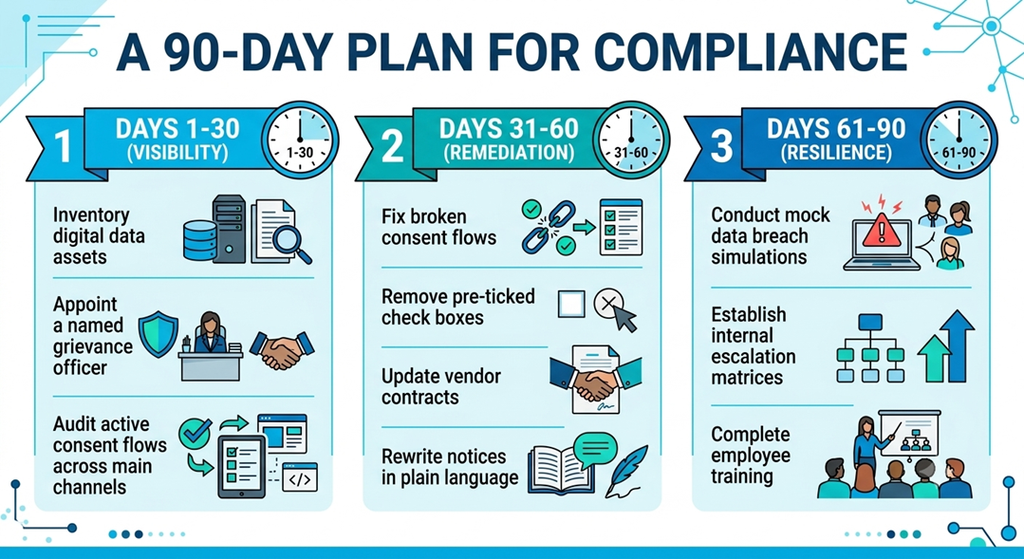
Making privacy compliant processes the path of least resistance ensures team members follow these habits automatically, much like putting on a seatbelt when getting into a car.
Master Data Governance and Business Leadership
Understanding regulations like the DPDP Act requires strong managerial oversight, clear strategic alignment, and modern operational frameworks. If you want to build leadership expertise across modern business operations, explore the Online MBA program with a specialization in Data Science from Manipal University Jaipur. This program help professionals master corporate governance, risk management, and digital transformation strategy to lead organizations confidently in evolving regulatory environments.
Prepare for your next career milestone with us