
Listen to this blog

Digital marketing is a more modern and popular way to promote goods, services, and brands through digital or online channels to target specific audiences, boost engagement with prospective customers, and achieve tangible marketing results. Today’s digital-first professional environment is driven by businesses engaging with customers via search engines, websites, social media, mobile and email apps, much more than ever before.
This blog explains in detail what digital marketing is and how it can be used in today’s competitive arena to build a business.
What is Digital Marketing?
In simple terms, digital marketing involves promoting products, services, and brands through online media. Some of the popular ones include social media platforms, search engines, websites, mobile and web applications, and email. Digital marketing strategies differ considerably from conventional marketing methods, enabling businesses to connect with their target audience in real time. They also enable organizations to optimize these strategies and track the performance of marketing campaigns based on data insights.
How Digital Marketing Works
The simple principle on which digital marketing works is the use of online promotional platforms. Some of the most popular channels include social media, search engines, websites, paid advertising, and email marketing.
All of these platforms enable individuals and organizations to identify and target their audience, build brand awareness among them, attract prospective customers, generate leads, and eventually drive sales using data-driven digital marketing techniques.
Key Components of Digital Marketing
The digital marketing framework comprises several core components, all of which help make brand promotion even more effective. These components are strategically incorporated into various digital marketing strategies to enable businesses to make data-oriented informed decisions. They also help organizations achieve long-term results by promoting brand loyalty and increasing their credibility in the market.
Listed below are the 10 key components of digital marketing:
| 1. Content Marketing |
| 2. Search Engine Optimization (SEO) |
| 3. Social Media Marketing (SMM) |
| 4. Email Marketing |
| 5. Paid Search |
| 6. Web Analytics |
| 7. Mobile Marketing |
| 8. Digital Advertising |
| 9. Online Reputation Management (ORM) |
| 10. Google Pay-Per-Click (PPC) |
Why Digital Marketing is Essential for Modern Business
Modern-day businesses can gain significantly from digital marketing, which allows them to reach a global audience and also measure the performance of a marketing campaign in real time. This further enables optimization of the campaign to improve results. Some of the key benefits of digital marketing are explained below:
- More affordable: Digital marketing strategies are comparatively more affordable than big-budget ad campaigns on TV, for instance. Social media platforms and search engine optimization allow businesses to target, identify, and build audiences for free, thereby boosting brand visibility and engagement.
- Wider global reach: Through digital marketing, businesses can easily move beyond local horizons and expand into international markets.
- Improved personalization: Digital marketing techniques also enable businesses to target specific audiences based on factors such as demographics, interests, behavior patterns, and search intent. Certain digital marketing tools can then be used to offer personalized recommendations to prospects based on these factors.
- Makes interactive communication possible: Digital marketing has facilitated two-way communication for businesses. Several brands are now directly engaging with their audiences on social media platforms, and people also leave product reviews on these channels, all of which help build brand credibility and trust.
- Performance tracking in real time: Where traditional marketing channels make real-time ROI measurement difficult, digital marketing strategies and tools enable businesses to measure analytics quite transparently.
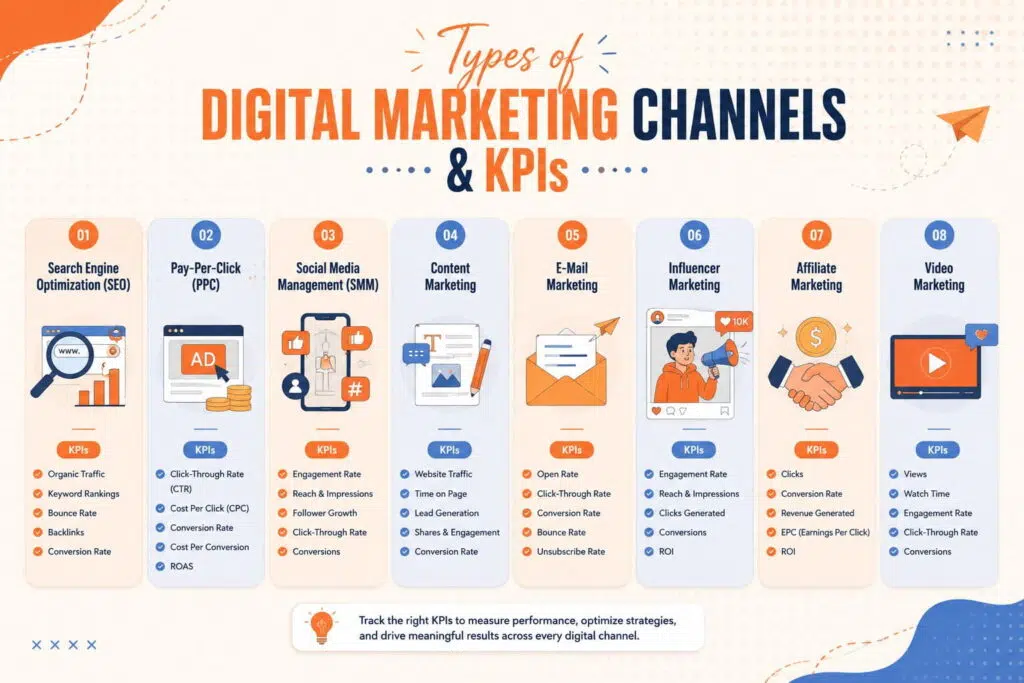
Types of Digital Marketing Channels & KPIs
There are several types of digital marketing channels, all of which enable brands to reach, engage, and convert their target audiences across various platforms. KPIs, at the same time, help measure the actual effectiveness and ROI of each marketing effort put in through these channels.
We look at the different types of channels below, each of which highlights the importance of digital marketing for a brand:
1. Search Engine Optimization (SEO)
Search Engine Optimization (SEO), One of the most commonly used and highly popular digital marketing channels used by various brands today, SEO’s primary focus is on boosting the visibility of a brand’s website in organic search results on search engines. It does this by optimizing keywords, content, the site structure, and overall user experience. SEO also helps improve brand credibility in the minds of its target audience, attract high-quality website traffic that is highly likely to convert, and generate more leads over time.
Benefits of Search Engine Optimization (SEO)
- Improved brand visibility: SEO helps increase brand visibility and credibility by boosting rankings on the first page of search results.
- Improved organic traffic: A higher ranking in search engine results helps attract more visitors to the website organically, without relying on paid advertisements.
- Better-quality leads: SEO helps brands target users who are actively searching for relevant products, services, or information. This enables brands to secure higher-quality traffic and leads, with a greater likelihood of conversion.
KPIs
KPIs, short for Key Performance Indicators, are metrics that help organizations track and measure progress toward the achievement of specific, desirable goals. Some of the main KPIs used for evaluating SEO success are:
- Keyword Rankings
- Organic Traffic
- Organic Click-Through Rate (CTR)
2. Pay-Per-Click (PPC)
PPC is yet another digital marketing model in which businesses pay a fee every time a user clicks their ad. It is popularly used on social media platforms and search engines, helping brands generate viable leads, drive organic traffic, and improve conversions.
Benefits of PPC
- Audience reach is highly targeted: Using the PPC model, brands can target specific audiences based on location, keywords, interests, and device type. This further helps ensure that the businesses’ ads reach the most relevant prospects.
- Facilitates instant brand visibility: PPC ads help place your business at the top of search engine results. This enables you to attract the right prospective customers much faster than other organic marketing methods can.
- Results can be measured and improved: Using PPC platforms, brands can obtain detailed data on the performance of a marketing campaign. This enables them to track and measure clicks and conversions, optimize campaigns, manage their budget, and evaluate overall ROI.
KPIs
- Impressions
- Clicks
- Cost Per Click (CPC)
Learn More: What is Search Engine Marketing (SEM)? A Complete Guide
3. Social Media Management (SMM)
One commonly used digital marketing strategy is to use social media platforms to build a brand. Businesses use SMM to build awareness of their presence, engage with audiences, and drive business growth. Social Media Marketing uses a combination of paid ads, targeted content, and community engagement to increase website traffic, help businesses connect effectively with prospective customers, generate leads, and boost their online presence.
Benefits of SMM
- Improves brand awareness: Social media platforms help businesses reach larger audiences, making it easier to build visibility and recognition among potential customers.
- Attracts traffic and leads: Thoughtfully designed social media campaigns can guide users to your website, generate leads, and increase prospects for conversions and sales.
- Promotes customer engagement: Social media platforms facilitate direct interaction with customers through messages, comments, content sharing, polls, etc., allowing brands to build stronger relationships with both current and new customers and credibility.
KPIs
- Impressions
- Reach
- Engagement rate
4. Content Marketing
Content Marketing refers to a strategic marketing design that primarily focuses on creating and sharing content that is relevant, valuable to the target audience, and most importantly, consistently posted to attract and engage with the prospective customer base. It involves creating blogs, emails, videos, social media posts, etc., all aimed at building brand awareness and credibility, generating leads, and prompting the lead to take the desired action. In other words, content marketing eliminates the need for direct advertising.
Benefits of Content Marketing
- Building brand awareness: Creating and consistently posting high-quality content establishes your niche and expertise in the domain, helps your audience identify with your brand, and builds customer loyalty over time.
- Improving visibility on search engines: Consistently publishing SEO-optimized, relevant content helps boost your website’s rankings, driving more organic traffic and contributing to the long-term growth of your business.
- Generating qualified leads: The right audience can be targeted and attracted via Informative blogs, videos, and guides. People who are actively searching for solutions to their queries are highly likely to convert into customers through useful content.
KPIs
- Engagement metrics like bounce rates and pages per session
- Traffic metrics like page views and unique visitors
- Lead generation metrics like content downloads or form submissions
5. E-Mail Marketing
Another popular form of digital marketing is E-Mail Marketing, this helps to promote products or services, engage with customers, and build long-term relationships. Also, it enables brands to increase their awareness among new prospects, attract website traffic, nurture leads, and promote sales—all via targeted, personalized, and measurable marketing delivered directly to subscribers’ inboxes.
Benefits of E-Mail Marketing
- Direct and personalized communication with prospects: Brands can send highly targeted messages based on behavior patterns, customer preferences, and demographics, thereby improving engagement and conversion rates.
- Affordable: E-mail marketing is highly cost-effective and thus ideal for new or budding brands, allowing them to achieve a high ROI at a relatively low cost compared to other traditional advertising/digital marketing channels.
- Measurable results: It is possible to track metrics such as open rates, click-through rates, and conversions generated through e-mail marketing, which helps brands assess the performance of the e-mail marketing campaign and optimize future efforts.
KPIs
- Click-Through Rate (CTR)
- Open Rate
- Conversion Rate
6. Influencer Marketing
Influencer Marketing, one of the most recent yet highly popular forms of digital marketing is in which brands collaborate with content creators or social media personalities with large followings or high engagement rates on social media platforms to promote their products, ideas, or services. Collaborating with influencers allows brands to leverage influencers’ audience reach, credibility, and trust to improve their own awareness, engagement, and lead generation.
Benefits of Influencer Marketing
- Allows brands to expand their reach: Partnering with influencers enables them to engage with new, highly targeted audiences and increase their visibility among prospective customers.
- Helps build brand credibility: Since influencers already have strong relationships with their audiences, seeking their assistance in recommending your brand lends more authenticity and builds trust.
- Improves engagement and conversions: Content from influencers typically results in higher engagement, enabling audiences to interact with the brand and take the desired action—sign up for a service or make a purchase.
KPIs
- Audience reach & impressions
- Audience engagement rate
- Audience conversion rate
7. Affiliate Marketing
Affiliate marketing is a more performance-based digital marketing technique that allows individuals or businesses to earn a specified commission by promoting other brands’ products or services. Known as affiliates, these individuals or organizations can use blogs, websites, email campaigns, social media platforms, videos, and other channels to boost traffic and sales.
Benefits of Affiliate Marketing
- Opportunity for passive income: After an affiliate’s content, campaigns, or links are live, they can continue earning commissions from the leads generated or sales made over time.
- Low-cost business prospect: Affiliate marketing can be pursued with minimal upfront investment, as no products or inventory are required, and affiliates do not need to handle customer service.
- Flexibility: Affiliates can promote products across different niches and work from anywhere. Additionally, they can increase their earnings by expanding their marketing channels and audience.
KPIs
- Average view duration
- View count
- Conversion rate
8. Video Marketing
In this digital marketing strategy, brands can use videos to promote their products, ideas, or services across social media, websites, digital channels, and email campaigns. It enables brands to capture audience attention, improve brand awareness and engagement, explain complex concepts, and drive conversions through engaging videos and visual storytelling content.
Benefits of Video Marketing
- Improves brand credibility: By sharing video testimonials, product demo videos, and similar content, brands can help audiences better understand their offerings, build trust, and influence their buying decisions.
- Higher reach and engagement: Videos capture attention much faster than text or images. This encourages users to spend more time on your content and also increases engagement on social media.
- Boosts SEO efforts: Video content can improve search engine rankings, increase visitors’ time on your website, and make your brand more identifiable on both YouTube and Google.
9. Performance Marketing
Performance marketing is yet another digital marketing approach where advertisers are required to only pay when a specific actions, such as click, lead, or sales is generated. This approach thus focuses on direct measurable results, allowing businesses to optimize their campaigns and maximize their ROI effectively.
Benefits of Performance Marketing
- Measurable results: Every performance marketing campaign can be tracked using metrics such as clicks, conversions, and ROI. This makes it easier for businesses to evaluate performance.
- Affordable advertising: Businesses pay only for specific actions achieved, such as leads or sales, helping marketers optimize their budgets.
- Targeted audience reach: Advanced audience targeting ensures that ads are only shown to those users who are most likely to engage or convert, thereby improving the effectiveness of the campaign.
KPIs
- Conversion Rate
- Cost Per Acquisition (CPA)
- Return on Ad Spend (ROAS)
How to Choose the Right Digital Marketing Strategy for Your Business?
Among the various digital marketing strategies detailed above, choosing the right one requires identifying your overall long-term business objectives, understanding your target audience, and selecting the digital marketing channels or platforms most likely to deliver measurable results.
- Step 1: Define your long-term business and marketing goals clearly.
- Step 2: Identify your target audience and understand its needs and preferences.
- Step 3: Opt for the most effective digital marketing channels.
- Step 4: Ensure the digital marketing strategy you choose aligns with your available resources and budget.
- Step 5: Track performance metrics and optimize them regularly to improve campaign performance.
Digital Marketing Case Studies of Some Popular Brands
Before choosing the best digital marketing strategies and channels for your brand, it helps to take a glimpse at some real-world examples where innovative marketing campaigns have transformed brand visibility, engagement, and revenue for companies. We share 3 real-world digital marketing examples below as case studies to help you better understand and make an informed choice.
1. SEO Case Study: How Airbnb Built Massive Organic Traffic Through SEO
Airbnb leveraged SEO to scale its global online presence, significantly driving massive organic traffic to its website. Instead of relying solely on paid ads, the company created numerous location-specific landing pages highly optimized for high-intent search queries, such as “homestays in London” or “vacation rentals in Australia”. This digital marketing technique significantly helped Airbnb rank high in search engine results across multiple countries.
Some of the key SEO strategies that the company used to its advantage are:
- Long-tail keyword targeting
- SEO-optimized city, neighborhood, and property listing pages
- Internal linking for improved crawlability
2. Social Media Marketing Case Study: Nike – “You Can’t Stop Us” Campaign
The success of Nike’s SMM campaign in 2020 propelled us to share this case study. Nike launched its highly effective “You Can’t Stop Us” social media campaign that year, the highlight of which was a split-screen video featuring athletes from different backgrounds. These athletes were seen performing coordinated movements, which created an impactful visual narrative. The video was shared across various platforms — YouTube, Instagram, Facebook, and X — and the campaign quickly went viral, boosting audience engagement for the brand.
3. Influencer Marketing Case Study: boAt and Bhuvan Bam
boAt collaborated with digital content creator Bhuvan Bam to promote its audio products to a young, tech-savvy customer base. The company chose not to rely on traditional ads; instead, it naturally integrated its products into Bhuvan’s social media presence and online content. His strong follower base among millennials and Gen Z enabled boAt to engage with this audience and convey its product features and benefits.
Common Digital Marketing Challenges
As digital marketing channels evolve, they don’t come without challenges that can sometimes hamper businesses’ reach, engagement, and conversion rates. Some of the most common challenges that brands may face when opting for digital marketing are:
1. Budget constraints: Most small brands and businesses have limited budgets and resources, which can make it challenging to execute and optimize digital marketing campaigns effectively.
2. Increasing competition: The digital marketing arena is highly competitive today, making it challenging for brands to capture audience attention and stand out within their target audience.
3. Algorithm updates: Very frequent updates to social media and search engine algorithms may impact the overall performance of the marketing campaign and reduce brand visibility.
4. Content saturation: Consistently creating fresh, helpful, and relevant content for your audience can pose a significant challenge and put pressure on your available time and resources.
5.Tracking and attribution issues: Keeping track of the direct impact of marketing efforts across multiple digital channels can be challenging.
6. High-quality lead generation: Attracting the right target audience and, most importantly, converting them into qualified leads consistently remains a major challenge for businesses using digital marketing strategies.
Also read, Top Digital Marketing Skills required to Overcome such Common Challenges
Future Trends in Digital Marketing
The future of digital marketing seems promising, with rapid evolution and advancements in automation, AI, and data-driven personalization. These trends are highly transforming the way businesses engage with customers. Listed below are some of the key future trends reshaping the digital marketing space:
1. AI-Powered Marketing: The rapid growth and widespread use of AI are enabling targeted content creation, smarter targeting of prospective customers, and more effective campaign optimization at scale.
2. Voice Search Optimization: With the growing popularity of voice and image search, digital marketers are adapting their SEO strategies accordingly to optimize their campaigns and align them with voice and visual search features.
3. Influencer-Led Campaigns: Collaborations with niche content creators on social media are proving much more effective than conventional advertising strategies for building brand credibility and loyalty, and even encouraging conversions.
4. Hyper-Personalization: Brands are now using predictive analytics and real-time data to deliver highly customized experiences to their customers based on their preferences and behavior patterns, thereby influencing their purchasing decisions.
5. Short-Form Video Popularity: Short videos and reels are gaining more popularity in boosting audience engagement, making bite-sized content a priority for most digital marketers.
6. Privacy-First Campaigns: In the wake of incidents highlighting the decline of third-party cookies and stricter data regulations, businesses are focusing more on consent-driven, ethical marketing practices.
Also Read, Digital Marketing Career Path: Why It’s One of the Best Career Choices in 2026 and Digital Marketing Salary in India 2026
Popular Online Digital Marketing Programs
| Online MBA in Digital Marketing – Learn advanced digital marketing strategies, data analytics, online advertising, and brand management. Ideal for professionals aiming for managerial and leadership positions. |
| Online BBA in Digital Marketing – Develop core skills in SEO, social media, content marketing, and digital business. Perfect for students looking to start a career in the fast-growing digital marketing industry. |
Final Words
Digital marketing has completely transformed the way businesses engage with audiences and made marketing more easily measurable, targeted, and even more highly affordable than ever before. With the right mix of digital channels—content marketing, email campaigning, social media posting, SEO, and paid advertising—brands can not only build awareness and visibility but also generate qualified leads and achieve sustainable growth.
This is exactly what the MBA program in Digital Marketing aims to equip learners with—skills in social media strategy, e-marketing, SEO, content creation, data analytics, and more. Manipal University Jaipur, one of the finest universities in India (NAAC A+ accredited), offers an online MBA with Digital Marketing specialization on the popular Online Manipal platform. The program is thoughtfully designed to enable learners to gain a deeper understanding of the rapidly evolving digital marketing landscape and adapt to it just as quickly.
FAQs
1. What is digital marketing in simple terms?
Simply put, digital marketing is the process of promoting and selling a business’s products, services, and ideas over the Internet. Brands depend more on digital marketing channels, such as social media platforms, search engines, and email, than on traditional advertising on TV, billboards, or flyers.
2. What are the main types of digital marketing?
Some of the most popular types of digital marketing channels used by most businesses include:
- Pay-Per-Click (PPC) Advertising
- Search Engine Optimization (SEO)
- Social Media Marketing (SMM)
- Email Marketing
- Content Marketing
3. What are the best digital marketing strategies?
Some of the best digital marketing strategies used by most businesses today include:
- Paid advertising
- SEO
- Email marketing
4. What is the difference between digital marketing strategies and techniques?
One of the key distinctions that separates the two is that while strategy refers to the “what” and “why”, digital marketing techniques define the “how” of the process. Digital marketing strategies are the key plans curated to achieve specific marketing or business goals. At the same time, the techniques refer to the specific action tools, steps, and platforms used to implement the designed strategies.
5. What are the benefits of digital marketing for businesses?
Some of the top benefits of using digital marketing for businesses today are:
- It is cost-effective.
- It has a wider global reach.
- Its results can be measured easily.
- It can be used to target specific audiences effectively.
- It boosts customer engagement.
6. Why is digital marketing important today?
Digital marketing is particularly crucial in today’s competitive business environment, allowing brands to connect with their prospective customers exactly where they spend most of their time—online.
7. What are some real-world digital marketing examples?
A few examples of digital marketing that can be picked from the real world are:
- SEO Case Study: How Airbnb Built Massive Organic Traffic Through SEO
- Social Media Marketing Case Study: Nike – “You Can’t Stop Us” Campaign
- Influencer Marketing Case Study: boAt and Bhuvan Bam
Prepare for your next career milestone with us