Blogs
Blogs 
Decoding Innovation: A Design Thinking Guide for the Modern Problem Solver

Listen to this blog

In the world of technology today, there are two letters that dominate every conversation: AI. We are living in a time where artificial intelligence can write thousands of lines of code in a minute, automate complex workflows, and generate answers in seconds. But here is the hook: while AI can give you answers, it cannot decide if you are asking the right questions.
In this age of information overload, your real competitive advantage is not the data you have, it is the problem framing. As I often say, AI accelerates execution, but design thinking ensures direction. Without the right direction, speed only helps you hit the wrong target faster.
Through my journey as a technology leader and mentor, I’ve seen how structured problem-solving transforms not just products, but lives. Let’s dive into how you can use this mindset to create real impact.
Explore: What is Corporate Communication? Top Careers and Skills to Succeed
Why Design Thinking is the Ultimate Game Changer
Design thinking is a non-linear, iterative process used to understand users, challenge assumptions, and redefine problems to create innovative solutions. It isn’t just for “designers”; it is for anyone who wants to solve problems effectively.
I have seen this work firsthand in social projects I’ve been involved with:
- The Water Wheel Project: In a tribal village in the Telangana region, women were struggling to carry heavy water pots over long distances. By empathizing with their physical toll, we introduced “water wheels”. This shifted the burden from lifting 10 liters on their heads to effortlessly rolling 30 liters at a time, completely transforming their daily efficiency.

- The School Bag Initiative with Goonj: We worked with the NGO Goonj to address waste and education needs. Instead of letting old clothes end up in landfills, we used design principles to upcycle them into durable school bags for children. It was a simple, low-cost intervention that solved two problems at once.

- The Araku Coffee Success Story: Farmers in the Araku Valley were growing world-class coffee but were struggling to get fair prices because they were selling it in bulk, unbranded bags. By applying design thinking to branding and market positioning, it was transformed into a premium global brand that eventually gained recognition from the highest levels of government.

Read more: Career Resolutions for 2026: How Online Education Can Help You Keep Them
The Frameworks of Innovation
To solve problems like a pro, you need the right mental models. Here are five powerful frameworks I use in my day-to-day work:
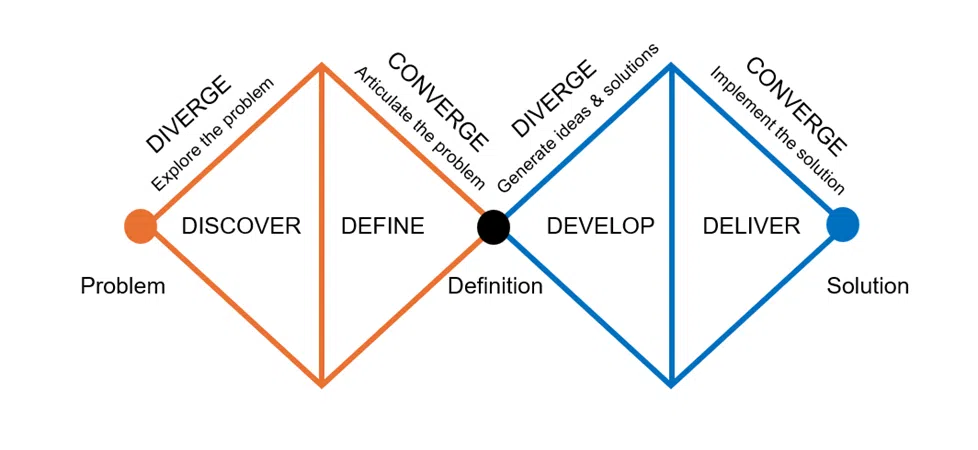
- The Double Diamond: This focuses on four stages – Discover, Define, Develop, and Deliver. It’s about “diverging” to explore many possibilities and “converging” to focus on the best one.
- The Five Whys: Developed by Toyota, this is my go-to for IT troubleshooting. If a server crashes, don’t just buy more servers. Ask “why” five times to find the root cause – which is often a process or governance failure rather than a technical one.
- First Principles Thinking: Popularized by innovators like Elon Musk, this encourages you to strip a problem down to its fundamental truths. Don’t ask how to improve a battery; ask what a battery is fundamentally made of and redesign the manufacturing process itself.
- IBM Design Thinking: Built for enterprise-scale, this framework focuses on three principles: a focus on user outcomes, restless reinvention, and diverse, empowered teams.
- The EDIPT Model: Standing for Empathize, Define, Ideate, Prototype, and Test, this is perhaps the most popular and powerful framework for creating user-centric solutions.
A Personal Lesson in Empathy
Early in my career, I realized that we often fail not because of low intelligence, but because of poor design. I often ask people: how many webinars have you attended in the last six months where you actually remember the learning? Most people only remember about 5-10%.
The problem isn’t the content; it’s the lack of a structured experience. In IT, we often jump to adding features when user engagement drops. Using the Double Diamond approach, I once discovered that users weren’t leaving an app because it lacked features, they were leaving because they were overwhelmed by too many notifications. By narrowing the problem down to “cognitive overload,” we improved engagement by simply optimizing the notification frequency.
Another interesting read: Guerrilla Marketing: Thinking outside the box
Conclusion: Building Your Future
Design thinking is not a buzzword; it is a survival skill in the age of AI. It gives you the “Hills” – the clear outcomes and destinations you need to aim for in a sea of information.
If you want to move from being someone who just executes tasks to someone who provides direction and innovation, you need to master these structured thinking processes. For those looking to dive deeper and build job-ready tech skills, I highly recommend exploring the specialized programs at Online Manipal. Their curriculum is designed to bridge the gap between industry needs and learner skills, much like the very principles of design thinking we’ve discussed today.
The future belongs to those who can frame the right problems. Are you ready to lead the way?
Prepare for your next career milestone with us