Listen to this blog

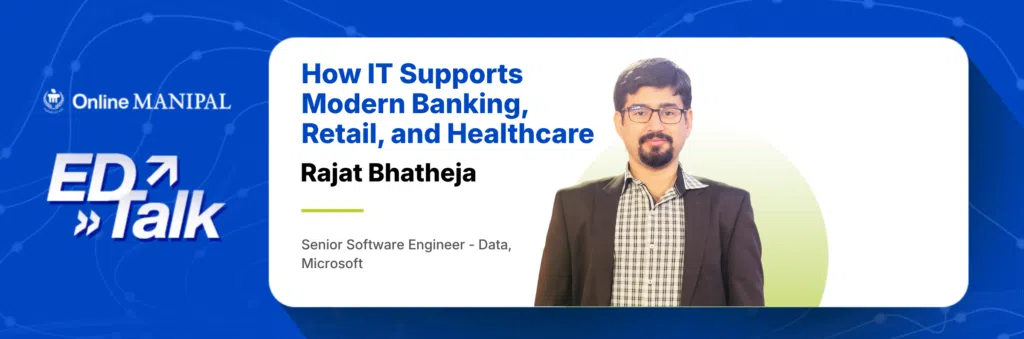
When I started my career 14 years ago, Information Technology was often tucked away in a quiet corner of the office. Back then, IT was viewed primarily as a support function – the department you called when your computer wouldn’t turn on or your emails weren’t sending. But today, the narrative has shifted completely. IT isn’t just a department; it is the nervous system of every modern business.
I have seen firsthand that when the IT infrastructure fails, a business doesn’t just slow down; it ceases to exist in the modern market. Every hour of our lives is now dictated by these invisible digital threads. Whether you are ordering a package, making a digital payment, or visiting a hospital, you are interacting with a complex web of data and code. I want to share how these systems are fundamentally reshaping the industries that move our money, our goods, and our health.
Quote: The future of banking, retail, and healthcare is being written in code right now. Make sure you’re part of the team writing it.
The Banking Revolution: From Physical Branches to Atomic Settlements
Banking was one of the earliest adopters of IT, and today, it remains the largest recruiter and one of the highest payers in the tech sector. When I joined my first company, nearly 60% of our client portfolio was from the banking and financial services domain. The scale of transformation here is staggering.
My father is a retired banker, and he often tells me how his branch used to require 30 people to operate. By the time he retired, that same branch only needed five people, yet it handled ten times the business volume. That is the leverage of technology. In the current landscape, banking is less about vaults and more about “atomic settlements” – transactions that happen in the blink of an eye.
- The UPI Phenomenon: We have reached a point where I rarely carry more than a few hundred rupees in my wallet. India now processes over 14 billion UPI transactions every month. This isn’t just a convenience; it’s a massive data engineering feat that requires 99.99% uptime.
- Real-Time Fraud Prevention: Security is the bedrock of finance. If your credit card is used at 3 AM in Dubai while you are sleeping in India, IT systems identify that anomaly and block the transaction in real-time. This involves processing millions of data points per second to distinguish a legitimate purchase from a fraudulent one.
- Blockchain and Speed: Traditionally, trade finance settlements could take up to 10 days of paperwork and verification. By using blockchain, leading banks have reduced that time to just four hours, ensuring that capital moves as fast as information.
- Customer Experience: Modern banking has moved from ‘9-to-5’ to ‘24/7.’ Through mobile apps and AI chatbots, customers can manage their entire financial life without ever stepping foot inside a physical building.
Another interesting read: Building Your Banking Career: How Blockchain and Smart Contracts Are Reshaping Finance
Retail: Personalization and the Quick Commerce Surge
In the retail sector, the physical storefront is no longer the primary point of contact. Most consumers today check their mobiles long before they ever consider walking to a local shop. As a data professional, I see retail as one giant optimization problem.
- The Rise of Quick Commerce: We’ve moved from weekly grocery runs to “instant gratification.” Companies like Swiggy and Zepto rely on hyper-local IT infrastructures to ensure that when you order a snack, it arrives in 10 minutes. This involves complex algorithms for rider assignment and inventory management.
- Predictive Analytics: Every time you see a “Recommended for You” section, there is a data architect behind the scenes. We use IT to analyze your past behavior, your search history, and even seasonal trends to predict what you might want next. This isn’t just a gimmick; it significantly boosts performance for nearly 65% of modern retailers.
- Supply Chain Visibility: Behind every “Out of Stock” or “In Stock” label is a massive database tracking millions of items across thousands of warehouses. IT provides the visibility needed to ensure products move from the factory to your doorstep with minimal waste.
- E-commerce Scalability: During festive sales, retail websites experience traffic spikes that would crash a standard server. Building ‘cloud-native’ systems allows these platforms to scale up instantly to handle millions of simultaneous users and then scale down to save costs.
Read more: Marketing vs Supply Chain Management: Which is a better career option
Healthcare: Technology That Saves Lives
Healthcare was historically a laggard in IT adoption compared to banking, but that is changing rapidly. By 2030, the healthcare IT market is expected to double, reaching nearly $400 billion. This isn’t just about efficiency; it’s about life and death.
- AI-Driven Diagnostics: One of the most exciting areas I’ve seen is the use of AI in medical imaging. High-volume data platforms now allow AI to scan X-rays and MRIs, often meeting or exceeding human accuracy in identifying early-stage issues.
- The Power of Telemedicine: This is the ultimate tool for social equity. Telemedicine allows us to provide specialist care to the most remote parts of society where a doctor cannot physically be present. A high-speed connection and a robust IT platform can bring a world-class cardiologist to a village in minutes.
- Electronic Health Records (EHR): Gone are the days of carrying a thick folder of paper reports. EHR ensures that your medical guidance is provided in the context of your entire history. If a doctor prescribes a medicine, the IT system can automatically flag if it reacts poorly with something you took five years ago.
- Drug Discovery: IT is even accelerating how we create medicine. By using high-performance computing to simulate how different molecules interact, researchers can find potential cures in months rather than decades.
Know more: 6 Reasons Why to Get an MBA in Healthcare Management
A World Built on Data and Clouds
If global IT spending were a country, it would be the third-largest economy in the world, trailing only the US and China. Despite this massive scale, there is a paradox: 87% of tech leaders report that they struggle to find the right talent. The skills gap is real because the technology moves faster than traditional education.
I didn’t necessarily plan to be a data engineer when I started my journey. In fact, I started with very different goals. But as I saw the world moving toward data-driven decision-making, I embraced tools like Azure, Spark, and Kafka, that allowed me to build scalable systems. The lesson I’ve learned is that you don’t just learn IT as a general subject; you must understand how IT acts as a solution for specific problems in these core domains.
Dive deeper: Top Emerging MCA Specializations: A Comprehensive Guide
Building Your Career in the Digital Age
The opportunities in the coming decade are immense. Whether you are interested in the $200 billion Indian fintech market or the burgeoning healthcare tech sector, the key is to stay ahead of the technology curve. You need to understand the “how” and the “why” behind the systems we use every day.
To succeed in this landscape, you need a mix of domain knowledge and technical expertise. If you’re looking to transition into this world or level up your current skills, programs like the Master of Computer Applications (MCA) or the MSc in Data Science at MAHE Online are specifically designed to bridge this gap. These courses offer the technical foundation in AI, cloud computing, and data architecture that is required to power the “nervous system” of tomorrow’s global businesses.
The technology stack will always change. Today it’s Generative AI, tomorrow it might be Quantum Computing, but the demand for professionals who can build secure, efficient, and innovative digital ecosystems is permanent. My advice is simple: don’t just be a user of technology; be the person who understands how to architect it. The future of banking, retail, and healthcare is being written in code right now. Make sure you’re part of the team writing it.
Prepare for your next career milestone with us