
Listen to this blog

Did you know that SWAYAM, which is India’s national online learning platform has stated in their survey that only 4% is the course completion rate since its inception in 2017?
What could be the reasons? Why are students dropping off in online programs? According to the same survey conducted, the most common factors include outdated content, content-quality gaps, structural stagnation, etc. This is definitely a systemic failure and not an individual learner’s issue.
Adding to the above factors, technical challenges, feelings of isolation, unclear course expectations, and perceived lower engagement compared to face-to-face learning also contribute to attrition. Financial constraints and career-related changes may further influence students’ decisions to discontinue their online studies.
In this blog, we discuss the reasons students drop off from Online programs and how Online Manipal stands out.
10 Reasons Why Students Drop Off from Online Programs
1. Lack of Communication and Academic Interaction
A common reason for dropping off online classes is a lack of communication between students and teachers, so if students cannot get answers to their questions fast enough or cannot interact academically with their teachers or peers, they will not feel a connection to their program. The longer this goes on, the less motivated they are to complete their courses, and their commitment decreases.
2. Financial Constraints
Students who are financially struggling often drop off online courses. Though online programs are comparatively affordable, financial instability can disrupt academic continuity and lead to withdrawal.
3. Working Professionals Struggling to Balance Responsibilities
A lot of online students are working professionals who have to deal with the pressure at work and/or other personal commitments that take up their time. This leaves less time to catch up on coursework. When students run out of time (and therefore cannot complete their course), they often give up on finishing their online programs.
4. Time Management Challenges
Since there are no fixed class times in an online program, students must have a high degree of self-discipline. Lack of time-management skills and procrastination can lead to a failure to complete the coursework and eventually drop out. If managed well, online programs are the best way to utilize time in its best possible way.
5. Feelings of Isolation in Virtual Learning
Online programs do not provide the same opportunities for peer-to-peer interaction and social engagement as traditional classrooms. Feeling disconnected or isolated from the learning community may lead to a decrease in motivation to continue the course. Students who do not feel a sense of belonging often lose motivation or persistence.
6. Technical Difficulties and Digital Fatigue
The learning process may be slowed if the student has a weak internet connection or is not familiar with the learning platform. Technical frustration and digital fatigue hinder the engagement of students, making it difficult to stay regular in the course over the long term.
7. Unclear Course Expectations
When students are unaware about evaluation methods, workload, or career outcomes for their degree, students can be confused about what assignments are due, deadlines for submitting work, etc. These students will be under greater stress and less engaged in their studies, thus increasing the chance that one or more students may drop out.
8. Lack of Immediate Doubt Resolution
Students in traditional classes can get their questions answered immediately. However, in an online course, if the student cannot count on a timely response or there is limited support for their studies, it will take longer for them to understand the learning materials. If they are not resolved on time, many students may lose academic confidence and perform poorly in their courses, eventually leading to them dropping off.
9. Low Engagement and Passive Content Delivery
Courses which rely solely on the delivery of recorded lectures do not offer opportunities to engage with fellow students or course facilitators via discussions, attending real-time classes and creating practical examples will likely result in little or no opportunity for engagement.
10. Career Shifts or Changing Personal Priorities
There are times when students leave the course due to either their career changes or a shift in their personal lives. A student may have been offered an entirely new job or a promotion, maybe living in a different part of the country, or may have personal issues, including family obligations. This results in a need to change their primary focus from online classes to shifting priorities.
How Online Manipal Stands Out?
Given below is a table of comparison which students and working professionals can consider while joining online programs:
| Aspect | Online Manipal | Traditional Learning |
| Learning Mode | Fully online with live virtual classes, recorded lectures, and digital assessments via LMS | Classroom-based, on-campus instruction with physical attendance |
| Location Flexibility | Learn from anywhere without relocation | Location-dependent; requires presence on campus |
| Student–Teacher Interaction | Interactive live sessions, discussion forums, and one-on-one academic support | Face-to-face interaction limited to classroom hours |
| Teaching Methodology | Blended digital pedagogy with case studies, quizzes, and real-world applications | Predominantly lecture-based with limited digital integration |
| Networking Opportunities | Connect with learners and professionals across diverse regions and industries | Networking largely restricted to campus community |
| Learning Pace | Flexible and customizable; access recorded content anytime | Fixed schedules with limited scope for self-paced learning |
| Suitability for Working Professionals | Highly suitable with flexible schedules and asynchronous learning | Difficult to balance with full-time work |
| Cost Efficiency | More affordable; saves on travel, accommodation, and material costs | Higher overall cost due to relocation and campus expenses |
| Return on Investment (ROI) | High ROI due to affordability, flexibility, and career relevance | ROI varies and is often higher in cost and time commitment |
Read More: The Psychology of Online Learning: What Makes It So Effective?
Key Statistics Reflecting Learner Interest in Online Manipal
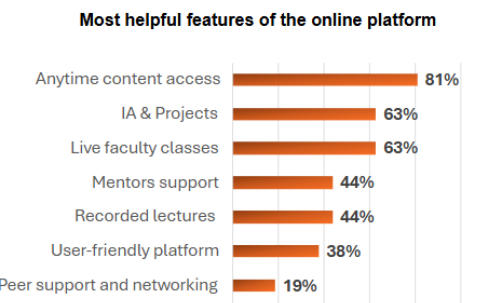
The real-time data we now provide here are the insights which we got from our students, on the reasons learners are motivated to attend Online Manipal learning programs. Flexibility, accessibility, and academic support are cited by learners as the main strengths of their online learning experiences. There are numerous other factors that are mentioned contributing to their level of engagement and satisfaction. Taken together, these points illustrate the increasing importance of our learning programs in helping enable learners’ desire to realize long-term career goals.
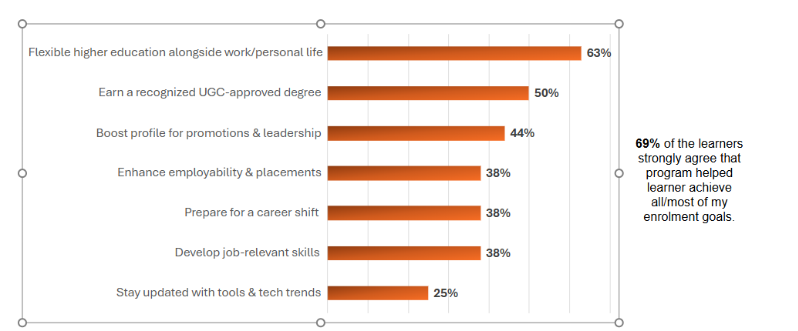
An Interesting Find: Learner Feedback: A Data-Led Report on Online Manipal’s Learning Experience
Conclusion
Having identified most of the significant causes of students’ dropping out of their online programs, now we know how Online Manipal stands out. Flexible learning schedules, strong academic support systems, interactive live classes, and curriculum that are directly connected to the career goals of the students are the few striking benefits of Online Manipal programs. With such options available to their students, Online Manipal seems to be an option of considerable value for students who want online courses that will benefit them greatly.
References
Prepare for your next career milestone with us