
Listen to this blog

Project management is the specialized skill of translating ideas into successful outcomes. This is typically achieved via effective coordination, thoughtful planning, and timely execution. Project management also involves efficiently managing timelines, resources, teams, and budgets to achieve specific goals on time. This blog aims to serve as a comprehensive guide to the different types of project management, the methodologies used, the skills required, and the career prospects for project managers.
What is Project Management?
In simple terms, Project Management refers to the process of planning, executing, overseeing, and completing a project within a specific timeline and budget. The aim is to achieve specific business goals for the organization by effectively using all company resources—time, money, and human effort to the optimum.
Project management thus involves using structured methodologies, effective communication strategies, and tools to align the teams with the projects to be completed on time. Efficient project management enables organizations to better manage costs, improve efficiency, meet stakeholder expectations, and enhance the quality of deliverables.
Objectives of Project Management
The primary objective of effective project management in any organization is to complete specifically defined goals within certain constraints. These include constraints of time, money, and available resources. Good project management enables organizations to maximize resource utilization, minimize risks, and ensure successful project results.
- Optimum utilization of available resources: Through efficient project management, a company’s budget, human resources, and materials can be allocated to reduce unnecessary waste and improve overall productivity.
- Effective risk management and prevention: A good project manager can identify potential challenges in a project’s early stages. Through clear communication with the relevant stakeholders, they can restore a smooth workflow throughout the project lifecycle.
- Achievement of overall business goals: Effective project management helps ensure the successful completion of a project within the desired budget and time, in the desired quality.
Key Components of Project Management
The foundation of efficient project management rests on key components that enable teams to plan, implement, and deliver projects within specified constraints and goals. Listed below are the core components of project management:
- Time and resource management: This is one of the most important requisites of effective project management, involving scheduling tasks, allocating resources, and overseeing task progress to ensure the project stays on track and is completed within the defined deadline.
- Scope of the project: The project’s overall goals, key requirements, and deliverables ensure that relevant stakeholders have a clear understanding of the expected results.
- Risk management: This key component involves identifying potential challenges in project execution and overall goal achievement, mitigating those risks, and effectively communicating them to the relevant stakeholders. All of this ensures smooth execution of the project.
Project Management Lifecycle
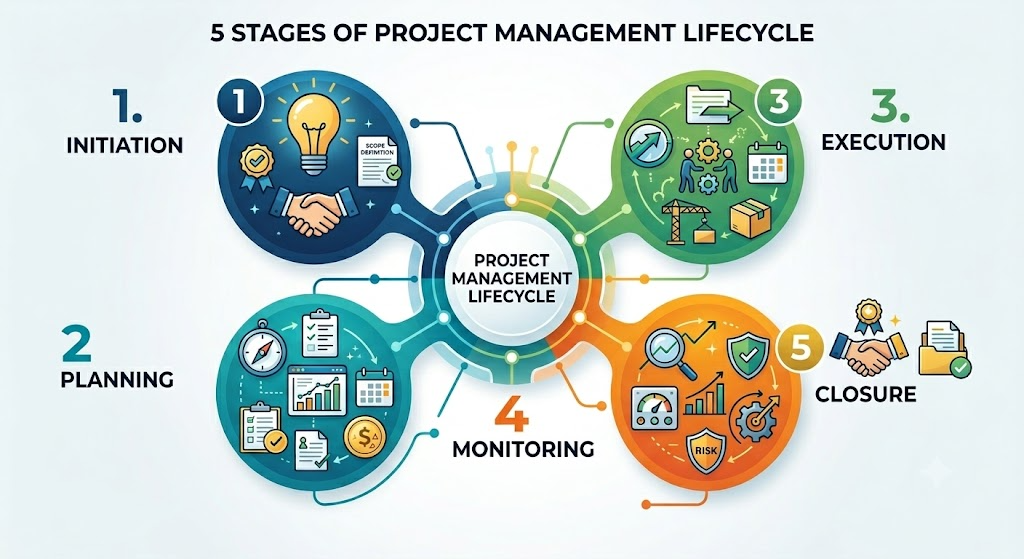
The project management lifecycle is a structured, step-by-step process that guides a project from the initial idea stage through to completion. The prime objective of the process is to ensure the efficient and successful completion of project goals.
The project management lifecycle essentially covers the following 5 stages:
1. Initiation
- At the start of the project lifecycle, the project’s overall objective is clearly defined, its scope is well understood, and its feasibility is assessed.
- The relevant stakeholders for the project have been identified, and project approval has been secured to proceed with initiation.
2. Planning
- Once the desired approval is received, the second stage of the project management lifecycle involves creating a detailed roadmap that carefully plans the tasks to be done, the available and required resources, timelines, budget, and any risks involved.
- At this stage, it’s also essential to set clear project goals and define desirable success metrics for effective evaluation later on.
3. Execution
- Stage 3 puts all the planning into action by allocating resources and coordinating with the relevant tasks to ensure task completion.
- The primary goal of the execution stage is to ensure that all deliverables are generated in alignment with specified requirements.
4. Monitoring
- This stage involves monitoring progress at every level of the project, assessing the team’s overall performance, managing risks, and addressing any potential challenges that arise during project execution.
- Any necessary adjustments to ensure the project stays on schedule and within the stipulated budget are made at this stage.
5. Closure
- The project is complete, and the final deliverable is ready for submission to the stakeholder(s) for their approval to close the project formally.
- This is also the time to review the project results and document all learnings for next time.
Importance of Project Management in Modern Businesses
Project management is crucial to the operations of today’s organizations competing in a highly competitive landscape. This is because effective project management enables businesses to achieve their goals on time, optimize available resources, and meet evolving market needs.
- Improves communication and collaboration: A good manager enables teams to work in tandem towards achieving shared organizational goals by designing clear workflows, effective communication strategies, and creating accountability for every team member.
- Improves Productivity and Efficiency: They also ensure that all planned tasks are effectively and fairly assigned to resources aligned with their strengths and implemented systematically. Wastage of resources and delays in project completion can also be significantly minimized through effective project management.
- Helps achieve project success and overall business growth: Effective project management enables businesses to consistently deliver projects on time, within budget, and aligned with company goals. This further helps ensure customer satisfaction and boosts the business’s competitiveness in the industry.
Project Management Methodologies (Types)
Structured project management methodologies are required for the successful and timely planning, execution, and completion of any project in a business organization. In addition, different methodologies suit different team sizes, project goals, and industries. Hence, it’s important to know the various project management types and methodologies that can be effectively used for a specific project.
What are Project Management Methodologies?
As the name suggests, Project Management methodologies are structured frameworks that guide a specific project through the 5 stages detailed above — initiation, planning, execution, monitoring, and closure.
These methodologies offer a well-planned set of processes, principles, best practices, and tools that enable teams to accomplish defined project goals efficiently while optimizing project cost, time, and quality.
Also note that different project management methodologies are designed to meet the requirements of different industries and projects. For instance, Agile project management methodology focuses on continual improvement and flexibility during project execution, while Waterfall follows a more step-by-step, linear approach.
Explained below are the different types of project management methodologies for your reference:
Methodology 1: Waterfall Methodology
The Waterfall methodology is a traditional approach and one of the most popular project management approaches followed today. The framework is linear and follows a clearly defined, step-by-step approach toward the successful completion of a project.
| Parameters | Description |
|---|---|
Process | Follows a clear sequence of steps with distinctly defined project phases—gathering, planning, design, development, testing, and deployment. Completion of each phase before initiating the next is emphasized. |
Advantages | Detailed documentation Clear structure Easy tracking of project progress More predictable project managementClearly-defined goals |
Limitations | Changes at a later stage can be expensiveTesting or feedback generally takes place after the completion of development |
Best Use Cases | Clearly-defined goalsProjects with fixed requirements, predictable results, and strict regulations Examples include manufacturing, construction, and some software projects |
Methodology 2: Scrum Methodology
This Scrum methodology divides all projects into short development cycles, commonly known as sprints. This further enables all project teams to make improvements quickly.
| Parameters | Description |
|---|---|
Process | The project is divided into short cycles for making iterations, known as sprints, each lasting typically 1-4 weeks. |
Advantages | Speedy project deliveryFacilitates regular feedbackLends flexibility to project execution Faster adaptation to changing project needsImproved team coordination |
Limitations | Need for experienced team membersActive stakeholder involvement is requiredIt’s a bit challenging for projects with a fixed budget and scope |
Best Use Cases | Product developmentSoftware development Startups |
Methodology 3: Agile Methodology
The Agile methodology follows a relatively flexible approach, focusing on regular project feedback, iterative development, and adapting to changing project needs over time.
| Parameters | Description |
|---|---|
Process | Projects are divided into short sprints, also called iterations, facilitating regular planning, development, testing, and client feedback. |
Advantages | Relatively faster result delivery Very flexible Quick adaptation to changing project requirementsImproved team collaboration |
Limitations | Requires active stakeholder involvement It can be difficult to predict budgets and timelines Need for experienced teams |
Best Use Cases | Digital product developmentSoftware development Startups Any other project requiring frequently changing requirements |
Methodology 4: Kanban Methodology
This is a more visual project management methodology that uses cards and boards to track task progress and ensure a smooth project workflow.
| Parameters | Description |
|---|---|
Process | Visual board with columns used to continuously track and manage workflows, such as Work In Progress, To Do, Done |
Advantages | Increases project flexibility Improves its visibility Better team coordination Helps quickly identify any challenges |
Limitations | May impact the overall project scope if priorities are not effectively managed May lack a clear structure for complex projects |
Best Use Cases | Software maintenanceIT supportMarketing teams Content management Projects with continuous workflow |
Methodology 5: Six Sigma Methodology
This is a data-oriented methodology that primarily focuses on improving project quality by introducing process variation and minimizing potential defects.
| Parameters | Description |
|---|---|
Process | Follows the DMAIC framework—Define, Measure, Analyze, Improve, and Control for improving the efficiency and quality of a project |
Advantages | Improves project qualityReduces process defects Boosts customer satisfactionSupports data-backed informed decision-making |
Limitations | Requires specialized training for completion It can sometimes be time-consuming May involve considerable costs for project execution |
Best Use Cases | Healthcare ManufacturingFinance Operations conducted on a large scale, focusing on process optimization and improvement of project quality |
Methodology 6: Lean Project Management Methodology
This methodology focuses on maximizing a project’s value while reducing inefficiencies and resource waste. It is thus highly popular among organizations.
| Parameters | Description |
|---|---|
Process | Focus on optimizing workflows, reducing waste, and delivering optimum value using minimal resources |
Advantages | Lowers costs Improves overall efficiencyIncreases team productivity Facilitates regular process improvement |
Limitations | Requires strong team commitment to optimize processesIt may be difficult to execute in the case of complex projects |
Best Use Cases | Software development ManufacturingInitiatives for process improvement Projects focused on lowering costs and improving efficiency |
Methodology 7: PRINCE2 Methodology
Short for PRojects IN Controlled Environments, this methodology is highly structured, involving well-defined roles, controls, and processes for each stage of the project.
| Parameters | Description |
|---|---|
Process | Follows a process-based, structured method involving well-defined roles, stages, responsibilities, and governance controls |
Advantages | Strong management of risksClear project overviewEasily scalable framework Well-defined accountability for each team member |
Limitations | Too rigid for smaller projects Can be documentation-heavy Needs adequate training for effective project execution |
Best Use Cases | Government initiativesLarge-scale projectsIT projects Projects that need strict control and governance |
Methodology 8: Critical Chain Project Management (CCPM) Methodology
More focus is placed on effectively and optimally utilizing all available resources, as well as on advanced planning, to avoid potential delays in project execution.
| Parameters | Description |
|---|---|
Process | Focus on resource availability and strategic time buffers to prevent delays in project completion. |
Advantages | Reduces the need for multitaskingOptimum utilization of existing resourcesImproved the scope of timely project completion |
Limitations | It may be challenging to execute in organizations unfamiliar with CCPM principlesRequires more accurate planning of resources |
Best Use Cases | ManufacturingProjects with limited resources: Engineering Large-scale projects with shared resourcesConstruction |
Methodology 9: Critical Path Method (CPM) Methodology
This approach identifies the exact sequence of crucial tasks that determine a project’s estimated completion time, thereby supporting the planning process.
| Parameters | Description |
|---|---|
Process | Identifies all tasks of a project, computes the longest sequence of critical activities, maps dependencies, and determines the estimated project completion time. |
Advantages | Highlights critical tasks Improves the accuracy of task schedulingHelps prioritize resources Facilitates better management of deadlines |
Limitations | Requires accurate estimates of tasks It can be complex for large projects May not work for projects with limited resources |
Best Use Cases | Engineering projects Construction projectsManufacturing Projects with well-defined tasks and timelinesProduct development projects |
Methodology 10: Hybrid Project Management Methodology
The last on our list of project management methodologies is the Hybrid Project Management methodology that blends core elements of traditional and Agile methodologies to meet specific project requirements.
| Parameters | Description |
|---|---|
Process | Blends traditional planning (Waterfall methodology) with Agile methodology’s execution approach to find the perfect flexibility and balance structure. |
Advantages | Improved collaboration with stakeholdersBetter adaptability Greater control over project resultsImproved management of risks |
Limitations | Requires experienced teams It can be complex to execute It may be confusing if the processes are not well-defined |
Best Use Cases | Large or complex projects that need fixed planning and adherence, while also making room for constantly changing requirements Examples include Healthcare, IT, and construction projects |
Choosing the Right Project Management Methodology
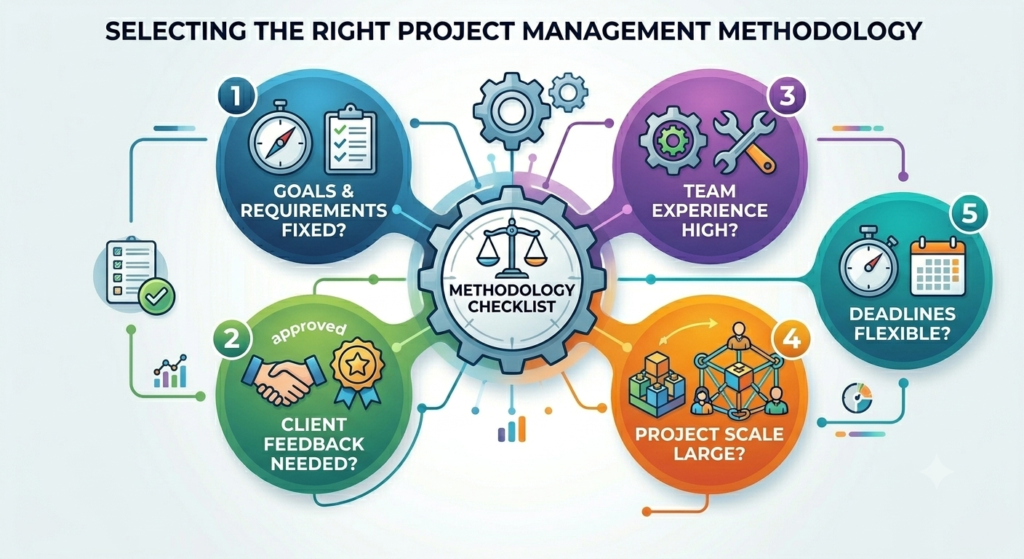
Among the various project management methodologies detailed above, it is crucial to select the right one for your project needs, as it can have a considerable impact on the overall efficiency, results, and success of a project. Following the simple checklist below can help:
- Are the goals and requirements of the project clearly defined and fixed, or are they likely to change with time?
- How often do the clients or other project stakeholders require feedback on the project progress and provide their approval on the deliverables?
- Does the team working on the project have any experience with Agile project management, or do they prefer a more structured framework?
- Is the project small and straightforward or large and complex, involving multiple teams and stakeholders?
- Does the project need to be completed within strict deadlines, or is there scope for flexibility?
Essential Project Management Skills
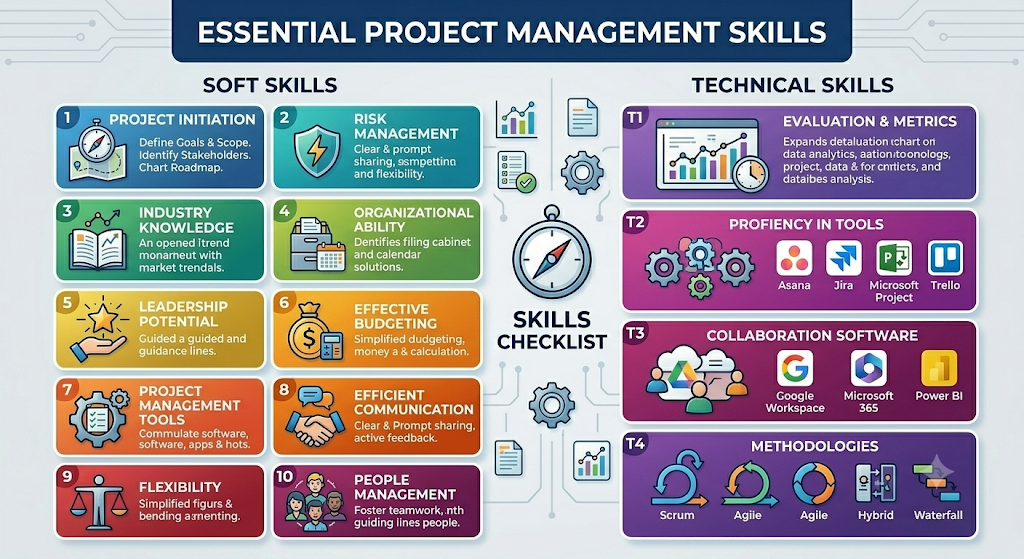
Acquiring the right and relevant project management skills in today’s fast-paced professional arena is crucial, as they help both individuals and teams plan, implement, and deliver projects efficiently. These skills can be of significant help while managing a small team task or a large business project that requires a mix of technical proficiency, effective communication, leadership potential, and problem-solving capabilities.
Let us now take a close look at the most in-demand project management skills that can help professionals take the next big step in their careers.:
1. Project Initiation
This is one of the most crucial project management skills managers must possess, as it helps them lay the right foundation for a project’s successful implementation. Initiating a project correctly means clearly defining the project objectives, identifying the relevant stakeholders, evaluating the project’s feasibility, understanding its scope, and charting a clear project roadmap.
2. Risk Management
This is yet another important skill that involves detecting, evaluating, and addressing potential risks that may affect a project’s overall success. With the right skills and knowledge, project managers can identify risks early in the project and devise strategies to mitigate them and reduce disruptions to the project’s progress.
3. Industry Knowledge
All project managers must have the required knowledge of their respective industries, as it helps them better understand market trends, customer expectations, the typical challenges businesses face, and the regulatory requirements they must adhere to. This knowledge further enables project managers to anticipate risks and make informed decisions to ensure the project goals remain aligned with the company’s overall objectives.
4. Organizational Ability
Project managers must have strong organizational skills, including documenting progress, coordinating allocated resources, and ensuring that all project tasks continue without interruption. Strong organizational skills enable project managers to track project progress more easily and reduce mistakes and delays.
5. Leadership Potential
A good project manager also needs to be a good leader, guiding their team and project toward successful completion, and encouraging effective coordination between them. With leadership skills, project managers are better able to motivate their team members, clearly communicate goals, and promote accountability while adapting to evolving project requirements.
6. Effective Budgeting
This is an important skill for project managers, enabling them to manage allocated resources effectively while keeping project costs under control. Through budgeting, project managers can estimate potential expenses, track spending, and make informed financial decisions throughout the project lifecycle.
7. Project Management Tools
Along with soft skills, project managers must also have sufficient proficiency with project management tools and software to make their everyday tasks easier, helping them plan, organize, and track progress seamlessly. Some popular tools include Asana, Microsoft Project, Jira, and Trello, which enable project managers to allocate responsibilities, manage timelines, coordinate with teams, and monitor progress.
8. Efficient Communication
Communication is a valuable asset for any project manager, enabling them to share crucial project details clearly, accurately, and promptly with the relevant stakeholders. Furthermore, it helps align team members with the project goals, facilitates faster decision-making, and reduces the scope of misunderstandings. Managers must be able to demonstrate skills in clear, concise documentation, active listening, honest feedback, and regular project progress updates.
9. Flexibility
A flexible mindset is a very important skill for project managers, enabling them to quickly adapt to changing project requirements, evolving organizational objectives, and unforeseen challenges. A good project manager stays open to new ideas, makes informed decisions under pressure, and adjusts plans as necessary.
10. People Management
The last on our list of crucial project management skills is people management. Interacting with the human resources team working on a project is vital, as it involves leading, coordinating, and encouraging them as needed to achieve project goals on time. Additionally, good people management skills among project managers help resolve conflicts, allocate tasks appropriately, and foster clear communication among teams.
Now, let’s see why project management skills matter as much in today’s competitive world and some of the vital must-haves for project managers today.
Why Project Management Skills Matter
The primary reason project management skills matter in today’s professional landscape is that they enable professionals to convert raw ideas into valuable, actionable tasks. This further ensures that the project is completed and delivered on time and efficiently, within the set budget.
- Better time management: Effective time management helps the team manage daily tasks and meet project deadlines. The entire day’s schedule can be efficiently set, project progress can be regularly tracked, and delays can be minimized by applying project management skills effectively.
- Improves planning and organization: Project management skills enable managers to follow a structured, sequential framework, helping them clearly define tasks, allocate resources, set priorities, and chart clear roadmaps to achieve organizational goals.
- Enhances problem-solving capacity: Project management skills are carefully designed to equip professionals to identify potential risks, address them promptly, and make informed decisions even under acute work pressure.
- Improves team coordination: Effective project management can facilitate seamless coordination among teams, clear, concise communication, and accountability. This further helps lessen confusion and enhances team productivity.
- Boosts career growth potential: Expertise in project management is highly valued across industries, thereby unlocking opportunities for high-paying careers and top leadership roles.
Technical Skills for Project Managers
In addition to essential soft skills like effective communication and leadership, a project manager needs a solid understanding of tools, technologies, and methodologies to guide a project to successful completion. Some of the technical proficiencies that are good to have for project managers are listed as follows:
- Evaluating project budget, data, performance metrics, and timelines
- Proficiency in project management tools, such as Asana, Jira, Microsoft Project, and Trello
- Collaborating, documenting, and reporting using tools like Google Workspace, Microsoft 365, and Power BI
- A fair understanding of Scrum, Agile, hybrid project management methodologies, Waterfall, etc.
- Allocating resources, managing risk, and optimizing workflow processes for successful project execution
Career in Project Management
Learners aspiring for a lucrative career path in project management require effective communication skills, strong leadership potential, and strategic problem-solving abilities. With these industry-desired skills and specialized knowledge in the domain, project managers are currently in high demand across industries, including construction, IT, healthcare, consulting, and finance.
How to Start a Career in Project Management?
Entering a project management role requires effective written and verbal communication, strong organizational skills, and leadership potential. In addition, securing relevant certifications and hands-on experience in real-world projects can be a significant value add.
Educational Requirements
To start a career in project management, it helps to have a formal educational qualification, though it is not mandatory. The following are the commonly accepted formal educational qualifications for a career in project management:
- A Bachelor’s degree, preferably in Management, Business Administration, IT, or a related/relevant field of study
- A relevant postgraduate degree (optional) in Project Management or an MBA in the field
Certifications to Consider
In addition to formal degrees and qualifications, it helps to continuously upskill yourself with relevant industry-preferred certifications in project management, such as:
- Project Management Professional (PMP)
- Certified Associate in Project Management (CAPM)
- PRINCE2 Foundation & Practitioner
- Certified ScrumMaster (CSM)
- Agile Certified Practitioner (PMI-ACP)
Popular Project Management Job Roles
The field of project management offers several career prospects across diverse industries, with professionals playing a crucial role in planning, coordinating, and delivering successful projects. Listed below are some of the most popular job roles for project management professionals.
Entry Level to Mid Level
- Project Coordinator
- Associate / Assistant Project Manager
- Project Manager
- Project Management Office Analyst
- Project Analyst
Senior Leadership
- Program Director
- Vice President (VP) of Project Management
- Project Director
- Portfolio Manager
- Chief Project Officer (CPO)
Industries Hiring Project Management Professionals
The demand for qualified and skilled project managers is felt across multiple industries today. This is because organizations are increasingly seeking professionals in skilled leadership roles to deliver projects on time and within the defined budget. Some of the popular industries where project managers are in high demand are:
- IT: Project managers in the IT industry are responsible for monitoring software development, taking the required cybersecurity initiatives, and carrying out system upgrades from time to time. They also help ensure effective collaboration between multiple teams to deliver technology solutions and meet the overall business goals efficiently.
- Construction: Construction project managers coordinate routine tasks such as planning, budgeting, procurement, and the effective implementation of building projects and infrastructure on-site.
- Healthcare: Project managers in the healthcare industry lead initiatives such as implementing healthcare technology, hospital expansion, and process improvement programs.
- Manufacturing: Manufacturing companies constantly need skilled project managers to launch new products, streamline production processes, and implement operational improvements.
- Finance: Project managers in financial institutions are responsible for ensuring regulatory compliance, managing risks, monitoring the progress of digital banking initiatives, and overseeing system upgrades.
- Marketing: In the rapidly evolving Marketing industry, project managers coordinate product launches, campaigns, branding initiatives, and digital marketing activities. They also ensure that the teams remain aligned to meet deadlines and achieve all marketing goals.
Project Management Tools and Software
To better carry out their day-to-day operations, project managers use tools and software that enable their teams to efficiently plan, organize, and monitor everyday tasks, and also improve overall collaboration and productivity. Some of the popular project management tools and software used by project managers today include:
- Microsoft Project
- Asana
- Trello
- Jira
- Monday.com
Common Project Management Challenges and Solutions
The role of project management is not without its occasional roadblocks. However, with the right tools, skills, and knowledge, project managers can address these challenges with innovative and effective solutions. Listed below are some of the common challenges and their respective solutions that can help project managers carry out their tasks more effectively:
1. Challenge: Missing the specified deadlines
Solution: Set achievable milestones and practical deadlines, preferably in consultation with the team. Make sure to track progress at each stage of the project.
2. Challenge: Limited resources
Solution: The key is to allocate existing resources optimally, prioritize assigned tasks, and adequately plan for untoward incidents as well.
3. Challenge: Ineffective communication
Solution: Have regular meetings and share updates with the team and other stakeholders on the project, and make use of collaboration tools for more effective communication (both internal and external).
4. Challenge: Risk management issues
Solution: Design risk mitigation strategies early in the project lifecycle to minimize large-scale defects. Also, carry out regular risk assessments at every stage of the project.
5. Challenge: Lack of collaboration between teams
Solution: Clearly define each team member’s role, conduct regular team meetings, and use collaboration tools to improve teamwork and coordination across teams for successful project execution.
Future Trends in Project Management
As industries evolve and adopt modern project management tools and methodologies integrating AI, automation, and data-backed decision-making, it helps to understand the future trends shaping the project management domain and what project managers need to be aware of.
1. Hybrid Project Management Methodologies: Instead of following a single, defined project management approach, several companies are now blending Waterfall, Agile, and other methodologies to create more flexible frameworks that meet diverse project requirements and adapt to evolving business needs.
2. Remote Teams: As organizations increasingly offer roles to skilled professionals dispersed across the globe, project managers are using digital collaboration tools to manage remote teams and ensure productivity and smooth project delivery.
3. AI-Supported Project Management: Project managers are heavily relying on AI tools to automate tasks, identify risks, perform predictive analytics, and allocate resources. These tools help managers make faster and more informed decisions to ensure seamless project completion.
4. Focus on Data-Oriented Decision-Making: Real-time dashboards and advanced analytics enable project managers to identify challenges, track team performance, and optimize project outcomes more efficiently.
5. Sustainability and ESG: Organizations are shifting their focus, incorporating ESG guidelines into planning and implementing projects and ensuring alignment of company goals with ESG and sustainability objectives.
Final Words
Project management is not just restricted to planning assignments or meeting deadlines. It is the very core of organizational efficiency, fostering a discipline that turns mere ideas into successful results. You too can achieve the same for your organization and become an in-demand management professional with an Online MBA in Project Management from the leading Manipal University Jaipur (MUJ).
Offered on the popular Online Manipal platform, the university makes this course available for learners in 100% online format. Adding to the flexibility for working professionals is the increased salary potential for course graduates who gain industry-ready skills. The course imparts in-depth knowledge of project management, combining theoretical concepts with hands-on experience in real-world projects.
FAQs
1. What is project management in simple terms?
Simply put, project management is the process of guiding and managing teams to ensure assigned tasks are completed efficiently from start to finish by optimizing the use of available resources and staying within the defined budget and timelines.
2. What are the main project management methodologies?
Some of the key project management methodologies include:
- Agile
- Waterfall
- Scrum
- PRINCE2
- Lean
3. What are the different project management types?
The various types of project management strategies are:
- Traditional/Predictive Methodologies
- Adaptive/Agile Methodologies
- Control & Enterprise Frameworks
- Quality & Efficiency Frameworks
- Hybrid Methodologies
4. What skills are required for project management?
Some of the key skills that efficient project managers must have to ensure seamless project execution are:
- Hard Skills: Project Planning, Budgeting, Scope Management, Risk Assessment, and Management
- Soft Skills: Communication, Leadership, Conflict Resolution, Empathy, Flexibility
- Technical Skills: Frameworks like Scrum, Agile, or Waterfall, and tools, such as Kanban boards and Gantt charts
5. Is project management a good career?
Yes, project management is a highly rewarding career path offering a high salary and the added advantage of transferable skills across industries.
6. Which certification is best for a project management career?
To start a career in project management, you can pursue a host of industry-relevant certifications, such as:
- Certified Associate in Project Management (CAPM) for entry-level roles
- Project Management Professional (PMP) for mid-to-senior-level roles
7. What industries need project managers the most?
Some of the top industries where project managers are consistently in high demand include:
- Information Technology
- Healthcare
- Construction
- Engineering
- Banking & Finance
Prepare for your next career milestone with us