
Listen to this blog

Introduction: What is Influencer Marketing?
Influencer marketing has emerged as one of the most effective digital marketing practices, driving brand growth today. Brands looking to promote their products or services online collaborate with influencers who have built an engaged, loyal follower base across various social media channels through sustained content creation. These influencers promote the products and services by organically integrating them with their content, unlike traditional ads that mainly focus on flashy sales pitches.
The idea is to tap into the popularity of these influencers to drive immediate or long-term online visibility. Unlike search engine optimization, influencer collaborations, especially celebrity partnerships, can guarantee quick results, significantly accelerating brand awareness and growth.
Depending on the business’s size, type, campaign objective, and budget, brands can collaborate with nano, micro, macro, and mega influencers across Facebook, Instagram, Pinterest, and LinkedIn. With social commerce set to grow even more in 2026 and beyond, influencer marketing is poised for continued growth.
How Influencer Marketing Works Step by Step
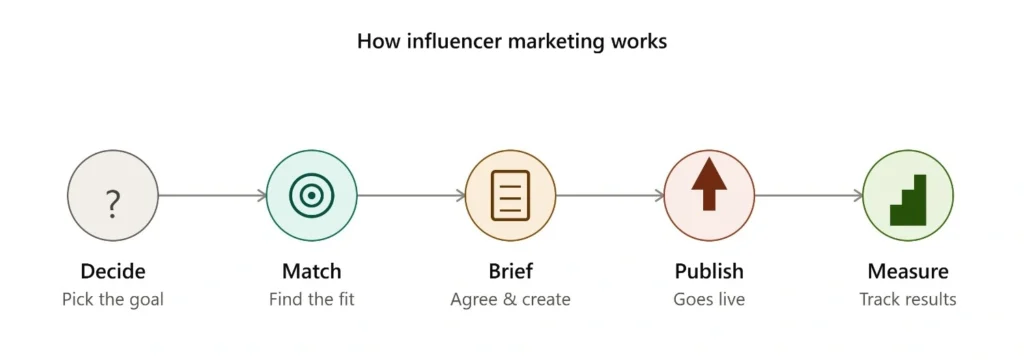
What is influencer marketing? Do you think it is a fairly simple process of roping in influencers and getting them to endorse your offering in exchange for money? Apparently, though campaigns may appear simple, effective collaborations follow a systematic process.
The first step is to define the campaign objective clearly. Are you looking for quick sales, brand awareness, lead generation, or higher website traffic? Depending on your campaign objective, start looking for influencers whose online presence best aligns with it.
Once the influencer is selected (after initial negotiations), both the brand and the influencer discuss the content style, expectations, remuneration, and disclosure requirements. Then, a creative is prepared by combining brand outlines and influencer input.
Once the content is ready, the influencer then publishes it across social channels. The campaign performance is evaluated regularly using popular metrics such as engagement, watch time, and conversions.
Brief History — From Celebrity Endorsements to Nano Creators
The earliest history of influencer marketing can be traced back to celebrity endorsements, in which brands partnered with actors, athletes, singers, dancers, and musicians to raise brand awareness and promote their products. The celebrity endorsements were essentially expensive, and outcomes were hardly measurable.
While celebrity partnerships remained limited to big brands, the foray of social media channels into the advertising space heralded a significant change. Brands, regardless of their size, can now partner with nano-influencers, who, even with 1–10k followers, command unmatched community trust and engagement. With a slightly higher budget, brands can even reach out to micro-influencers with 10k+ followers, known for their infallible credibility online.
With time, influencer marketing continued to gain substantial momentum since users have now started trusting content creators more than celebrities – quite simply because the former have successfully shaped audience perception through authentic content creation over a considerable period of time.
Types of Influencers: By Size, Reach, and Platform
Businesses can select the type of influencer marketing based on their campaign objectives. Here is a look at the leading types of influencers:
1. Nano Influencers (1K–10K): Community Trust and Hyper-Engagement
Nano influencers typically have 1000 to 10,000 followers, consisting primarily of friends, close-knit communities, local members, and acquaintances. These influencers usually maintain regular communication with followers on social media, thereby fostering highly engaged and authentic brand interactions.
They are ideal for small businesses and startups operating on a limited marketing budget and looking to target specific interest groups. Roping in nano-influencers also helps businesses bolster their brand outreach by improving brand awareness, engagement, and credibility.
Since they have way fewer followers than macro influencers or celebrities, it is relatively easier for them to track comments and reply, a practice that contributes significantly to their credibility. Today, many brands prefer partnering with multiple nano-influencers rather than a single influencer with millions of followers to generate authentic conversations around their offerings. Incidentally, nano-influencers are often seen generating higher engagement than bigger influencers.
2. Micro Influencers (10K–100K): Niche Authority Sweet Spot
Brands looking for a broader audience can consider micro-influencers, who typically command 10,000 to 1,00,000 followers on social media. They are often considered the right balance between size and engagement since they primarily focus on educational content to drive visibility and, in particular, charge much less than macro influencers.
They usually operate within specific niches such as lifestyle, health, beauty, fitness, technology, finance, and parenting. Followers generally turn to them for relevant advice, recommendations, and opinions, treating them as highly credible sources of information.
Brands typically rope them in for product launches, brand awareness, educational campaigns, software demonstrations, extensive product reviews, and tutorials.
Since these creators have successfully demonstrated expertise in their field for years, users tend to place a lot of faith in their reviews and recommendations. Businesses looking to boost their credibility with audiences with high purchase intent should consider roping in micro-creators to promote their offerings.
3. Macro Influencers (100K–1M): Broad Reach with Polish
Macro influencers are those with between 1 lakh and a million followers. They are seasoned content creators who rely on professional production quality and consistent publishing schedules to deliver content efficiently.
They are basically established brands themselves. So businesses that want to reach a huge audience overnight usually consider bringing these creators on board. Since they charge significantly more than nano and micro creators, only large businesses and established brands with huge marketing budgets approach them.
While macro influencers have significantly lower engagement than nano and micro influencers, they guarantee a much wider audience reach and immediate brand recognition. What more? They even have prior experience collaborating with big brands and, as such, can provide significant advice on ways to boost campaign execution and performance.
Businesses looking for instant recognition, fast yet wide outreach, professional production quality, and higher ROI often consider macro influencers for product endorsements.
4. Mega / Celebrity Influencers (1M+): Awareness at Scale
Mega or celebrity influencers have over 1 million followers, with some even reaching tens or hundreds of millions across multiple social platforms. This influencer group usually consists of actors, entertainers, athletes, television personalities, and globally acclaimed digital creators.
Needless to mention, one of the immediate advantages of celebrity endorsements is the massive reach they command. However, the collaborations require equally massive budgets, high-level productions, large teams, agencies, and extended campaign planning to ensure optimal campaign outcomes.
Brands looking to promote global products, international campaigns, and high-level product launches typically get these celebrities on board. In this regard, it must be remembered that celebrity brand endorsements have significantly lower engagement than collaborations with nano and micro creators.
This is because it’s humanly impossible for celebrities to regularly track and reply to comments from more than a million followers. Successful celebrity and mega-influencer deals also attract massive media attention.
Comparison Table: Cost, Engagement Rate, Best Use Case per Tier
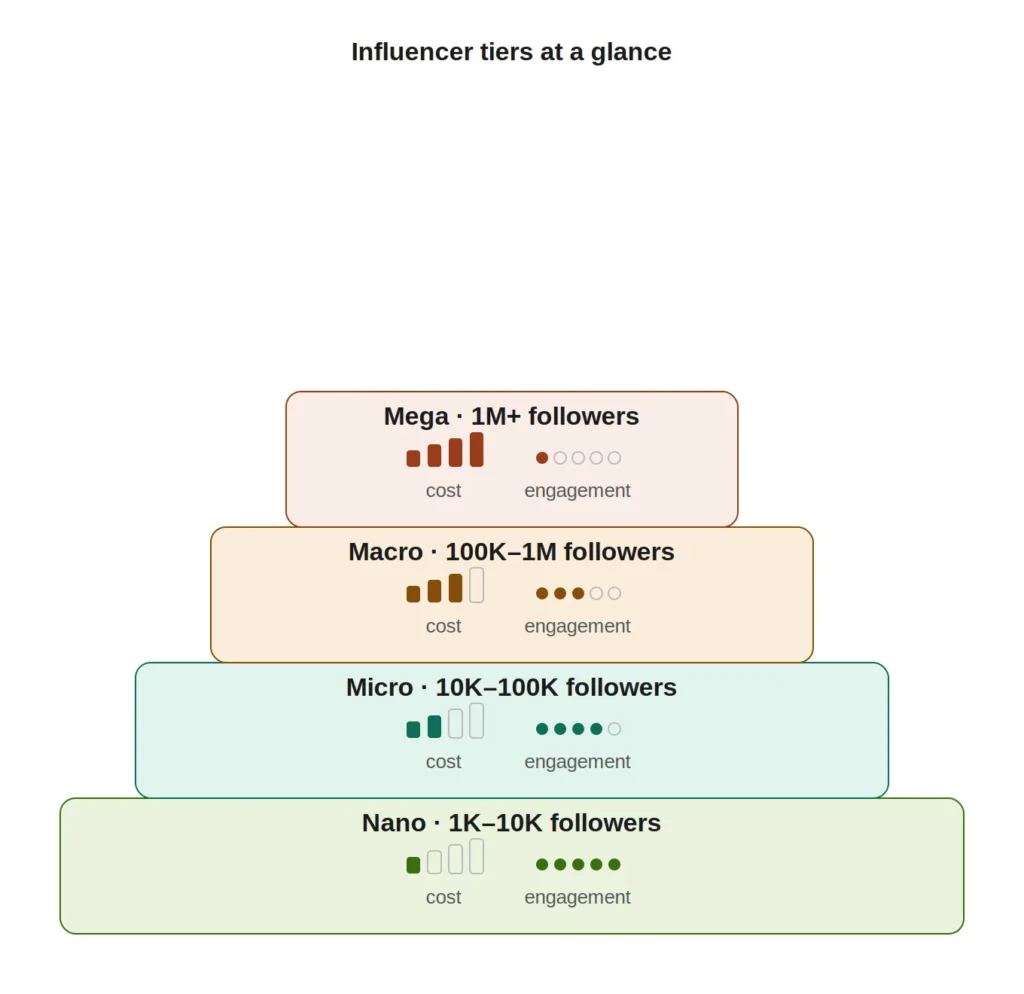
Here is a quick comparison of the typical charges, use cases, and average engagement rate backing every type of influencer marketing we have learned about so far:
| Influencer Tier | Followers | Typical Charges | Average Engagement Rate | Best Use Case Per Tier |
|---|---|---|---|---|
| Nano Influencer | 1k – 10k | Low | Very High | Brands can leverage the web presence of nano influencers to generate user-generated content, support local campaigns, and build community trust. |
| Micro Influencer | 10k–100k | Low to Medium | High | Businesses rope them in for niche marketing, product reviews, and lead generation. |
| Macro Influencer | 100k–1M | Medium to High | Moderate or a little less | Get them on board to boost national awareness campaigns, product launches, and campaigns requiring professional production quality. |
| Mega Influencers or Celebrities | 1M+ | Very High | Very Low | Accelerate global campaigns, mass awareness, and unmatched brand positioning by partnering with them. |
Influencer Marketing vs. Celebrity Endorsements vs. Affiliate Marketing
Know what the key differences among influencer marketing, celebrity endorsements, and affiliate marketing are? Find out details below:
Key Differences in ROI Measurability
Though the main objective of influencer, celebrity, and affiliate marketing is to promote products, they differ significantly in terms of measurability.
Influencer marketing combines awareness and engagement. Although quantifying engagement is difficult, influencer marketing remains a highly measurable digital practice. Businesses can track ROI using popular metrics such as impressions, likes, shares, watch time, clicks, website traffic, views, comments, promo code redemptions, and conversions.
Celebrity endorsements typically prioritize brand esteem and visibility. It is difficult to quantify campaign outcomes from television ads. Campaign efficiency is usually measured by recall, reach, brand perception, and, at times, word of mouth.
Affiliate marketing, on the other hand, is backed by clear ROI tracking capabilities. This marketing model pays affiliates only when predefined actions, such as quality leads and purchases, occur. Marketers can measure every click, commission, and conversion, making affiliate marketing the most quantifiable of the three marketing models.
When to Use Each Model
Depending on their campaign objectives, target audiences, and budgets, businesses can choose among influencer, celebrity, and affiliate marketing models to deliver optimal outcomes.
Influencer marketing works best when you are looking to launch a product, improve brand awareness, leverage user-generated content, earn community trust, reach out to niche groups, or educate your audience. SaaS companies, D2C brands, and businesses of varying sizes launching new products typically leverage influencer partnerships to drive positive business outcomes.
Celebrity endorsements are typically recommended for brands seeking massive visibility in a short time. Global consumer brands, luxury brands, and entertainment businesses typically rely on expensive celebrity endorsements to accelerate visibility and growth.
Affiliate marketing typically facilitates businesses’ revenue-generation efforts. Online course creators, e-commerce businesses, subscription services, and software companies often use affiliate marketing to improve ROI.
In some cases, businesses can also combine all three marketing strategies in a single campaign.
How to Combine All Three in a Single Campaign
How can you integrate all three in a single campaign to maximize impact across all stages of a customer journey? Shared below is a step-by-step use case.
Your campaign may start with a celebrity or a macro influencer announcing the launch of a product or a service, immediately attracting massive media coverage and public curiosity. Your brand has now been introduced and has already generated desirable public interest.
The next step may involve micro or even macro influencers publishing detailed tutorials or reviews of the product (whichever format suits your product the best). You can also consider unboxing videos and testimonials to foster immediate confidence and trust in the offering.
Then come the affiliate partners who can leverage newsletters, blogs, YouTube videos, and comparison websites to bolster promotions through discount codes and unique referral links.
How to Build an Influencer Marketing Strategy in 6 Steps
Now that you’re aware of how influencer marketing works, let’s unlock the holistic strategy through a step-by-step process:
Step 1: Define Goals and KPIs (Awareness vs. Conversion)
Like any other marketing campaign (SEO, SEM, SMM, etc.), influencer marketing campaigns should also have predefined goals. What do you want a specific marketing campaign to do for your brand? Increase website traffic? Generate leads? Increase brand awareness? Drive conversions?
Unless you have clearly defined campaign goals, you will never be able to determine whether your campaigns are successful. It’s as simple as that! What more? It’s your campaign objective that influences the type of influencer you should rope in, the type of content format you should use, and the type of metrics you should measure.
Businesses usually follow a SMART (Specific, Measurable, Achievable, Relevant, and Time-Bound) framework for their campaigns. Awareness campaigns typically require you to measure clicks, views, engagement, follower growth, and brand mentions. Conversion-driven campaigns, on the other hand, prioritize Cost per Acquisition (CPA), Click-through Rate (CTR), and ROI (Return on Investment).
Step 2: Know Your Audience Demographics Before Choosing an Influencer
Who is your target audience? Do the influencers you are considering have relevant followers? If not, you must seriously consider revisiting the list of influencers you’re considering connecting with.
Start developing an audience profile based on demographics such as gender, age group, location, occupation, income, and purchasing behavior. Then consider psychographics, including hobbies, interests, values, and lifestyle goals. Map your audience profile against the influencers’ follower base. The closer the alignment, the better the chances of high engagement, visibility, and lead generation.
Most professional creators share audience insights from platform analytics, clearly highlighting engagement trends, follower demographics, and geographic distribution. Businesses should also ideally check influencers’ comment sections to gauge the authenticity of their interactions with followers.
Notably, an influencer with fewer engaged followers may deliver far greater value than someone with far more disengaged and unrelated followers.
Step 3: Set a Realistic Budget, Including Hidden Costs
Most marketers assume that influencer marketing budgets are largely limited to creator fees. That’s actually a mistake.
Yes, indeed, influencer compensation based on follower size, engagement, exclusivity, and content complexity takes up a chunk of the marketing budget. However, businesses should also consider shipping fees, product samples, videography or photography support, agency fees, licensing rights, campaign management software, and paid ads to boost influencer content.
Proper budget allocation is a crucial determinant of campaign success. Depending on their budget constraints, businesses may face various financial challenges. While small businesses don’t have to worry about high production costs, they still need to ensure that their choice of influencer with limited outreach justifies their marketing spend.
Big businesses, on the other hand, don’t have to worry about outreach, but high production and creator costs can leave a dent on finances if campaign objectives are not met.
Step 4: Find and Vet the Right Influencers
Remember that finding the right influencer is not only about researching followers and hashtags. Your campaign objective should ideally govern the choice of influencer. While smaller creators with a high number of engaged followers are recommended for brands looking to build trust and credibility, larger creators are ideal for businesses seeking overnight exposure.
What more? Make sure the influencers’ overall follower profiles align with your audience profile as well. If you’re a SaaS company, for instance, looking to promote high-end software for better engagement or conversions, it’s way more meaningful to approach a LinkedIn influencer (CEO, small business owner, etc.) with 20k followers than a Gen Z fashion icon with 100k Instagram followers.
Regardless of the follower count, you should steer clear of influencers with a controversial past – whereby their past posts, comments, or actions had sparked serious internet debates, leaving a dent on their reputation.
Step 5: Write a Solid Creative Brief without Killing Creative Freedom
No matter who you partner with, it’s your content that will stand out for your audience. It’s true that visibility in these cases largely depends on the content creator you are roping in. However, businesses that consistently produce highly innovative, unique, yet relevant content eventually stand out for their creative brilliance.
When it comes to influencer marketing, successful content creation is all about the right combination of user relevance, the uniqueness of the creative outline, and the level of creativity that the influencer brings to the table. None of these factors can work in silos to drive campaign performance. Many brands make the mistake of completely overriding influencers’ opinions.
Conversely, some brands are way too intimidated by the influencers’ web presence – so much so that they give them free rein to tamper with the script or creative outline.
Step 6: Review, Refine, and Build Long-Term Relationships
The end of campaigns marks the beginning of new long-term relationships.
Measure campaign performance against predefined KPIs like website traffic, likes, comments, shares, views, calls, clicks, and store footfalls. Discuss the campaign performance with the influencers to identify opportunities for improvement. Focus on building sustainable ambassador programs rather than repeatedly hiring new influencers.
Consistent partnerships go a long way toward building audience familiarity, reducing negotiation efforts, improving content quality, and supporting credibility. Influencers, by virtue of working with you repeatedly, become well-versed in your brand values, thereby delivering insights and content that often surpass brand expectations.
While sponsored ads also contribute significantly to brand growth, having a steady roster of influencers promote your brand multiple times goes a long way toward supporting productivity as well. When you are working with people who have already worked with you, you don’t have to spend much time introducing your brand or explaining its values.
How to Measure Influencer Marketing ROI
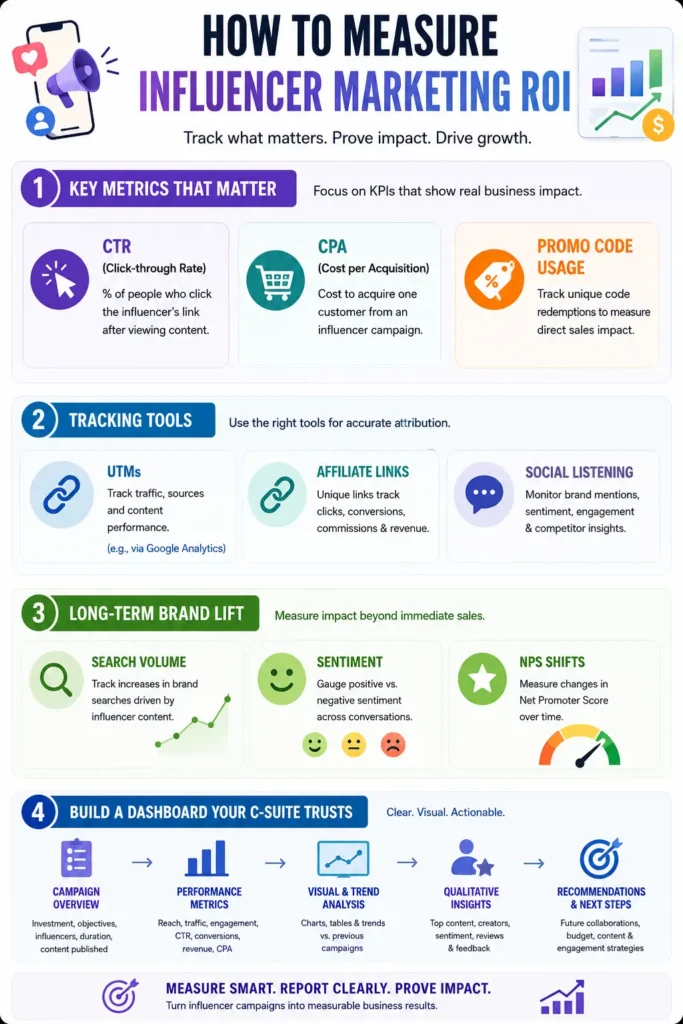
Businesses need to track Influencer Marketing ROI regularly to determine whether it is contributing to their overall marketing efforts.
Key Metrics: CTR, Cost per Acquisition, Promo Code Usage
While it’s heartening to receive many likes and gain many followers from a campaign, please remember that likes, views, and followers do not demonstrate actual business impact.
Measure campaign performance against KPIs such as CTR, CPA, and Promo Code Usage.
CTR, or Click-through Rate, reflects the percentage of people who clicked the link shared by the influencer after viewing their content. A high CTR means the influencer has successfully encouraged viewers to check out your brand or take other predefined actions, such as using a promo code.
CPA or Cost-per-Acquisition denotes how much it actually costs to acquire a single customer from an influencer’s campaign. Businesses often compare CPA across marketing channels, such as social media and paid ads, to assess campaign efficiency.
Promo codes are another highly quantifiable KPI. Sometimes brands leverage unique influencer-specific discount codes to encourage customers to buy from them.
Tracking Tools: UTMs, Affiliate Links, Social Listening Platforms
Today, marketers have access to numerous accurate tracking tools for measuring influencer marketing. While inaccuracies previously marred these tracking tools, they have been refined today to deliver significantly improved results.
UTMs: You can use platforms like Google Analytics to track UTMs. UTM parameters are nothing but custom tracking tags added to URLs. They help businesses track which influencer, content format, or content platform has generated website traffic.
Affiliate links: As mentioned above, are highly quantifiable metrics that help marketers determine ROI. Since every creator receives a unique link and earns commissions only when a desired action is met through that link, brands can easily track commissions, purchases, clicks, and revenue.
Social listening: This empowers brands to monitor customer sentiment through comments (the nature of discussions, emotions surrounding the brand, etc.), shares, likes, and brand mentions. Brands can maximize efficiency by leveraging these tools’ competitor comparison capabilities, too.
Long-Term Brand Lift: Search Volume, Sentiment and NPS Shifts
Not all influencer marketing campaigns guarantee immediate sales. Many of these campaigns are driven by “qualitative” objectives such as raising brand awareness, generating more discussion around the brand, building audience familiarity, and improving future purchase intent.
Search Volume One of the best ways to gauge “qualitative” efficiency of a campaign is to measure search volume. Search volume indicates the number of times people have searched your brand online after viewing influencer content. A higher search volume means that the creator’s content has successfully generated curiosity around your brand, thereby enhancing future purchase intent.
Brand sentiment is another important metric governing campaign success. It typically indicates the nature of discussions around your brand. Users can discuss several aspects of the brand, including the quality of its content, their expectations of the brand, their experiences (for those who have already purchased the product after encountering it in the influencer’s content), and usage advice. Brands should track social sentiments regularly through likes, shares, comments, etc., to gauge marketing impact.
NPS or Net Promoter Score is another important metric used by businesses. They measure changes in the Net Promoter Score to gauge shifts in customers’ willingness to recommend brands.
Building a Reporting Dashboard Your C-suite Will Trust
Your C-suite expects marketing reports focused on highly quantifiable metrics rather than on social media activities. So, work on preparing an influencer marketing dashboard that reflects the right metrics tied to organizational objectives.
Adopt a systematic approach to structure your report. Start with an insight-driven campaign summary that includes total financial investment, primary campaign objectives, the number of influencers, the campaign duration, and the number of pieces of content published.
The second part of the summary should include impressions, reach, website traffic, engagement rate, conversions, click-through rate, revenue generated, and cost per acquisition.
Facilitate visual performance mapping through charts, comparison tables, and trend lines. Take your report to the next level by highlighting comparisons with previous campaigns.
Now that your quantitative data is in place, back it up with sufficient qualitative data, including top-performing content, creators, brand sentiment analysis, customer reviews and feedback, and overall takeaways from the campaign. While you’re mentioning top creators, also explain why they have outperformed others.
Conclude your report with recommendations based on overall campaign learning. Highlight future collaboration opportunities, budget suggestions, content trends and recommendations, and engagement strategies.
Make sure your dashboard is an infallible mix of qualitative and quantitative insights, reporting campaign performance in the best possible way imaginable.
Best Platforms for Influencer Marketing in 2026
Let’s now identify the best platforms in 2026:
1. Instagram: Visual Storytelling, Reels, and Stories
Instagram has become synonymous with influencer marketing, thanks to global influencers who have embraced the platform. The social channel supports varying content formats, including Reels, stories, static posts, and carousels. E-commerce brands also leverage their in-app shopping features to increase visibility and drive clicks.
It’s the reels that drive maximum exposure on the platform. The platform boasts a solid recommendation algorithm that pushes reels even beyond followers. Its Stories feature is particularly effective for promoting limited-time deals, polls, and BTS. Carousels, on the other hand, are ideal for product reviews, customer testimonials, static tutorials, or other educational content.
Brands heavily dependent on visual storytelling (fashion, makeup, home décor, lifestyle, food, and retail, etc.) regularly leverage Instagram for optimal influencer marketing campaigns. If you are looking for the right mix of brand awareness, engagement, conversions, and social commerce, then be sure to include Instagram in your marketing mix.
2. YouTube: Long-Form Trust and Evergreen Shelf-Life
One of the biggest advantages of YouTube is the long-term discoverability of content. While it’s very difficult for users to find old content on Instagram or Facebook, you can easily search for and find content on YouTube even a very long time after it has been published.
What it means for brands is that their YouTube content continues to generate likes, views, comments, and other forms of user interaction for a long time. Businesses looking to promote tutorials, product reviews, interviews, product demonstrations, and educational content should explore this platform to achieve long-term visibility and engagement.
One of its major (often undermined) merits is that it integrates well with search engines like Google. Audiences mulling over high-consideration purchases such as electronics, software, gadgets, automobiles, financial services, and online education rely heavily on YouTube recommendations when making decisions.
Brands focused on building authority and credibility (rather than immediate sales) through educational content can leverage YouTube to run effective influencer marketing campaigns.
3. LinkedIn: B2B Thought Leadership Influencers
LinkedIn is right at the forefront of B2B influencer marketing, quite simply because it has global business leaders as a major part of its active user base. LinkedIn is a professional network leveraged by CEOs, CFOs, business analysts, financial gurus, and trade experts from across the globe.
Regardless of their business sizes, leaders who continue to deliver highly insightful, value-driven content end up commanding substantial followings on the platform.
Brands that are particularly looking to drive awareness and authentic interactions through educational content must explore LinkedIn for the desired exposure. You can collaborate with thought leaders, decision-makers, entrepreneurs, and IT leaders to promote webinars, research reports, white papers, recruitment campaigns, enterprise software, and professional campaigns.
Engagement volumes might be lower than the other platforms, but LinkedIn is usually associated with a stronger professional influence and high-intent purchases.
4. Pinterest, Twitch, Snapchat — Niche but High-Intent Audiences
Today, YouTube and Instagram are dominating influencer marketing. However, other niche platforms like Pinterest, Twitch, and Snapchat offer more engaged conversations. Though exposure is limited compared to YouTube and Instagram, businesses with hyper-targeted objectives often explore these platforms for their high purchase intent.
Pinterest is highly recommended for brands that prioritize visuals. A few examples would be home décor, recipes, fashion, weddings, event planning, lifestyle, jewelry, and food.
Twitch, on the other hand, can be explored by esports, gaming, and live-streaming communities to facilitate real-time communication with loyal followers.
Platform × Influencer Tier Matrix: Who Works Where
| Platform | Best Influencer Tier | Ideal Campaign Objective |
|---|---|---|
| Nano influencers, Micro Influencers, Mega Influencers, and Macro Influencers | Brands looking to bolster brand awareness, highlight product launches, and drive social commerce can engage Instagram influencers to align with their campaign objectives. | |
| YouTube | Micro Influencers and Macro Influencers | Businesses looking to build brand awareness and long-term trust through educational content, such as tutorials, product reviews, and usage guides, can leverage YouTube. |
| Micro Influencers and Macro Influencers | Looking to enhance discoverability through thought leadership and B2B lead generation. | |
| Nano Influencers and Micro Influencers | Businesses can leverage Pinterest for product discovery and lifestyle inspiration. |
7 Influencer Marketing Mistakes and How to Avoid Them
Effective Influencer marketing is not only about learning what to do but also about avoiding what not to do. Here’s a look:
1. Chasing Follower Count Over Engagement Rate
There is no point in mindlessly chasing followers. Roping in an influencer with fewer engaged followers is way more beneficial than getting someone with a huge number of disengaged and unrelated followers on board. Partner with creators who have made sustained efforts to build a solid follower base through authentic interactions.
2. Skipping the Creative Brief or Over-Scripting It
Your creative brief is the foundation of your content. Do not skip it, thinking you can pull off a mind-blowing script without it. The right creative brief, aligned with campaign objectives, user relevance, and brand voice, helps you convey the right message to the audience without the risks of under- or over-scripting.
3. No Formal Contract or Unclear Deliverables
Both businesses and creators should prioritize a formal agreement that clearly defines campaign objectives, disclosure norms, expectations, remuneration, and other deliverables. A partnership without a written agreement brooks serious risks of unresolved disagreements, unexpected bottlenecks, dissatisfaction, and even unfulfilled deliverables. Avoid these challenges or risks by getting everything in writing.
4. Failing to Define Clear Goals and KPIs Upfront
Launching an influencer campaign without clearly defined objectives and KPIs can undermine its efficiency. Improving brand awareness, website traffic, engagement, conversions, and sales are common objectives for influencer marketing campaigns. Campaign performance, on the other hand, is commonly measured against KPIs such as click-through rate, Cost per Acquisition, impressions, reach, conversion rate, and revenue earned.
5. Restricting the Influencer’s Creative Freedom Too Much
While it is important to stay aligned with your brand voice, make sure you’re not unnecessarily stringent about it. In other words, do not curb the influencer’s creative freedom in the process. Creators often have experience partnering with multiple brands and know how to strike the perfect balance between brand alignment and creativity. So, have faith in them.
6. Ignoring Audience Demographics in Favor of Brand Fit Alone
An influencer may look like the perfect fit for your brand, thanks to their aesthetic social presence. However, partnering with him won’t yield results if his follower profile doesn’t match your user persona. Review follower demographics such as location, age groups, income, preferences, and user engagement thoroughly before entering partnerships.
7. Focusing on Wrong Metrics and Missing Long-Term Brand Lift
Don’t just focus on likes, comments, and shares. Businesses seeking meaningful brand growth should prioritize metrics with real business impact, such as clicks, conversions, queries, and revenue.
Do not miss long-term campaign benefits as well. Successful influencer partnerships often lead to improved search volume, curiosity, and customer sentiment. These are crucial to brand growth, too.
Influencer Marketing Examples: Campaigns That Actually Worked
A quick look at the B2C and B2B influencer marketing examples that stood out.
B2C Examples
Famous watch brand Daniel Wellington remains one of the greatest influencer marketing success stories. The brand, instead of relying on flashy ads led by big celebrities, roped in thousands of nano and micro-influencers from travel, fashion, lifestyle, and photography.
These creators went on to produce authentic, lifestyle-focused content on Instagram featuring the watches in everyday settings. Every influencer’s content was backed by personal discount codes, enabling followers to click on links and make purchases, and the brand to closely track conversions from each influencer ad.
The brand strategy also generated a huge amount of user-generated content. Since the creators were consistently sharing aesthetic visual content using brand hashtags, the users quickly began to follow suit – creating similar content on their pages, as well.
It can be said that it’s the combination of social proof, discount codes, and influencer partnerships that worked wonders for Daniel Wellington. This brand strategically steered clear of flashy promotions and celebrity-backed endorsements, focusing on building a real, authentic, value-driven, and fuss-free social presence.
B2C businesses currently mulling over influencer partnerships must turn to this example for value-driven takeaways on brand positioning, audience building, and revenue generation.
B2B Examples
The brand that emerges as a pioneer of successful influencer marketing in the B2B space is Adobe. They have partnered with photographers, educators, filmmakers, and other creative professionals to build a strong brand presence on social media rather than relying solely on traditional advertising.
Their marketing initiatives, such as Adobe Creative Residency, Adobe MAX, and others, can be well termed revolutionary marketing strategies that propelled their social media success. The brand encourages professionals to showcase real-world applications of its products through live streams, tutorials, conference presentations, seminars, and social media content.
Then there are industry experts, who demonstrate product applications and share knowledge, success stories, and testimonials with global audiences. So, instead of pushing software sales through direct messages, Adobe relied on unbeatable expertise and authenticity to sell.
They roped in the most knowledgeable creators hailing from different walks of life. They encouraged them to speak about their product experiences, demonstrate their applications, and address user pain points.
Since B2B influencer marketing is all about positioning your brand through education, Adobe today stands as one of the biggest and most successful examples for relevant brands.
Read our blog on digital marketing to learn more about the various digital marketing channels.
Popular Online Digital Marketing Programs
| Online MBA in Digital Marketing – Learn advanced digital marketing strategies, data analytics, online advertising, and brand management. Ideal for professionals aiming for managerial and leadership positions. |
| Online BBA in Digital Marketing – Develop core skills in SEO, social media, content marketing, and digital business. Perfect for students looking to start a career in the fast-growing digital marketing industry. |
FAQs
1. What is influencer marketing in simple words?
Influencer marketing involves social media partnerships between brands and influencers, aimed at pushing products or services.
2. What are the main types of influencers?
There are four main types of influencers – Nano (1k to 10k followers), Micro (10k to 100k followers), Macro (100k to 1M followers), and Mega (1M+ followers).
3. What are the key benefits of influencer marketing?
Influencer marketing helps brands increase reach, improve brand awareness, build an engaged audience, and accelerate revenue growth.
4. What is an influencer marketing strategy?
Defining a campaign objective is an important step in a holistic influencer marketing strategy. At this stage, brands specify what they want from a particular campaign, i.e., increase brand awareness, conversions, engagement, or revenue.
5. What platforms are best for influencer marketing?
Instagram, YouTube, LinkedIn, Twitch, Snapchat, and Pinterest are leading influencer marketing today.
6. How is influencer marketing different from celebrity endorsements?
Influencer marketing refers to brand partnerships struck with content creators who have fewer but more engaged followers. Celebrity endorsements, on the other hand, are steered by actors, athletes, and other celebrities with more than a million followers.
7. How do I start influencer marketing with a $0 budget?
Even with a $0 budget, you can still start influencer marketing with a limited budget by roping in nano influencers, who charge the lowest rates in the influencer marketing tier.
8. How long does it take to see results from influencer marketing?
Depending on your campaign objectives and the type of influencer you have roped in, your campaign can take anything from a day to 2–3 weeks (approx.) to show results.
9. Is influencer marketing worth it for small businesses?
Yes. Small businesses with limited budgets can rope in nano or micro influencers to target highly dedicated niche communities and local users with high purchase intent.
10. What tools do I need to run an influencer marketing campaign?
Google Analytics, UTM parameters, creator marketplaces, affiliate platforms, and project management software are a few tools you need to start influencer marketing campaigns.
Prepare for your next career milestone with us