Listen to this blog

When I think back a few years, the Union Budget was primarily a topic for the common man to check if the price of daily commodities like soap or pulses had gone up or down. It was something that made front-page news in the morning paper and dominated news channels for a day. However, after the GST reforms, many started believing the budget was now only for economists, politicians, or high-profile industrialists. But that is far from the truth. The budget is a powerful economic tool that shapes our industries, our businesses, and the career trajectories of millions of Indians. It impacts every household, student, and professional in this country.
Let me share a story about a young man named Arjun from a small town in Odisha. Arjun is energetic and brilliant, often topping his class. He dreamt of higher education and would cycle 12 kilometres every day just to reach a coaching centre to prepare for MBA or technology entrance exams. The hurdle wasn’t his talent; it was his geography. There was no decent college in his town, and the nearest university was a three-hour journey over roads that became muddy and flooded during the monsoon.
Arjun’s struggle is not unique; it is the story of millions of young Indians. The Budget 2026, presented by Finance Minister Nirmala Sitharaman, is what I call a “Yuva Shakti” or youth-driven budget, specifically designed to address these challenges and ensure that people like Arjun can finally “catch the train” to their dreams.
The Macroeconomic Vision: Stability Meets Growth
The 2026 budget outlines a clear objective: investment-led growth while maintaining strict fiscal discipline. India remains one of the fastest-growing economies globally, and this budget sets the stage for that momentum to continue.
- Growth Projections: Our economy is expected to grow in the range of 6.8% to 7.2%, with a nominal growth rate (which factors in inflation) of around 10%.
- Capital Expenditure: The government is spending a significant 3.1% of the GDP on capital expenditure for FY 26-27. This focus on “capex” is a deliberate move to boost the economy through long-term assets.
- Fiscal Discipline: While prioritizing growth, the government is also keeping the fiscal deficit at an estimated 4.3%, with a goal to bring the debt-to-GDP ratio down to 50% in the coming years.
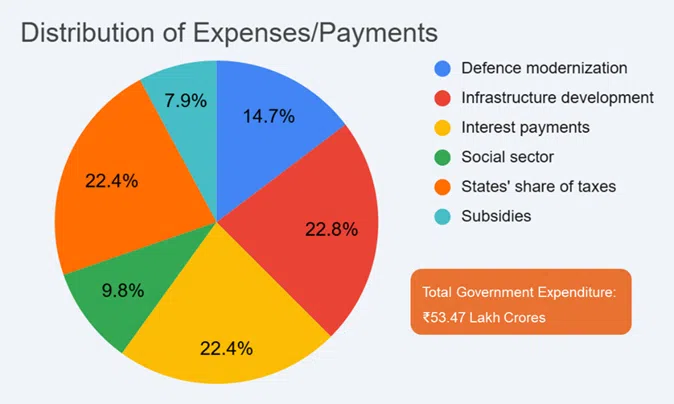
- Strategic Allocation: Out of a total planned expenditure of 53.47 lakh crore, a large chunk is directed toward infrastructure, defence, and social sectors.
Another interesting read: Union Budget 2026: Allocation to Education Sector Increases to ₹1.39 Lakh Crore
Driving Industry through Strategic Manufacturing
One of the most exciting parts of this budget is the identification of seven strategic areas where India aims to scale up manufacturing. We aren’t just looking to assemble products here; we want to design and manufacture them for the world. These seven pillars include:
- Biopharma and Chemicals: Focusing on high-value health and industrial research.
- Semiconductors and Electronic Components: Moving into Semiconductor Mission 2.0 to ensure we aren’t just importers but creators of technology.
- Rare Earth Magnets: Securing the supply chain for future tech.
- Capital Goods and Textiles: Strengthening our traditional and industrial manufacturing bases.
To support the backbone of our economy, the government has also created a 10,000-crore fund for MSMEs. Since MSMEs create the largest chunk of employment and contribute significantly to our GDP, this support is vital for inclusive growth.
A Digital-First Economy
The government’s focus on technology is unmistakable. We are seeing sustained investments in AI, quantum missions, data centres, and cybersecurity. The goal is to make India a key player in the global supply chain by fostering a robust digital infrastructure.
To make India an even more attractive investment destination, corporate tax laws are being rationalized. For instance, the tax rate for the International Financial Services Centre (IFSC) in Gujarat has been reduced to 15%, and the Minimum Alternate Tax (MAT) has been lowered to 14%. These changes, along with making buybacks taxable as capital gains rather than dividends, are designed to be investor-friendly and boost the startup ecosystem.
Personal Taxation and Compliance
While there are no major changes to personal tax rates, the focus has shifted toward ease of compliance and minor reforms.
- TCS Rationalization: Tax Collected at Source (TCS) rates for education and medical expenses have been reduced to 2%.
- Discouraging Speculation: There is an increase in the Security Transaction Tax (STT) on equity derivatives to discourage high-frequency trading that can sometimes be manipulative in nature.
- New Income Tax Act: Perhaps most importantly, a new Income Tax Act is expected to become effective from April 1, 2026, aimed at further simplifying the tax landscape for all of us.
You may like this: 14 Best Career Options after MCom
Preparing the Workforce for Tomorrow
Ultimately, this budget asks the right questions: Are our colleges equipped to provide the facilities needed for this new industrial era? By creating university townships within industrial corridors, the government is bringing education closer to the companies that need talent. This ensures that as new job opportunities are created in the digital economy, our youth are ready to step into them.
Read more: Union Budget 2025: A major boost for higher education
As we move toward a green energy transition and a more technology-driven business landscape, the need for continuous skill development has never been greater. Whether you are a student like Arjun or a working professional, understanding these economic shifts is the first step toward future proofing your career.
To stay ahead in this rapidly evolving economy, it is essential to align your skills with the country’s growth priorities. For those looking to master the financial and strategic nuances highlighted in this budget, pursuing Master of Commerce (Online MCom) from MUJ can provide the competitive edge needed to thrive in India’s “Yuva Shakti” era.
Prepare for your next career milestone with us