Blogs

How an MBA Helps Sales Executives Move into Management Roles

Listen to this blog

Rahul has been his company’s top-performing sales executive for three years. He beats his quarterly targets, clients ask for him by name, and his manager relies on him to close the difficult deals. Yet when a sales manager position opened up last year, it went to someone else. The feedback was polite but clear: he was an outstanding seller, but leadership wasn’t sure he was ready to run a team.
This situation is common. Sales is one of the few functions where performance is visible every month, so strong performers naturally start looking at the next step. But the next step is a different job. A sales executive is measured in personal numbers. A sales manager is measured on the team’s revenue, the accuracy of forecasts, the profitability of deals and how well people grow under them.
That shift, from generating revenue to building and running the business that generates it, is where many capable salespeople stall. This guide looks at what career growth in sales really involves, why the jump to management is harder than it looks, which skills matter most, and where an MBA for sales executives fits into the journey.
What Does the Career Progression of a Sales Executive Look Like?
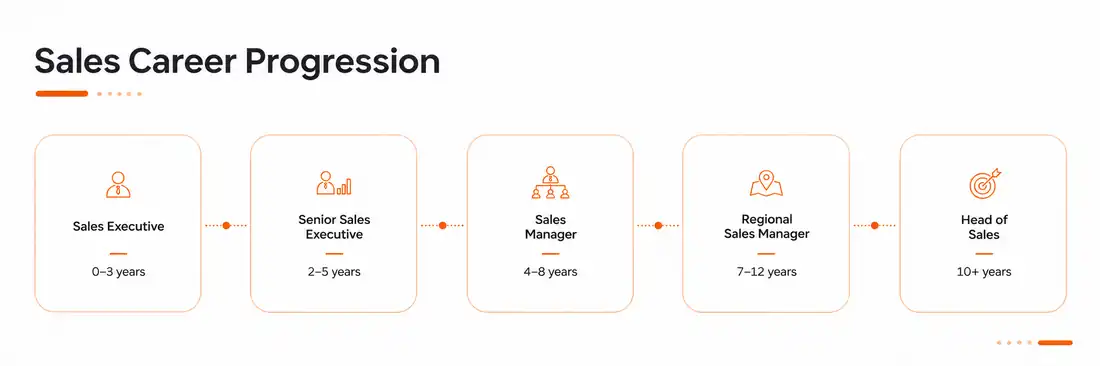
Titles vary by industry and company size, but most sales careers follow a recognizable path. The experience ranges below are indicative; they shift widely between FMCG, banking, SaaS, pharma and other sectors.
| Stage | Typical Experience | Core Focus |
|---|---|---|
| Sales Executive | 0–3 years | Prospecting, client meetings, closing deals, hitting individual targets |
| Senior Sales Executive / Key Account Executive | 2–5 years | Larger or strategic accounts, complex negotiations, informally guiding juniors |
| Sales Manager / Area Sales Manager | 4–8 years | Leading a team, setting and tracking targets, coaching, managing the pipeline |
| Regional Sales Manager | 7–12 years | Several teams or territories, regional revenue planning, channel and distributor management |
| National Sales Manager / Head of Sales | 10+ years | Sales strategy, budgets, cross-functional leadership, reporting to senior management |
Individual Contributor vs Manager
Up to the senior executive level, you are an individual contributor: your success depends on your own output. From the sales manager onwards, your success depends on other people’s output. Your calendar fills with one-on-ones, pipeline reviews, hiring interviews, reports and meetings with marketing, finance and operations. You may still sell, but selling is no longer the main thing you are paid for.
When Sales Professionals Consider Management Education
Most sales professionals start thinking about management education at one of three points:
- They consistently exceed targets but are not being considered for promotion.
- They have just been promoted and find the new role demands skills they never needed before.
- They want to move beyond pure sales into business development, marketing, or general management.
For many, this happens three to six years into their career, once they have enough field experience to connect classroom concepts to real decisions.
Also read: Is Getting an MBA Worth It for Working Professionals?
Why Is Transitioning from a Sales Executive to a Sales Manager Challenging?
The skills that make someone a great salesperson are not the same ones that make a great sales manager. Organizations often promote their best seller by default, and both the new manager and the team can struggle as a result.
Consider Pooja, promoted to lead a team of eight after two record years in B2B software sales. In her first quarter, she keeps jumping into her reps’ calls to close deals herself. This keeps the numbers afloat for a few weeks, but her team stops learning, two reps start missing targets, and she has no time left for the quarterly forecast her regional head keeps asking for.
By the end of the quarter, she is working longer hours than ever, and the team is behind plan. Pooja isn’t failing because she lacks talent. She is struggling because nobody prepared her for a different job.
The transition from sales executive to sales manager usually brings these challenges:
- From “my target” to “our target”: You are now accountable for numbers you don’t directly control. Results depend on how well you hire, coach, and motivate.
- Managing underperformance and conflict: You need honest conversations with struggling reps, some of whom were your peers last month, and you will have to settle disputes over leads, territories and incentives.
- Forecasting and pipeline management: Leadership expects you to predict revenue with reasonable accuracy, which means judging the quality of deals, not just their number.
- Balancing customers and profitability: A deep discount may close a deal, but a manager has to weigh margins, payment terms and the cost of serving each account.
- Cross-functional collaboration: Managers work closely with marketing on lead quality, finance on budgets and credit, operations on delivery and HR on hiring and incentives.
- Greater responsibility: Your decisions now affect people’s careers, the company’s revenue plan, and, at times, its reputation with key customers.
Know more: Which MBA Format is Best Suited for Working Professionals and Why?
What Skills Do You Need to Become a Successful Sales Manager?
Sales management skills fall into five broad areas. Most top-performing salespeople are already strong in one or two of them; the rest have to be built deliberately.
Leadership and Team Management
Coaching reps on technique and deal strategy, delegating instead of doing, motivating the team through recognition, fair incentives and clear goals, and managing performance through regular reviews and honest feedback. A good sales manager makes the whole team better rather than being the best closer on it. Building these soft skills early can make the move into management smoother.
Strategic Sales Planning
Setting targets that are ambitious but achievable, based on market potential and team capacity. Identifying new segments, geographies or channels, and deciding where to focus on limited time and budget.
Financial and Business Acumen
Understanding budgets, revenue, profit margins, and customer acquisition cost (CAC). For example, a ₹10 lakh deal at a 5% margin earns the business ₹50,000, while a ₹6 lakh deal at a 25% margin earns ₹1.5 lakh. A manager needs to see that the smaller deal may be the better one.
Data Analysis and Sales Forecasting
Reading CRM reports and tracking KPIs such as conversion rate, average deal size, sales cycle length and win rate, then using them to forecast revenue and spot problems before they show up in the monthly numbers.
Communication and Negotiation
Managing key accounts, negotiating with large customers and channel partners, resolving conflicts within the team, and presenting plans and results clearly to senior leadership and other departments.
Must read: MBA Course Syllabus (2026): All Semester Subjects List in India
How Does an MBA Help Sales Executives Prepare for Management Roles?
Field experience teaches you how to sell. It rarely teaches you how the rest of the business works: why finance pushes back on your discount, how marketing decides where its budget goes, or how your region’s numbers roll up into the company’s annual plan. This is the gap an MBA for sales management is designed to fill.
A good MBA program connects each subject to decisions a sales manager makes every week.
| MBA subject | How it helps in a management role | Example in practice |
|---|---|---|
| Marketing Management | Helps develop customer acquisition strategies, understand consumer behavior and identify market opportunities. | Working with marketing to define the ideal customer profile and improve lead quality |
| Financial Management | Builds the ability to manage budgets, analyze profitability, and make financially sound decisions. | Checking whether a discount request still leaves the deal profitable |
| Human Resource Management | Helps with team development, employee motivation, and performance management. | Designing a fair incentive structure and running performance reviews |
| Business Analytics | Develops the ability to interpret business data, evaluate sales trends, and make informed decisions. | Building a forecast from CRM pipeline data instead of gut feel |
| Operations Management | Improves sales processes, resource allocation, and coordination between departments. | Shortening the order-to-delivery cycle so the timelines promised to customers are met |
| Strategic Management | Helps align sales objectives with broader organizational goals and long-term growth plans. | Turning the company’s growth plan into regional targets and priorities |
Related read: MBA Specializations Guide: Types, Options and How to Choose
Which MBA Specialization Should Sales Executives Choose?
There is no single best MBA specialization for sales professionals. The right choice depends on where you want your career to go.
| Specialization | Suitable career interest | A good fit if you… |
|---|---|---|
| MBA in Marketing Management | Sales strategy, brand management, market research and marketing leadership | Want to stay close to customers and markets, or move between sales and marketing leadership |
| MBA in Business Analytics | Sales analytics, business intelligence and data-driven decision-making | Enjoy working with numbers and want to move towards sales operations or revenue planning |
| MBA in Finance | Revenue planning, financial analysis and commercial management | Want to own pricing, deal profitability or commercial decisions for key accounts |
| MBA in General Management | Broader business leadership and cross-functional management | Aim for roles such as business head or general manager that span several functions |
When deciding, weigh three things: your career goal for the next five years, the skill gaps you have noticed in your current role, and the kind of management responsibility you want, whether that is leading people, owning numbers or shaping strategy. Marketing is the most natural extension of a sales background, but a sales executive who already has strong customer instincts may gain more from analytics or finance, because those fill a bigger gap.
Check out: Top 6 In-Demand MBA Specializations in 2026
What Career Opportunities Can Sales Professionals Explore After an MBA?
An MBA does not guarantee a promotion but combined with sales experience it opens several management paths.
Sales Manager
Oversees a sales team, sets and allocates targets, coaches reps, reviews the pipeline and monitors revenue performance against plan. This is the most direct next step for most sales executives.
Business Development Manager
Identifies growth opportunities, builds strategic partnerships, and expands the customer base into new segments or markets. The role suits people who enjoy opening doors as much as closing deals.
Regional Sales Manager
Manages sales operations and performance across a geographical region, often leading several area managers and working with distributors and channel partners.
Sales Operations Manager
Improves sales processes, manages CRM and reporting, analyses performance data, and supports sales teams with territory design, incentive planning and forecasting. A strong option for analytically minded sales professionals, especially those with a background in business analytics.
Marketing Manager
Develops marketing campaigns, positions products and aligns marketing initiatives with business goals. Sales experience is an advantage here, because you understand what customers actually respond to.
You may also like: Career After MBA in Marketing: Jobs, Salaries & Scope in India
What to Look for in an Online MBA
Below are some of the parameters to look for while searching for an online MBA:
- University recognition: In India, check that the university is entitled by the UGC to offer online degrees, and look at its NAAC accreditation.
- Curriculum: Look for subjects and electives that match the management skills you need, such as sales management, analytics, finance, and strategy.
- Faculty: Check the mix of academic expertise and industry experience.
- Eligibility: Confirm the requirements for graduation marks, work experience, and any entrance test.
- Learning support: Consider live sessions, access to recorded content, mentoring, career services, and how easy the learning platform is to use.
Read more: Online Manipal’s MBA Placement Record, Partners & Industry Network (2026)
How to Move from a Sales Executive Role to a Management Position
If you want to become a sales manager, these six steps give you a practical plan.
- Identify your career goal: Decide whether you want to move into sales management, business development, or broader business leadership. Each path needs a slightly different mix of skills.
- Assess your skill gaps: Compare your strengths against the five skill areas above. Be honest about where you are weakest, whether that is team management, financial understanding, or strategic planning.
- Build leadership experience now: Volunteer to mentor new joiners, lead a project or a product launch, or take responsibility for a team initiative. You don’t need the title to start leading.
- Strengthen your business knowledge: Learn to read sales reports, understand how your company’s budget is built, and evaluate business performance beyond your own numbers.
- Pursue relevant management education: Consider an MBA that aligns with your career objectives and lets you keep working while you study.
- Demonstrate managerial readiness: In appraisals and interviews, highlight measurable results that involve other people: a junior you coached who hit target, a process you improved, a cross-functional project you led.
Conclusion: Turn Your Sales Experience into Management Potential
Years in sales give you something many managers lack: a first-hand understanding of customers, objections, competitors, and what it really takes to close a deal. That is a strong foundation for a management career.
What often holds sales professionals back is not ability but perspective. An MBA for sales executives helps build the wider business view needed to lead teams, plan revenue, manage budgets, and make strategic decisions with confidence.
Career progression in sales takes more than hitting targets. It means learning to drive performance through people, processes, and business strategy. A sales executive knows how to generate revenue; a sales leader must know how to build and manage the business that generates it.
Ready to take the next step? Explore online MBA courses and find a specialization that fits your sales career goals.
Frequently Asked Questions
1. Is an MBA Useful for Sales Executives?
Yes, particularly for those who want to move into management. Sales experience builds customer and negotiation skills, while an MBA adds finance, strategy, analytics and people management, which are the areas sales managers are evaluated on.
2. Can a Sales Executive Become a Sales Manager After an MBA?
An MBA strengthens your case, but it is not an automatic route to promotion. Employers look for a mix of strong sales results, early leadership experience, and business knowledge. An MBA helps with the last of these and makes the other two more visible.
3. Which MBA Specialization Is Best for Sales Professionals?
Marketing is the most common choice because it builds directly on sales experience. Business analytics suits those interested in sales operations and data-driven roles, finance suits commercial and pricing roles, and general management suits broad leadership goals.
4. What Skills Are Required to Become a Sales Manager?
The core skills are team leadership and coaching, strategic sales planning, financial and business acumen, data analysis and forecasting, and communication and negotiation.
5. Can I Pursue an Online MBA While Working in Sales?
Yes. Online MBA programs are designed for working professionals, with recorded lectures and flexible schedules. Check that the university is entitled by the UGC to offer online degrees before enrolling.
6. What Are the Career Opportunities After an MBA in Marketing?
Common roles include sales manager, marketing manager, brand manager, business development manager, market research manager and, with experience, head of sales or marketing.
Become future-ready with our online MBA program


Information related to companies and external organizations is based on secondary research or the opinion of individual authors and must not be interpreted as the official information shared by the concerned organization.
Additionally, information like fee, eligibility, scholarships, finance options etc. on offerings and programs listed on Online Manipal may change as per the discretion of respective universities so please refer to the respective program page for latest information. Any information provided in blogs is not binding and cannot be taken as final.
Explore Similar Blogs
View All
 25 Nov 2026
 13 mins
 24 Nov 2026
15 mins
 23 Nov 2026
8 mins
 23 Nov 2026
16 mins