Listen to this blog

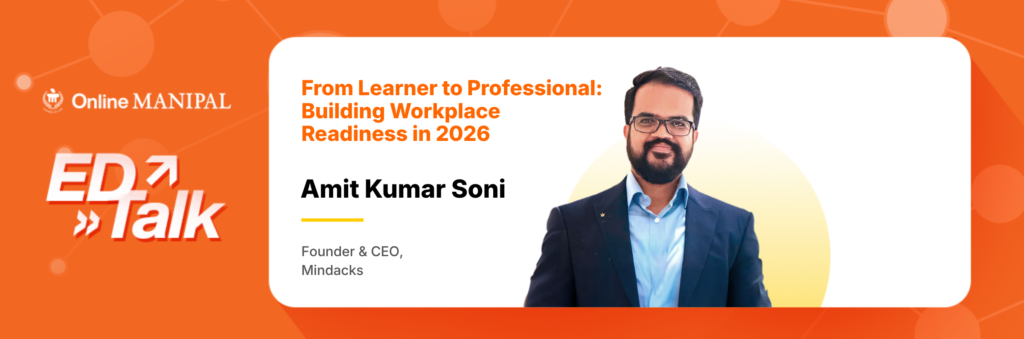
Imagine you are offered a brand-new professional role tomorrow morning. This role requires advanced technological skills. You must also collaborate across diverse teams, solve highly complex problems, and learn completely on the go. How confident do you feel right now about stepping into that position? Note down that level of confidence. The professional landscape is transforming faster than ever before.
Technology, especially artificial intelligence (AI), completely reshapes how we execute our day-to-day responsibilities. Don’t worry, though. Success isn’t about competing with machines. Instead, you must actively develop unique human skills that make you incredibly valuable alongside technology. I have spent eighteen years conducting research in the spaces of AI and neuroscience. Throughout this time, I’ve observed that success isn’t determined by the specific tools you use. It comes down to human intelligence.
If you give two individuals access to the exact same software, one person will generate outstanding work while the other will struggle to achieve meaningful results. The differentiator is always the individual using technology. Your critical thinking, communication, judgment, and problem-solving abilities make all the difference. To thrive, you must shift your perspective and build comprehensive workplace readiness.
Shifting Your Mindset
Every single professional skill you build starts directly within your mind. Technology can learn a technical skill, like a new coding language, in a fraction of a second when you upload a textbook to its system. Humans need time.
Taking in that learning requires dedicated space, time, and practice. Your mindset acts exactly like a mobile phone operating system, while your specific skills are the applications. If your operating system is severely outdated, the newest applications will fail to work properly or won’t even start. To keep your professional operating system completely up to date, you must adopt six core mindsets:
1. Growth Mindset
You must commit to learning on the go and solving problems actively. When you possess a growth mindset, you don’t believe you know everything. Instead, you realize you can always improve and view mistakes as vital lessons rather than failures.
2. Curiosity Mindset
You must stay deeply interested in the world around you and consistently ask better questions. Children naturally learn by asking ‘why’, ‘how’, and ‘what if’. Many adults stop doing this because they fear looking inexperienced. The best professionals do the exact opposite and stay curious.
You me interested to read: Design Thinking for Modern Problem Solvers
3. Adaptability Mindset
You have to be completely ready when things inevitably alter around you. When I started my career at Larsen & Toubro, we had a distinct cabin culture. Whenever a desktop computer faced a technical glitch, we had to call an IT team over a landline phone to sit in our seats and fix it. Today, there is no specialized IT team coming to handle your technical challenges. You must adapt and manage technology independently.
4. Human Plus AI Partnership
You should actively avoid asking whether technology will replace your job. This question simply creates unnecessary fear that freezes your capacity to take action. Instead, you have to ask how technology can amplify your existing capabilities and help you perform your job faster.
5. Creator Mindset
Massive amounts of data are generated in seconds today. Your objective shouldn’t be to simply consume information blindly. You must focus heavily on creating actual value for your business, customers, and audience.
6. Ownership Mindset
You must take absolute responsibility for your own professional growth. You can’t wait for a manager, a parent, or a teacher to solve your professional problems. You have to take the lead yourself.
Cultivating Essential Human Skills
As software becomes smarter by the day, it easily handles text generation, report summaries, and presentation creation. Uniquely human connections become the ultimate premium in the workforce because technology cannot build deep trust, inspire a team, or truly process human emotions. You must intentionally practice several crucial human skills to elevate your presence.
Critical Thinking and Verification
Critical thinking is the answer to some of the greatest modern challenges. Modern software is trained to make you feel comfortable and happy, which means it will sound incredibly confident even when it is completely wrong. If you blindly accept information without evaluating it, you open yourself up to massive errors.
Treat advanced software like a highly intelligent intern. It can assist you immensely, but you must always pause, verify, and review the final output because your name is the one attached to the final work.
Read more: Risk Management Careers in India: Roles, Skills, and Growth
Clear Communication and Articulation
Communication isn’t merely about having proper verbal or written capabilities. It is about making your complex ideas extremely easy for other people to understand. If you have the absolute best idea in a room but fail to articulate it clearly, it will have zero impact. Conversely, someone with an average idea who communicates with flawless clarity will drive substantial action.
Creativity and Dynamic Collaboration
Creativity is not limited to drawing or painting. It is simply the act of solving everyday business problems differently. Think of advanced technological tools as a brand-new Ferrari car where you are sitting directly in the driver’s seat.
You must first learn how to steer the vehicle safely, navigate different roads, adjust your speed, and apply the brakes effectively. Collaboration is transforming from human-to-human interaction into a hybrid dynamic. You will soon find yourself collaborating directly with digital agents inside communication channels, meaning you must view these tools as active members of your professional team.
Unlocking Your Cognitive Superpowers
Cognitive skills dictate exactly how you maintain focus, how fast you learn, and how you make critical corporate decisions. When two individuals join the same firm with identical qualifications and tools, one often grows exponentially faster because of how they think.
To unlock this hidden superpower, you must develop four cognitive areas:
- Unwavering Focus: We are currently living in a highly distracted environment where notifications constantly battle for our attention. If you open your laptop to finish a crucial report but instantly get sidetracked by messaging apps, emails, and online videos, an hour vanishes instantly. The ability to isolate your mind and focus deeply is an incredibly scarce and valuable asset.
- Learning Agility: Years ago, a professional could master a single tool like an Excel spreadsheet, work comfortably for decades, and retire peacefully. That world no longer exists. You must possess the agility to learn new methodologies rapidly and let go of outdated practices that are no longer effective.
- Systems Thinking: Instead of merely reacting to superficial symptoms, you have to look underneath the surface to discover the root cause of an issue. If a plant’s leaves turn yellow, you can keep watering it, but the true issue might be root damage or poor soil. Systems thinkers don’t just ask how to patch a problem today. They uncover why the failure occurred in the first place to safeguard tomorrow.
- Metacognition: This is the practice of thinking about your own thinking. It requires you to take a conscious step back to analyze your reactions and mental processes. When utilizing digital tools throughout the day, pause and evaluate whether the tool is expanding your cognitive capability or making your brain lazy.
Also read: Future of Work & AI: Panel Discussion at Panorama 2026
Technical Literacy and Effective Workflow Design
To engage with modern systems safely and productively, you must establish strong foundational literacy. This doesn’t mean you need to become a programmer or an engine builder. It simply means you need to understand what the system can achieve, what its limitations are, and what risks you must watch out for.
To get the absolute best results from your digital systems, don’t treat them like basic search engines. Utilize structured frameworks to outline your requirements. I recommend using the RCTF formula, which stands for:
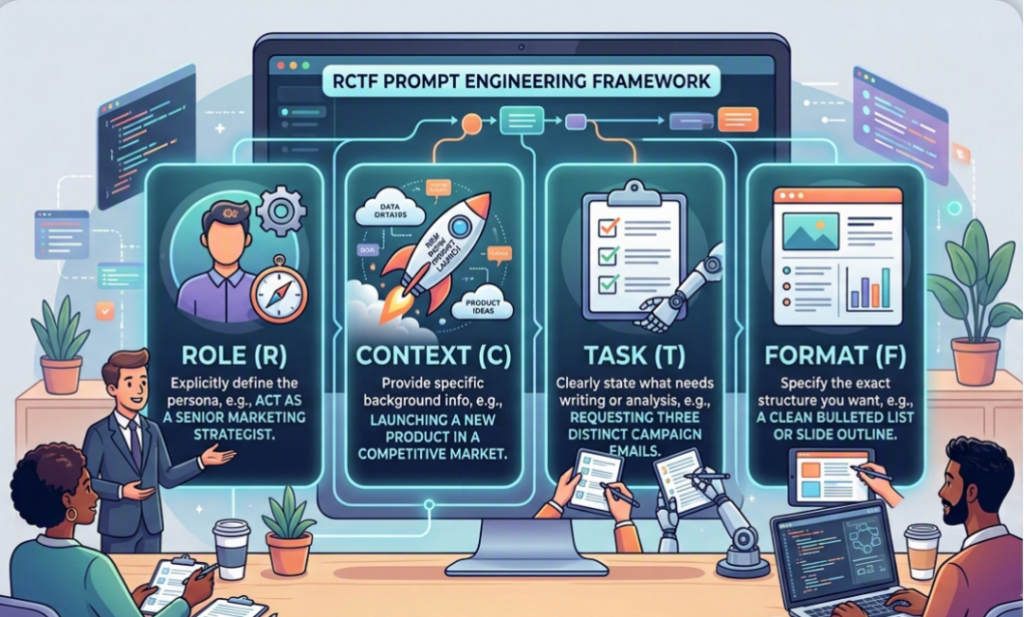
While technology can easily automate repetitive tasks, you must stay aware of phenomena like hallucinations, where a system confidently delivers a completely incorrect answer. Protect sensitive data by ensuring you never paste confidential company, customer, or personal identification records into public systems. True technical literacy involves designing workflows that treat technology as a highly supportive assistant, never as a total replacement for your own human judgment.
You may be interested to read: 9 Side Hustle Ideas Students Can Start While Studying
Leading with Purpose, Trust, and Empathy
Ultimately, true workplace readiness culminates in human-centered leadership. The professionals who rise to leadership positions in this technological era won’t necessarily be the ones who understand the underlying programming code the best. They will be individuals who lead with absolute trust, profound empathy, and clear purpose.
Strategic thinking requires you to look far ahead, much like a skilled driver looking down a long highway rather than staring solely at the front bumper of the vehicle. Change leadership involves helping your peers navigate transitions smoothly without succumbing to anxiety.
Remember that every single individual you work alongside faces personal or professional challenges that you might not see. Sometimes, they don’t need immediate technical advice. They simply need a leader who will listen attentively. When you define a clear purpose, a true North Star, for yourself and your team, you eliminate distractions and build long-term career resilience.
Aligning Your Journey with Continuous Education
Building these multi-faceted dimensions of workplace readiness requires structured development. If you want to formalize these competencies and stay ahead of the curve, pursuing an advanced online degree program can provide the ideal ecosystem.
Online Manipal offers a robust selection of UGC-entitled online degree courses, including specialized Master of Business Administration (MBA), Bachelor of Computer Applications (BCA), and Bachelor of Commerce (BCom) programs tailored for the modern workforce. These programs help learners integrate critical thinking, digital literacy, and strategic human-centered leadership into their professional toolkits, ensuring long-term career growth in a rapidly changing world.
Prepare for your next career milestone with us