Blogs
Blogs 
The Science of Attention: How to Stay Focused During Online Classes

Listen to this blog

Have you ever been in a situation where it’s just 10 minutes into your online lecture, and you are thinking about what will happen in the second volume, fifth season of Stranger Things? And then you are going through the cast, release dates, etc., and now you are researching the Montauk Project. Five minutes later, you have no idea what your professor is talking about.
Unless we were superhumans, this scenario would have happened to everyone. Now, speaking about the shift in education, it can be said that our brains are not wired for a digital classroom. Further, it also demands a lot of attention. There is a strong scientific backing to this. And there are also tips for overcoming these challenges, making it frustrating to satisfying.
Hence, we have put together this blog post that explains the neuroscience behind attention, how online classes drain focus, and provides evidence-based strategies that can actually eliminate this. Whether you’re a student struggling through Zoom University or a professional taking online courses, you’ll discover practical techniques to reclaim your concentration and maximize your learning potential.
Read More: The Psychology of Online Learning: What Makes It So Effective?
The Three Types of Attention
Neuroscientists identify three primary attention networks that govern how we focus:
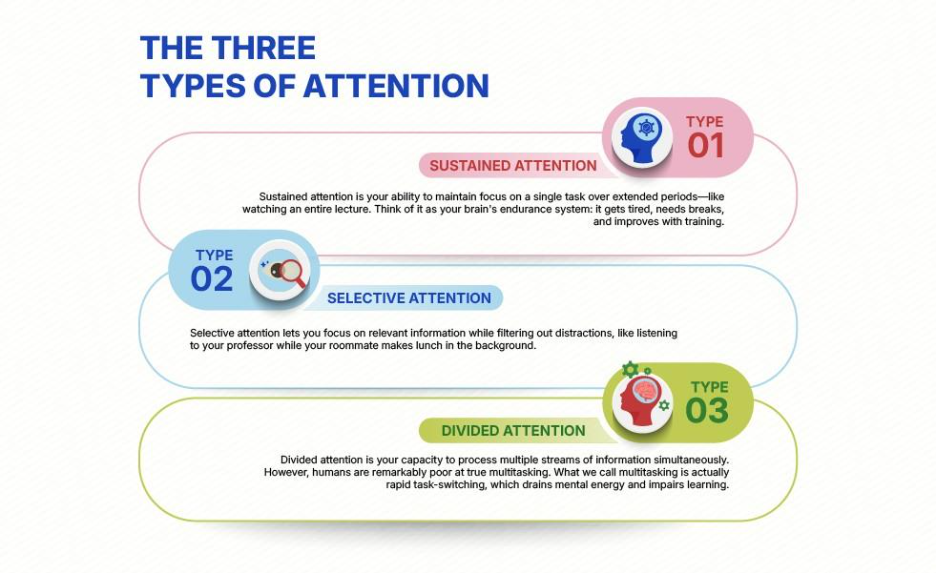
Sustained attention refers to the ability to maintain focus on a single activity over an extended period of time. For example, a student demonstrates sustained attention when they concentrate on an online lecture or work continuously on an assignment without losing focus.
Selective attention is the ability to focus on a specific task while filtering out distractions from the surrounding environment. An example of selective attention is when a learner listens carefully to an online class while ignoring background noise or phone notifications.
Divided attention refers to the ability to manage more than one task at the same time. For instance, a student shows divided attention when they listen to a recorded lecture while simultaneously taking notes or checking course-related messages.
How the Prefrontal Cortex Manages Focus
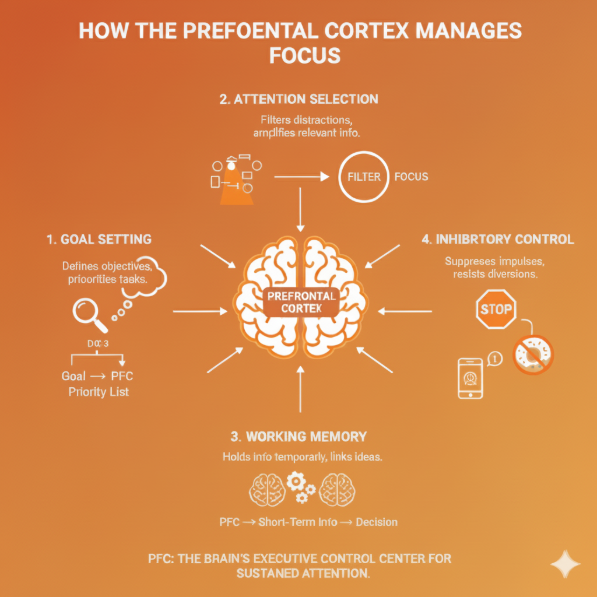
The prefrontal cortex is the brain’s executive control centre, where everything from paying attention to filtering distractions takes place. When functioning at its best, it helps you resist immediate temptations in favor of long-term goals like staying focused on a lecture rather than checking Instagram.
But the prefrontal cortex can be easily energy deprived. Further, if the person undergoes a messed-up sleep cycle, stress, hunger, decision fatigue, and so on, it can affect the prefrontal cortex. This is why your focus tends to wane, and it gets harder to concentrate during stressful periods.
Given below is an image of how the prefrontal cortex works:
Why Digital Environments Hijack Our Attention
Usually, the digital environment is designed to be very engaging. For instance, social media platforms, apps, websites, and other products are designed with the help of expert psychologists to be as engaging as possible, which literally translates to being as distracting as possible.
Further, the digital environment eliminates the natural attention cues. If taking a physical classroom, there are several focus elements such as spatial boundaries, social presence, environmental context, and so on. But these blur when classes are taken online. This is because your screen is in the same space as your entertainment, social hub, and sometimes your relaxation zone, too. All this leads to lower concentration rates, making it difficult for your brain to manage an appropriate mental state.
The Cognitive Load Problem
Cognitive load theory explains that our working memory has limited capacity. When you’re processing video, audio, chat messages, visual slides, and trying to take notes simultaneously, you’re overwhelming your cognitive system. This is particularly problematic in online classes where technical issues, platform navigation, and screen management add additional mental burdens that don’t exist in physical classrooms.
Challenges Faced During Online Classes
The challenges students face during online classes are unique. Since education is not delivered in person, it can raise concerns due to differences in cognitive environments. Below are a few:
Lack of Physical Presence and Social Accountability
When learners are placed in a physical classroom, they are bound to focus, as the setup creates implicit social pressure to pay attention. This phenomenon, called social facilitation, naturally supports concentration. But online classes remove this dynamic. Since the learner is left alone and there is no social accountability, it is psychologically easier to disengage, check your phone, or simply zone out.
Digital Distractions at Arm’s Reach
The biggest challenge an online student can face is the constant threat of infinite distractions. In a traditional classroom, the options for diversion are very limited. In an online class, every distraction is just a single click away. Further research shows that the mere presence of a smartphone (even when turned off) is likely to reduce cognitive capacity. This “brain drain” effect means that simply having your phone nearby diminishes your ability to focus and learn, even if you never touch it.
Screen Fatigue and Its Impact on Concentration
Mental and physical fatigue can be triggered by extended screen time. If the learner is also a working professional, then they are glued to screens for longer periods of time. And the eyes work harder to focus on screens. And this visual process demands more cognitive resources. Further, blue light can disrupt circadian rhythms and cause eye strain, making it even harder to concentrate.
The “Zoom Fatigue” Phenomenon Explained
In a traditional classroom, it is very easy to understand your faculty’s facial expressions, body language, spatial relationships, and so on. But in video classes, these cues are flattened, delayed, and sometimes contradictory, requiring extra mental effort to interpret. Hence, this builds some cognitive burdens. Additionally, there may be an increase in cognitive dissonance between social rules. The constant awareness of your own face in the gallery view can also trigger self-monitoring that doesn’t occur in regular conversations, consuming mental resources that should be directed toward learning.
Multitasking Temptation and Why It Doesn’t Work
In an online setup, the whole environment screams multitasking. Learners can have multiple tabs open, with notifications received on one tab and tasks completed on the other. And studies have shown that this kind of multitasking can harm learning and retention. It is said that the brain takes 23 minutes to fully regain focus once it is lost. And this frequent switching can lead to a fractured experience where the concepts are not fully registered in the memory.
An interesting read: Online Learning: Pros and Cons of Online Education
Science-Backed Strategies for Better Focus
The above-mentioned challenges are not serious, as neuroscience and educational psychology provide evidence-based strategies to help you focus on your online class.
Before Class: Setting the Stage for Success
Your ability to focus during class is largely determined by what you do beforehand. Proper preparation primes your brain for optimal attention and learning.
Optimize Your Physical Environment
Always have a designated place for your brain’s thinking activities so it automatically signals, “This is where I focus.” This develops contextual associations, and studying in the same place where you sleep or watch Netflix can create cognitive confusion. Make sure the focus area has natural light and minimal glare on the screen. Further controlling the acoustic environment is very important, as the best way to focus is in a quiet place. Research suggests that moderate ambient noise (around 70 decibels, like a coffee shop) can actually enhance creative thinking.
The Role of Sleep and Nutrition
When it comes to the most powerful cognitive enhancer, nothing can beat sleep. When studying the psychology of sleep, it is said that it consolidates memories, clears metabolic waste, and restores neurotransmitters essential for attention. Hence, even a mild sleep deprivation can affect focus, learning ability, and memory. Hence, 7-8 hours of sleep is very important. Good nutrition is also like being on the same side of the coin. Our brain accounts for about 20% of the body’s energy, as it requires steady glucose levels to function optimally. Hence, eating a balanced meal with protein, healthy fats, complex carbohydrates, and avoiding high–sugar foods is very important.
Pre-Class Routines That Prime Your Brain
Always establish a routine before classes, so the brain knows it’s time to focus. This can be as simple as light stretching, revising previous notes, or even noting key takeaways for the coming session, which will help. If this is followed consistently, it makes it easier to engage in class. Learners can also practice brief mindful exercises to clear mental clutter and enhance attention.
During Class: Active Engagement Strategies
Once class begins, your goal is to maintain active engagement rather than passive observation. The brain learns best when actively processing information, not merely receiving it.
Active Learning Techniques
One thing learners can start doing is to become active participants rather than passive viewers. The best way to do this could be through strategic notetaking. Rather than transcribing everything verbatim, engage in generative notetaking where you process and rephrase information in your own words. This forces deeper cognitive processing and enhances retention.
The Pomodoro Technique Adapted for Lectures
The Pomodoro Technique uses focused work intervals (traditionally 25 minutes) with short breaks. In live lectures, use natural transitions, topic changes, or Q&A pauses to quickly reset close your eyes, take deep breaths, or stretch. These microbreaks prevent attention from fatigue. For recorded lectures, watch 25–30-minute segments with actual five-minute breaks away from your screen. This rhythmic approach aligns with your brain’s natural attention cycles and enhances sustained focus.
Managing Notifications and Digital Distractions
Before class, put your phone in another room—not on your desk or in your pocket. This eliminates temptation and cognitive drain. Close unnecessary browser tabs and enable “Do Not Disturb” mode. For emergencies, designate one person who can reach you by phone. Consider browser extensions like Freedom, Cold Turkey, or StayFocusd to block distracting websites during class. These tools support your focus when willpower weakens.
Body Positioning and Its Effect on Alertness
Your posture directly affects alertness. Sitting upright with feet flat promotes focus; while slouching signals relaxation. This is neurobiology, not etiquette. Use a standing desk or tall stool for part of the class to boost engagement. Keep your screen at eye level to prevent drowsiness. Incorporate movement: shift positions, flex your feet, engage your core, or do subtle exercises. An engaged body supports an engaged mind.
After Class: Consolidating Learning
What you do immediately after class is crucial for transforming short-term attention into long-term learning.
Consolidate Through Active Review
Within an hour after class, spend ten minutes reviewing your notes. Fill gaps, clarify confusion, and summarize main concepts. This is when your brain transfers information to long-term memory. Connect new material to existing knowledge: How does this relate to previous lectures? How can I use this? What questions remain? These connections strengthen retention.
Restore Attention Capacity Through Strategic Breaks
After class, give your brain a true rest. Ideal activities engage you without requiring intense concentration. Nature exposure is particularly effective even a short walk restores attention. Other options include light exercise, creative hobbies, social conversation (not about class), or brief naps. Avoid immediately switching to another demanding task or mindless scrolling, which doesn’t restore attention capacity.
Conclusion
Attention is not a personal failing, but a limited biological resource shaped by how our brains interact with digital environments. Online learning has not weakened our ability to focus; it has simply highlighted how easily attention can be drained when screens, notifications, and cognitive overload compete for mental space. Understanding the neuroscience behind attention helps reframe distraction as a natural response, not a lack of discipline.
The encouraging reality is that focus can be rebuilt with intention. By designing supportive environments, following brain-friendly routines, and engaging actively before, during, and after class, online learning can become both effective and sustainable. Small, science-backed adjustments compound over time, turning digital classrooms into spaces where attention is protected, and meaningful learning can truly occur.
Prepare for your next career milestone with us


Information related to companies and external organizations is based on secondary research or the opinion of individual authors and must not be interpreted as the official information shared by the concerned organization.
Additionally, information like fee, eligibility, scholarships, finance options etc. on offerings and programs listed on Online Manipal may change as per the discretion of respective universities so please refer to the respective program page for latest information. Any information provided in blogs is not binding and cannot be taken as final.

Explore Similar Blogs
View All
 25 Sep 2026
 7 mins
 23 Sep 2026
6 mins
23 Sep 2026
6 mins
 20 Aug 2026
10 mins
20 Aug 2026
10 mins
 19 Aug 2026
10 mins
19 Aug 2026
10 mins