
Listen to this blog

Have you ever paused to think about how many times you have used the Unified Payments Interface (UPI) in the last 24 hours? Whether it is paying for a morning cup of tea, booking a cab, or settling a bill with a friend, scanning a quick response (QR) code has become an unconscious habit for millions of us. But behind this daily convenience lies an architectural marvel that has completely taken over the global stage.
Did you know that 49% of all real-time payments in the entire world happen right here in India? This staggering figure means that one out of every two real-time transactions globally takes place in our country surpassing the combined digital payment volumes of the United States, the United Kingdom, and even the European Union. The evolution of how people deal with money is moving at an unbelievable pace in India that is redefining global financial technology platforms.
The Historical Journey of Indian Payments
To appreciate where we are today, let us look back at how our relationship with money has transitioned over the last few decades. India was historically a heavily cash-centric country. Long before that, as we all studied in our school textbooks, our societies relied on barter systems where individuals exchanged one product directly for another. Following independence, cash became our most prominent transaction mode, and digital infrastructure was nowhere near what we see today.
The structural shift began unfolding through key milestones:
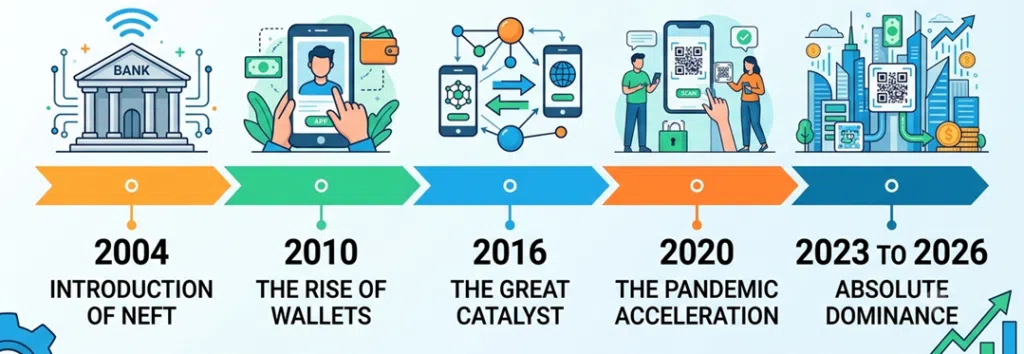
- 2004 (Introduction of NEFT): The Reserve Bank of India (RBI) introduced National Electronic Funds Transfer to facilitate bank-to-bank and bank-to-merchant transfers. Today, NEFT is primarily utilized for high-value transactions, operating similarly to Real Time Gross Settlement (RTGS).
- 2010 (The Rise of Wallets): Early FinTech pioneers like Paytm emerged, introducing the concept of digital wallets. Users had to manually load money into a standalone wallet to make transactions to merchants or other users.
- 2016 (The Great Catalyst): In November 2016 at 8:00 PM, the nation went through demonetization. Concurrently, the National Payments Corporation of India (NPCI), a not-for-profit company established by the RBI and the Indian Banks Association, launched UPI. This accelerated the adoption of digital payments, resulting in an immediate 300% surge in digital transactions during the 2017 financial year.
- 2020 (The Pandemic Acceleration): The restrictions imposed during the COVID-19 pandemic meant individuals could not visit physical bank branches. This forced necessity resulted in another massive hike in regular UPI usage.
- 2023 to 2026 (Absolute Dominance): By 2023, UPI powered 95% of all digital consumer transactions in India. The remaining 5% is split among debit cards, credit cards, prepaid payment instrument (PPI) wallets, NEFT, and RTGS.
The Pillars of Success: The JAM Trinity
When I analyze what made this massive scale possible in just a single decade, it comes down to a structural acronym known as the JAM Trinity. Without these three foundational pillars, the infrastructure of UPI could never have achieved deep market penetration.
| Pillar Component | Abbreviation | Description & Scale Impact |
|---|---|---|
| J | Jan Dhan Accounts | Launched in 2014 to bring the unbanked population into the formal banking fold, this scheme has added over 580 million new bank accounts. |
| A | Aadhaar Digital Identity | Serving as a secure identity stack, over 1.3 billion Indians (more than 95% of the population) possess an Aadhaar card, allowing for seamless identity validation and know-your-customer (KYC) checks. |
| M | Mobile Connectivity | India boasts over 1.1 billion mobile connections over which 750 million are smartphone users. This was further accelerated by the market entry of telecom disruptors like Jio, which brought down data costs from over 250 rupees per gigabyte (GB) to between 8 and 10 rupees per GB. |
Another interesting read: What is International Financial Reporting Standards (IFRS)?
Demystifying the Architecture: How UPI Works
When you perform a simple scan-and-pay transaction, you are interacting with a highly orchestrated network. In my time working with core banking platforms and financial ecosystems, I often use the analogy of an Air Traffic Controller (ATC) to explain the role of the NPCI. The ATC does not own the airplanes, the money, or the physical airport, but it perfectly coordinates every single movement. Similarly, the NPCI acts as the central router that orchestrates tokenized data transfers between distinct bank architectures.
The underlying mechanics involve several critical players working synchronously 24/7/365:
- The Payer and Payee: You initiate a payment using a Virtual Payment Address (VPA), such as name@okicici or name@upi, which uniquely identifies your account without exposing sensitive bank details.
- Third-Party Application Providers (TPAPs): Applications like PhonePe, Google Pay, and Paytm handle the consumer interface. As of April 2026, these top three applications command a combined market share of over 80%, while other platforms like Cred, Super Money, BHIM and Navi make up the remaining segments.
- Payer and Payee Banks: The infrastructure operates on top of pre-existing Immediate Payment Service (IMPS) rails. When you enter your personal identification number (PIN) or utilize biometric authentication (which now supports face ID or fingerprint recognition up to a limit of 5,000 rupees), a real-time message debits your bank account and instantly credits the beneficiary bank.
An incredible aspect mandated by the NPCI from day one is absolute interoperability. Unlike messaging applications like WhatsApp and Telegram, where a message sent on one cannot appear on the other, UPI operates like different cars traveling along the exact same highway. If you are using Google Pay, it does not stop you from seamlessly sending money to an individual utilizing PhonePe or a merchant using Paytm.
To protect the ecosystem from a monopoly, the NPCI introduced a circular capping individual application market shares at 30%. Due to the heavy reliance of users on dominant players, this deadline has been extended to December 31, 2026, to allow newer applications to scale up naturally.
You may like to read: How to Get a Banking Job After BCom?
The Staggering Scale of Modern Transactions
To put the current ecosystem into perspective, let us look at the official numbers recorded recently. In the single month of May 2026 alone, the platform processed 23.2 billion transactions, accounting for a monetary value of 29.9 lakh crores (approximately 312 billion US dollars). For the entire financial year of 2026, the volume reached an astonishing 241.62 billion transactions.
This translates to more than 60 million transactions every day, or roughly 7,600 transactions occurring every single second. This means that while you have been reading this specific paragraph, tens of thousands of secure transactions have successfully processed across the country.
Going Global: Cross-Border UPI Expansion
We are no longer keeping this national infrastructure to ourselves; India is actively exporting this payment technology globally. Recently, an announcement confirmed that our systems have officially gone live in Greece via Euro Bank. This brings the total count to nine international countries that accept our payment network:
- Singapore
- United Arab Emirates (UAE)
- France
- Qatar
- Bhutan
- Nepal (Which uniquely supports two-way transfers, enabling their citizens to use the architecture too)
- Sri Lanka
- Mauritius
- Cambodia
- Greece
When you travel to these destinations, you do not have to rely entirely on expensive international credit cards or forex cards. You simply have to enable international transactions directly inside your preferred application. Through integration with international foreign exchange partners, you scan a foreign merchant’s QR code, view the live transaction value converted clearly into Indian Rupees (INR), and make the payment. Your account is debited in rupees, and the merchant instantly receives their local currency, whether it is Euros or Dinars.
Read more: Step-by-Step Guide on How to Become a Chartered Accountant (CA)
Understanding the Central Bank Digital Currency (CBDC)
A separate but highly relevant innovation introduced by the RBI in late December 2022 is the E-Rupee, our Central Bank Digital Currency (CBDC). It is crucial not to confuse the E-Rupee with volatile cryptocurrencies or commercial stablecoins. Cryptocurrencies fluctuate wildly and are highly restricted, whereas the E-Rupee is legal tender issued directly by the RBI and holds an exact 1:1 value equivalent to physical cash.
Key distinctions of the E-Rupee include:
- Digital Cash, Not a Deposit: It does not sit as a typical bank deposit; it functions like digital cash held in a specialized secure wallet app provided by participating banks.
- Offline Capability: It supports completely offline transactions, and if you happen to lose your smartphone, your money is not permanently lost; it can be fully recovered once you secure a duplicate SIM card and complete secure re-authentication.
- Programmable Money: This is its most revolutionary feature. Money can be programmed to be conditional or have an expiration. For instance, if the government distributes an agricultural direct benefit subsidy of 50,000 rupees to a farmer as E-Rupee, the currency can be structurally locked so it can only be spent on valid agricultural requirements, such as fertilizers or farming machinery.
As of March 2026, the RBI reported 7.7 billion rupees worth of CBDC currently in circulation, with the user base expanding past 8 million citizens across more than 50 pilot cities, including active implementations in Maharashtra and Gujarat.
Explore more: Top BCom Specializations List in India – A Complete Guide
The Next Frontier: Credit on UPI and ULI
The lending landscape in India is currently undergoing a massive transformation via digital public infrastructure. Historically, you needed a positive balance in your savings bank account to complete a scan-and-pay transaction. Today, we have Credit on UPI, which allows you to attach a pre-approved digital credit line or link a RuPay credit card to your applications.
Previously, Visa and Mastercard held absolute dominance over card payment networks. However, since the launch of RuPay credit cards and their integration with QR codes, the market share has shifted significantly, with RuPay commanding 38% of all new credit card issuances. This allows consumers to buy now and pay later without needing physical point-of-sale swiping terminals.
Furthermore, the Reserve Bank Innovation Hub (RBIH) has introduced the Unified Lending Interface (ULI). Just as UPI revolutionized immediate payments, ULI aims to completely transform the complex digital lending ecosystem. Instead of manually submitting heavy paperwork, bank statements, or asset evaluations to lenders, ULI creates an open architecture to automate underwriting. It securely pulls alternative data, credit histories, and documentation instantly, reducing the time required to secure formal, regulated credit. This will significantly protect citizens from turning to unregulated lenders who charge predatory interest rates of 30% to 40%.
Future Trends, Challenges, and Generative AI
As we look toward the next five years, several emerging trends are actively shaping the financial technology landscape:
- Agentic Protocols and AI Shopping Assistants: The intersection of generative AI and digital infrastructure is already real. Partners like Pine Labs, Razorpay, and OpenAI have developed advanced protocols where you can prompt an AI agent to search, compare prices, select the cheapest product, and complete the transaction on your behalf using established limits or UPI mandates. NPCI itself is moving in the same direction with the proposed Unified Agent Protocol (UAP) – a framework to register, verify, and authorize AI agents to transact directly over UPI rails, with RBI oversight expected before rollout.
- AI Fraud Detection: While digital transaction expansion presents challenges, digital domain fraud has sharply declined due to robust AI monitoring. Annual card/internet/digital payments fraud figures dropped steeply from around Rs. 1,400 crores from 2023-24 to 29 crores in the 2026 financial year as per RBI data.
- The Zero MDR Challenge: One of our main system challenges remains sustainability. The zero Merchant Discount Rate (MDR) policy means consumers and merchants pay absolutely nothing to use the network. While banks pay a minute 0.02% architecture fee to the NPCI to run the rails, funding this massive national infrastructure long-term remains a structural question mark.
Shape the Future of FinTech
The digital payments ecosystem is no longer just about moving money from bank account A to bank account B; it has turned into a deeply sophisticated technical field involving open APIs, regulatory technology, automated underwriting, cross-border remittance architecture, and advanced security frameworks. For professionals looking to build a career in this booming market, understanding these intricate underlying mechanisms, compliance rules, and payment protocols is absolutely vital.
Know more here: Online BCom (Professional) with ACCA
If you want to position yourself at the forefront of this financial revolution, building strong structural domain expertise is essential. Online Bachelor of Commerce (BCom) from Manipal Academy of Higher Education (MAHE), can equip you with a solid foundation in finance, accounting, business, and evolving financial technologies. The program is ACCA-accredited, offering learners globally recognized credentials and exemptions from selected ACCA papers, helping them fast-track their journey toward an internationally respected accounting qualification.
The future of money is digital, intelligent, and global; and the opportunities to shape it are yours to seize.
Prepare for your next career milestone with us