
Listen to this blog

Good product managers focus on the ‘what’ and the ‘why.’ Great product managers also understand the ‘how.’
— Ben Horowitz
Ask ten professionals what a Product Manager does, and you’ll get ten different answers. Some will say it’s like being a “mini-CEO.” Others will describe it as herding cats across engineering, design, marketing, and sales. A few will joke that it’s mostly meeting with a side of spreadsheets.
The truth is both simpler and more nuanced. Product management has quietly become one of the most coveted roles in technology and yet, for many people considering a career pivot or a fresh graduate mapping their options, the reality of the job remains genuinely mysterious.
This blog pulls back the curtain. We’ll cover what a product manager does daily, what the day in the life of a product manager really looks like, the skills needed to become a product manager, whether product management is a good career choice, and what the product management career path in India looks like right now alongside honest insights from our own internal product team.
Also read: Skills required for a career in Product Management
What does a Product Manager Do Daily?
The cleanest way to understand a PM’s job is this: they sit at the intersection of business, technology, and user experience. They don’t write code (typically), they don’t design screens (usually), and they don’t close sales deals, but they deeply influence all three.
So, what does a product manager do daily? On any given day, a PM might be talking to employees to understand what’s frustrating them, translating those frustrations into a clearly written requirements document for engineering, then sitting in a meeting with the CEO to explain why a certain feature was prioritized over another. They are, in the truest sense, the connective tissue of a product organization.
Their core responsibilities span understanding user needs, identifying problems worth solving, prioritizing what gets built (and just as importantly, what doesn’t), aligning stakeholders, and measuring whether the product is working once it ships.
From our product team
“A typical day involves managing multiple streams of work. There are larger product initiatives like launching new portals or changing refund processes, and there are operational tasks like managing campaigns, handling volumes, or pushing updates. Product management is really about ensuring all these moving parts deliver business requirements.”
The role is fundamentally about making good decisions under uncertainty — and then standing behind those decisions while remaining open to being wrong.
A day in the life of a product manager
Understanding the day in the life of a product manager helps make the role tangible. No two days are identical, but most PMs will recognize a familiar rhythm where one that moves from data and check-ins in the morning, through deep collaboration midday, and into planning and reflection by the evening
Morning
Review product dashboards and key metrics. Check for anomalies like a drop in activation, a spike in support tickets, an unexpected change in retention. Catch up on engineering updates and anything flagged overnight.
Midday
Sprint planning or stand-up with the engineering team. A working session with design to review wireframes or prototype flows. Perhaps a user interview to validate a hypothesis about a new feature direction.
Afternoon
Stakeholder sync — aligning leadership and cross-functional teams on roadmap priorities. Writing or refining a product spec. Reviewing the feature backlog and deciding what moves up, what gets cut, and what needs more discovery.
End of day
Analysing user feedback from surveys, reviews, or support tickets. Noting recurring themes and open questions. Loosely planning priorities for the next sprint cycle.
Also read: How does an MBA fit into your product management career?
Inside our product team
“Many requirements come to us as a single line — something like ‘we need a different process.’ But real work begins after that. We have to map the entire user journey, create process flows, think about personas, messaging, OTP flows, test scenarios, and align with teams like marketing, finance, and sales before anything moves into development.”
What you’ll notice is that a PM’s day is unusually social. This isn’t a role for people who prefer to work in isolation. The job is relational to its core.
How product managers work across every team
If there’s one skill that separates good product managers from great ones, it’s the ability to work effectively with people who think and speak very differently from one another.
Engineering team
With engineering, a PM translates product vision into technical requirements that are clear and achievable. They prioritize the feature backlog, protect the team’s focus from scope to creep, and make trade-off calls when deadlines are tight.
Design team
With design, they collaborate on user experience, challenge assumptions, and ensure that what gets built actually makes sense for the person using it. The best PM–designer relationships are genuinely creative partnerships.
Marketing and Sales
With marketing and sales, product managers share roadmap context, help define product positioning, and feed real customer feedback back into the development cycle. A product launch doesn’t succeed by accident; it succeeds because PM and marketing were aligned weeks before the release date.
From our product team
“One of the most challenging parts is aligning sales and marketing. Sales want to drive numbers at any cost, sometimes through discounts or offers, while marketing focuses on reducing customer acquisition costs. As product managers, we act as a neutral voice, evaluating the pros and cons and guiding the organization toward what makes the most sense”.
Skills needed to become a product manager
There’s no single degree or background that produces a great PM. Understanding the skills needed to become a product manager is more about mindset than credentials. PMs come from engineering, design, consulting, marketing, and even teaching. What they share isn’t a resume template but a set of mental habits.
- Problem-solving: Identifying the real user pain point beneath the surface-level complaint.
- Communication: Explaining complex decisions clearly to engineers, designers, and executives alike.
- Strategic thinking: Seeing the long arc of where the product needs to go, not just the next sprint.
- Customer empathy: Genuinely caring about the user’s experience and building from their perspective.
- Analytical thinking: Reading product data, interpreting experiments, measuring what actually matters.
- Decision-making: Moving forward confidently with incomplete information — and owning the outcome.
From our product team
” The most important habit for a product manager is asking why. Many requirements come in simply because someone wants them to be built. But a PM must question the purpose, understand the business benefit, and evaluate the cost before committing resources.”
Roadmap planning, writing crisp product specs, running discovery interviews, and navigating stakeholder dynamics are all learnable. The foundational habits such as curiosity, empathy, and the ability to hold ambiguity without anxiety will build over time.
Also read: Is an MBA in business analytics a good option for a product management career?
Is product management a good career?
So, is product management a good career?
By most measures, substantially yes. Demand for skilled PMs is high across every sector that builds digital products which now includes almost every industry. Salaries are competitive, the work is intellectually varied, and the exposure to strategy, technology, and user insight makes for a genuinely rich professional life.
But it’s worth being honest about the harder parts too. Product managers often carry significant responsibility without direct authority. You can’t force engineering to build what you want or convince a skeptical stakeholder with a single slide. You make decisions with incomplete data, own the consequences of launches that underperform, and sometimes watch months of work get cut from the roadmap for reasons entirely outside your control.
The role suits people who find energy in collaboration and strategy, and who genuinely enjoy the puzzle of “what should we build, and why?” If that question makes you lean forward, product management will likely feel less like a job and more like a calling.
An interesting find: My Journey of a Career in Product Management
Product management career path in India
The product management career path in India has matured remarkably over the last decade. The explosion of startups in Bengaluru, Mumbai, Delhi NCR, and Hyderabad combined with the global expansion of SaaS companies, fintech platforms, and e-commerce players has created robust, sustained demand for product talent at every level.
The typical progression looks like this:
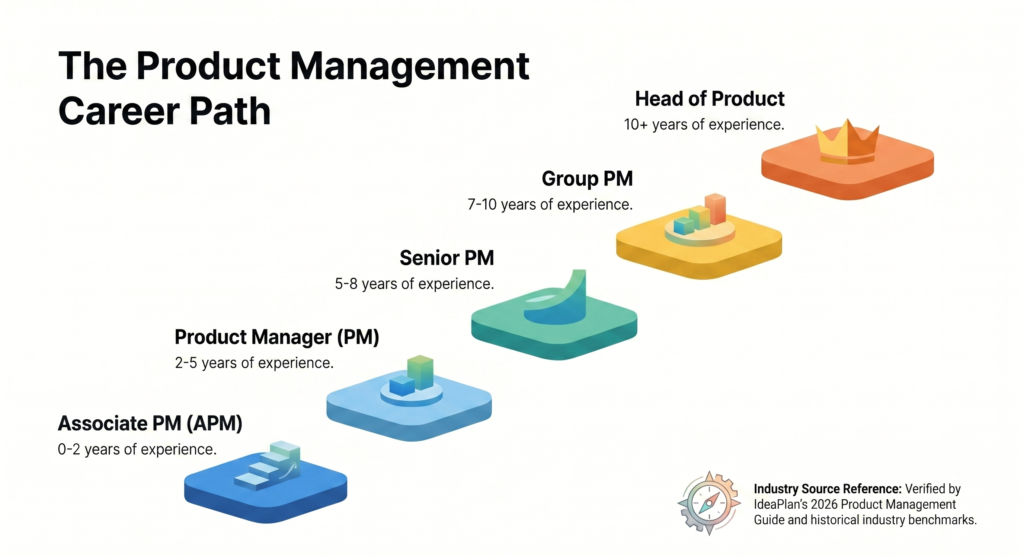
Many professionals enter the field as lateral moves like software engineering, business analysis, data, or management consulting. The transition is well-trodden enough that most good companies now run a structured APM (Associate Product Manager) program designed specifically to bring in and develop new product talent.
What’s striking about the Indian product landscape today is the breadth of sectors actively hiring: B2B SaaS, consumer apps, AI-native companies, health tech, edtech, and enterprise software. A product management career here isn’t limited to a single type of product or industry, which is part of what makes the trajectory so compelling.
Bottomline
At its best, product management is one of the few careers where you get to sit at the center of a business and genuinely shape what gets built and for whom. You’re not purely executing someone else’s vision. You’re synthesizing information from users, markets, data, and strategy, and converting all of it into something real that thousands or millions of people will use.
Must read: Best MBA Specialization for Product Management
That’s a rare kind of leverage. And it’s why despite the long meetings, the difficult trade-offs, and the occasional launch that quietly lands with a thud product managers tend to be people who love their work.
A product manager needs to understand every layer of the business, i.e. from payment failures and API connections to marketing lead flows and business rules. It’s not a role confined to one function. Curiosity across every part of the system is essential.
-Prasad Shankarwar, Director of Products, UNext Learning Pvt Lmt
Prepare for your next career milestone with us