
Listen to this blog

Selection Process in HRM: The selection process in HRM is the procedure through which organizations identify, evaluate, and choose the most suitable candidate for a job role. It typically includes application screening, interviews, assessments, reference checks, medical examination, and final selection.
Picture this: you’re sifting through 3,000 applications for a single role, knowing that somewhere in that stack is the one person who could transform your entire team. Overwhelming? Absolutely. But that’s precisely why mastering the selection process in HRM has become non-negotiable for organizations today.
Hiring in 2026 looks nothing like it did a decade ago. AI-powered screening tools filter resumes in seconds, hybrid work has redefined what “team fit” even means, and candidates now interview companies just as critically as companies interview them. Amid all this disruption, one thing hasn’t changed: how you handle selection in HRM still decides whether your organization scales smoothly or stumbles through costly hiring mistakes.
This is exactly why the importance of selection in HRM can’t be overstated. Whether you’re an HR professional refining your hiring toolkit or a student gearing up to specialize in talent acquisition, understanding the fundamentals of human resource management can help you build teams that actually deliver results.
So, what does a smart, future-ready selection process in human resource management actually involve? Let’s break it down step by step.
Must read: How does Online Manipal offer Placement Assistance?
What is the Selection Process in HRM?
At its core, selection in HRM refers to the process of choosing the most suitable candidate from a pool of applicants for a specific job role. It’s the decision-making stage that follows sourcing, where organizations evaluate, screen, and shortlist individuals based on skills, experience, and cultural fit.
Recruitment and selection are often used interchangeably, but they serve very different purposes. Recruitment is the outward-facing effort of attracting talent: posting job ads, sourcing candidates, building a pipeline. Selection picks up where recruitment leaves off, narrowing that pipeline down to the one person who deserves the offer letter. Think of recruitment as casting a wide net, and the selection process in HRM as the careful sorting that follows.
The objective of selection is straightforward yet critical: match the right person to the right job, at the right time. This aligns closely with the broader objectives of HRM within an organization. A well-executed selection process in human resource management doesn’t just fill a vacancy; it protects the organization from turnover costs, productivity dips, and team friction down the line, setting up the foundation for long-term workforce success.
Check this out: How to become an HR manager: Job role and salary
Recruitment vs Selection in HRM
Although recruitment and selection are often used interchangeably, they are distinct stages of the hiring process. Recruitment focuses on attracting candidates, while selection involves evaluating and choosing the most suitable applicant for the role.
| Recruitment | Selection |
| Attracts candidates for a job role | Chooses the most suitable candidate |
| Creates a pool of applicants | Shortlists and hires the best applicant |
| Positive process that encourages applications | Eliminative process that filters candidates |
| Focuses on sourcing talent | Focuses on evaluating talent |
| Begins the hiring process | Completes the hiring process |
What are the Key Steps in the Selection Process in HRM?
Let’s look at the step-by-step guide to the employee selection process.
1. Preliminary Interview
Once a requirement is posted, a company may receive hundreds of thousands of applications. In a granular pre-process, the preliminary interview is conducted to weed out all candidates who do not meet the essential eligibility criteria – educational qualifications, required skill sets, proven certifications, and experience. Candidates may also be assessed based on their background and level of interest. This early stage plays an important role in the selection process in HRM, helping recruiters identify suitable candidates efficiently.
Some companies employ innovative techniques to bring the right candidates to the table right from the get-go. For example, Uber deployed “Code on the road,” an in-app coding game that took candidates straight to the next stage of the selection process if they passed the challenge! Gamifying recruitment selection is among the latest trends in HRM.
2. Receiving Applications
Once candidates pass the preliminary interview, organizations must aim to standardize the application process. Here, candidates must fill out a standard application form that collects bio-data, qualification, experience, background, and educational information. The application could gather a broader understanding of the candidate, such as hobbies and interests. A comprehensive application form will come in handy during the final selection process in human resource management when decisions are to be made between similar candidates.
3. Screening Applications
This stage includes shortlisting potential candidates from the pool of applicants who applied. The screening committee constitutes various team leads, department members, inter-department associates, and coordinators who would be working closely with the selected candidates. Screening can include multiple criteria, including educational prowess, relevancy in terms of experience, etc. The interview details and requirements are shared with potential candidates via a call or email. Effective screening is a critical aspect of selection in HRM, ensuring that only the most suitable candidates move forward through recruitment and selection.
4. Preliminary Tests
Preliminary tests are an essential part of the job selection process. They assess the aptitude, IQ, emotional intelligence, proficiency, and personality of candidates. While some organizations hold these tests remotely, many prefer to arrange a test venue generally within organizational premises. Should they be held at the premises, the candidates are informed of the itinerary. These assessments help strengthen the selection process in HRM by providing objective insights into a candidate’s capabilities.
5. Employment Interview
The selection interview is the crux of the entire process. It could be defined as an in-person conversation that puts candidates on their feet. This step signals how well he/she fits into the company ethos. During this stage, companies provide a detailed brief of the job profile, including the roles and responsibilities that the candidate is expected to shoulder. Likewise, the candidate is encouraged to share his/her concerns or queries with the employer.
The employment interview itself may be divided into several rounds, including group discussions and other activities. In-person interviews allow employers to judge the candidate’s calibre, personality, teamwork, and leadership skills. This stage further highlights the importance of selection in HRM, as hiring decisions can significantly influence organizational performance.
6. Checking References
Although in-person interviews provide a fair idea about the candidate, contacting references allows employers to verify their understanding. Through discussions with references who vouch for the candidates’ professionalism and work ethics, they may discover other qualities about him/her. For this stage of the recruitment process in HRM, organizations may reach out to previous employers or the concerned educational institutions. Reference checks contribute to a more reliable selection process in human resource management.
7. Medical Examination
Although not strictly followed, medical examinations are slowly becoming commonplace among organizations today. Modern companies are viewing medical fitness (both mental and physical) as a cost function. A healthy employee would require fewer sick leaves and handle stress relatively quickly, allowing greater productivity in dynamic, fast-paced environments. Some employers view this matter seriously and consider this a preliminary phase during the screening stage. For certain roles, this step supports the overall selection process in HRM by ensuring candidates meet job-specific requirements.
8. Final Selection
The last phase of the selection process is to cross the t’s and dot the i’s; candidates who have successfully qualified through all rounds of the recruitment and selection in HRM receive an offer/appointment letter from the organization. More often than not, candidates receive a temporary position with an assurance of permanency on completion of the probation period. The appointment letter typically includes all such details, including salary and company policies. Candidates may also be asked to sign an NDA (Non-Disclosure Agreement) that ensures the protection of company data.
The final stage reflects the importance of selection in HRM, as choosing the right candidate helps organizations improve productivity, reduce turnover, and build a strong workforce.
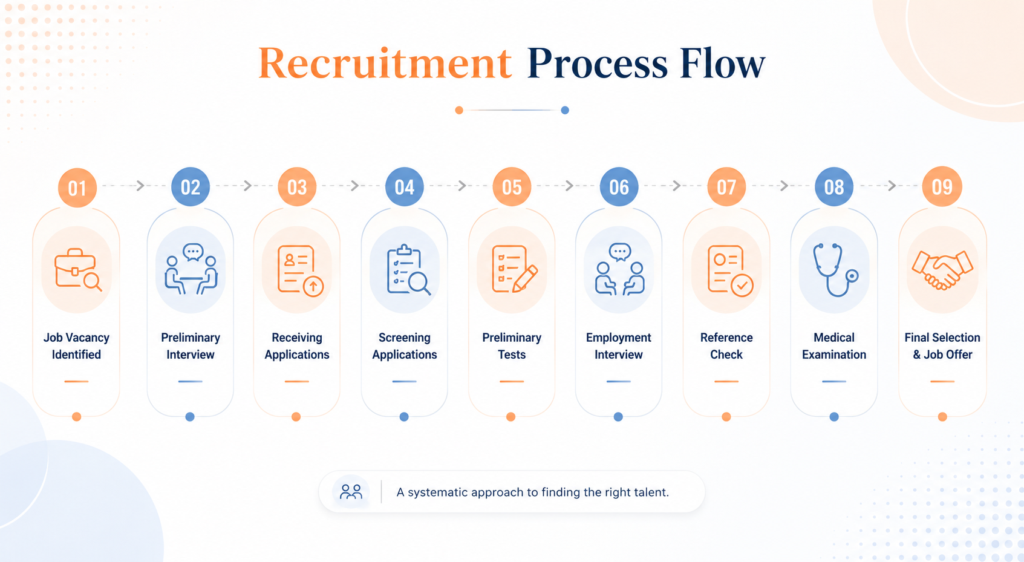
Flowchart showing the selection process in HRM from candidate application to final selection.
Importance of the Selection Process in HRM for Organizational Success
A well-defined selection process is vital in Human Resource Management (HRM). Understanding the wider scope of human resource management helps organizations appreciate how hiring decisions impact business performance. This helps to reduce costs associated with poor hiring decisions, enhances employee retention, promotes fairness and compliance with the law, and aligns talent with overall business strategy.
Below are some points which highlight the importance of selection process in HRM:
- Boosts Organizational Productivity
A rigorous selection process enables companies to choose the right individuals for the right job, thereby enhancing work and productivity and facilitating the achievement of organizational goals in a timely and efficient manner.
- Limit Training Costs
Poor hiring practices can lead to significant training costs, which can be avoided by hiring qualified candidates through rigorous recruitment methods.
- Improves Retention Rate
Selecting suitable candidates for different positions, in line with the company culture, helps reduce turnover and increase job retention.
- Help Acquire Good Talents
A proper selection process enables the hiring of talented individuals to support productivity and profitability within organizations.
Consider Reading: Top HR activities: Guide to HR functions
Common Challenges in the Selection Process in HRM
The selection process in HRM is crucial; however, it comes with specific challenges. Dealing with biases, maintaining fairness, identifying the right applicants, and adapting to changing technologies are among the key challenges faced in the HRM selection process.
The table below outlines some of the most common challenges in the selection process in HRM and their impact on hiring decisions.
| Challenges | What they imply |
|---|---|
| Attracting the Right Talent | Finding candidates with the right mix of talent, technical expertise, and cultural fit can be a significant challenge. |
| Bias and Subjectivity | Unconscious bias can impact unbiased and fair decision-making at the interview and shortlisting stages. |
| Keeping Up with Technology | There may be challenges in adapting to new recruitment tools and platforms for HRM teams. |
| Limited Resources and Time Pressure | The urgent need to fill positions, combined with a lack of time and budget, can lead to hasty and poor hiring decisions. |
| High Volume of Applications | Sorting bulk resumes can be time-consuming and inefficient. Managing a large number of resumes becomes overwhelming at times. |
| Changing Job Market Trends | Rapidly changing industry standards and job trends make defining role requirements challenging. |
Best Practices to Improve the Recruitment and Selection Process in HRM
Below are some of the best practices that can be followed
- Define clear job roles and responsibilities
- Use structured interviews and standardized evaluation criteria
- Leverage data and analytics for better decision-making
- Promote diversity and reduce unconscious bias
- Build a strong employer brand to attract top talent
- Streamline application and screening processes with technology
- Conduct thorough background and reference checks
- Provide interviewer training for consistent candidate evaluation
- Maintain clear and timely communication with candidates
- Continuously review and optimize the recruitment strategy
Recommended read: How an MBA prepares you for various HR functions
How can an MBA in HRM from Manipal Academy of Higher Education be a Gamechanger for You?
An Online MBA in HRM from Manipal Academy of Higher Education can be a gamechanger for you. Equipping you with a comprehensive understanding of human resource management, a crucial aspect of any organization’s success, it will aid you in accelerating your career to new heights.
Pursuing the same with the reputed brand of Manipal Academy of Higher Education ensures that you receive high-quality education, access to industry experts, expand your network and enhance your career prospects. The practical insights and real-world exposure provided during the program will ensure you are prepared for the dynamic and evolving HR landscape.
Overall, this Online MBA program will not only enhance your knowledge and skills but also boost your confidence and credibility in the field, positioning you as a gamechanger in the HRM domain, ready to drive organizational excellence through effective human resource management.
Deep dive: Why pursue an MBA in HR? – Benefits, career growth & opportunities
Conclusion
In this era of digital transformation, the traditional meaning of a job has been redefined. Consequently, the selection process definition must also follow suit. MAHE’s online MBA in Human Resource Management, is designed to empower the next-gen HRM to make smart, practical, and data-driven decisions. The program allows individuals to be well-equipped to handle a post-pandemic economy’s requirement – providing organizations, both large and small, the impetus necessary to push for performance and productivity through people-oriented actions.
FAQs About the Selection Process
What are the 8 steps of the selection process in HRM?
The selection process in HRM typically includes eight key steps: preliminary interview, receiving applications, screening applications, preliminary tests, employment interview, reference checks, medical examination, and final selection. These steps help organizations identify and hire the most suitable candidate for a job role.
What is the objective of selection in HRM?
The primary objective of selection in HRM is to match the right candidate with the right job. A well-structured selection process in human resource management helps organizations improve productivity, reduce employee turnover, and ensure long-term workforce success.
Why is the selection process important in human resource management?
The importance of the selection process in HRM lies in its ability to hire qualified and culturally fit employees. An effective selection process in human resource management reduces hiring costs, improves employee retention, and contributes to overall organizational growth.
What are the challenges of the selection process in HRM?
Common challenges in the selection process in HRM include attracting qualified candidates, managing a high volume of applications, reducing hiring bias, adapting to recruitment technology, and making accurate hiring decisions under time constraints.
What is the difference between recruitment and selection?
Recruitment is the process of attracting and encouraging candidates to apply for a job, while selection in HRM involves evaluating applicants and choosing the most suitable candidate. Recruitment creates a talent pool, whereas the selection process in HRM identifies the best fit for the role.
Prepare for your next career milestone with us