Listen to this blog

Panorama 2026, Online Manipal’s flagship networking event for online learners, closed its session on AI and careers with a question every working professional is quietly asking themselves: if change is now the only constant, how do you actually prepare for it?
The session opened with a keynote from Mr Raghav Gupta, Head of Education for India and Asia Pacific at OpenAI, joining virtually, followed by a moderated panel featuring leaders from JP Morgan, Manipal Education and Medical Group (MEMG), Elsevier, and Manipal Academy of Higher Education (MAHE) itself. Dr Manojkumar Nagasampige, Director of Online Education, moderated the conversation.
Here’s what they had to say about where work, learning and AI are headed, and what learners and professionals should do about it.
The Scale of AI Adoption Is Already Massive
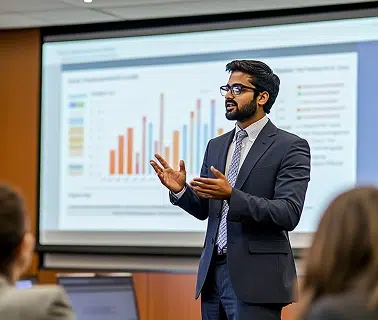
Mr Raghav Gupta joined the discussion virtually and opened with numbers that reframed the conversation. Close to 90 crore people now use ChatGPT every week globally, a figure that has roughly tripled in the past year. In India alone, around 10 crore people use it weekly, and a third of them are students.
He pointed to a shift already underway in how organizations use AI: tools are moving from personal productivity aids to becoming embedded in workflows, with agentic capabilities changing what individual roles look like. Work that once took three weeks can now take three hours. That compression, he said, is reshaping the skills that matter, with judgment and the ability to iterate becoming critical for both working professionals and students entering the workforce.
He also flagged that there is a widening capability gap. As AI capability accelerates, a small group of power users is pulling far ahead of the median user, not because people have gotten slower at learning, but because the technology itself is moving faster than most people can track.
Also read: PANORAMA 2026: A Celebration of Learning, Connection, and Community
AI in Education: Opportunity and Risk in the Same Breath
On higher education, Mr Gupta noted that the single biggest use case for ChatGPT globally, including in India, is learning. He framed OpenAI’s mission in education as advancing learning rather than replacing institutions, working with universities to build their own capability and with students to move from consuming conceptual knowledge to actually building with it.
He cited what’s known as the “two sigma” effect: learning outcomes improve significantly when instruction shifts from a conventional classroom to one-on-one tutoring, and AI has the potential to function as that personal tutor at scale. But he was equally direct about the risk: research shows that students who use AI purely as a shortcut see their critical thinking erode rather than develop.
He highlighted ChatGPT’s Study Mode, designed to guide students toward answers socratically rather than handing them over, and noted that Manipal was among the first university groups in India to adopt ChatGPT Edu, alongside institutions like IIM Ahmedabad and IIT Delhi, as part of a broader push to become “AI native.”
His closing advice to students: don’t use AI as a shortcut for assignments, build a portfolio of AI-assisted work relevant to your field, and treat judgment and creativity as the two human skills worth deliberately strengthening. He left them with a sobering statistic: 95% of people using tools like ChatGPT are tapping into only about 5% of what the technology can actually do.
Replace, Reshape, or Create? The Jobs Question
When the panel discussion began, the moderator turned first to Rohit Castelino, HR Business Partner Leader at Elsevier Technology India, with the question on everyone’s mind: will AI replace jobs, transform them, or create new ones?
His answer: all three, simultaneously. He drew a parallel to GPS, which was expected to eliminate taxi driver jobs but instead gave rise to an entirely new gig economy through platforms like Uber and Ola. Citing the World Economic Forum’s Future of Jobs 2025 report, he noted that AI is projected to create 170 million new jobs while reshaping 90 million others, a net addition of roughly 78 million jobs.
But he didn’t sugarcoat the near-term picture. Entry-level hiring, he said, has already dipped by around 13% in roles highly exposed to AI, and many hiring managers are pausing to rethink what they actually need. His read: the “career ladder” itself is changing shape, particularly at the bottom rung, and India’s young workforce has a real opportunity to lose if reskilling doesn’t keep pace.
Pressed on whether the panel was overestimating job loss, Mr Castelino was candid: a lot of the current narrative is hype rather than evidence. At Elsevier, a 146-year-old organization, no roles have been cut because of AI. His advice to students was to filter out the noise and focus on what they can control: building strong fundamentals and staying curious through hands-on experimentation with the tools available to them.
Read more: Navigating the Future: AI Trends and Opportunities in 2026
From Creators to Editors: The New Skill Stack
Mr Mansij Majumder, Head of Corporate Human Resources at MEMG, framed the shift in economic terms: as the cost of routine cognitive work falls, the value of human judgment rises sharply. He outlined three shifts professionals need to make:
- From creator to editor: When an HR policy can be drafted in five different versions in seconds, the real skill is judging which version fits the context, not generating the draft itself.
- Learning velocity: The ability to learn a new tool quickly and just as quickly let it go when something better arrives.
- Deconstructing work: Entry-level “apprentice work” that once built foundational understanding is disappearing. The expectation for new entrants now starts higher: can you break a task into what AI can handle and what genuinely needs human judgment, and can you brief the AI clearly enough to get a useful answer back?
Mr Gupta added a perspective for educators here too: banning AI in classrooms doesn’t work against a wave this large. The more productive path is guiding students toward AI as a tool for deeper engagement, not a shortcut, while being honest with them about the research on what shortcut use actually costs their learning.
You may also like: How AI Is Creating New Jobs While Replacing Others
Redesigning the University Around Judgment, Not Recall
Dr Kartikeya Bolar Pramoda, professor at T.A. Pai Management Institute (TAPMI), MAHE, tackled the curriculum question directly. Universities, he argued, have long relied on knowledge-recall frameworks, exactly the kind of task AI can now replicate instantly. If an assignment can be fully answered by AI, that’s a signal the assignment needs to change, not that students need to be policed more closely.
He shared a framework he’s developed for using AI responsibly, built around four stages:
- Lift: Start the task yourself before reaching for AI, the way you’d begin a workout before reaching for a spotter.
- Lighten: Delegate the genuinely fatiguing, repetitive parts of the work to AI.
- Learn: Use AI as a tutor or even a “devil’s advocate” to test your own thinking, since it won’t judge you for asking basic questions.
- Lead: Own the final decision. No matter how much AI contributed along the way, judgment and ethical reasoning at the point of decision-making remain human responsibilities.
His recommendation for institutions: build AI into the curriculum through simulation-based, real-world decision scenarios rather than trying to ban it outright.
Domain Knowledge Still Decides Who Wins
Ms Lakshmi Devi Prakash, Vice President and Applied AI/ML Lead at JP Morgan, pushed back on the idea that knowing AI tools alone makes someone a high performer. Without domain knowledge, she argued, you can’t validate what the model generates, you’re just trusting its output blindly. Combining domain expertise with critical thinking and execution is what actually separates high performers from casual users.
She was equally clear that prompt engineering isn’t the differentiator people think it is. The real skill is problem-framing: knowing what question to ask, what data to use, what assumptions to test, and what outcome you’re actually looking for. Her phrase for where this is heading: people shouldn’t think of themselves as competing with AI, but as AI collaborators, with humans remaining the final decision-makers and judges of output.
Another interesting read: 7 Job Roles That Will Survive the Rise of AI

Leadership’s Real Challenges: Investment, Adoption, Velocity
Dr Ganesh Prasad, Director of IT at MAHE, brought 28 years of enterprise IT experience to the question of what’s actually hard about digital transformation at the leadership level. He framed AI as a shift from being implementers of others’ technology to becoming innovators in their own right, building proprietary LLMs and SLMs rather than only consuming what’s available off the shelf.
He named three concrete challenges leaders face:
- Investment: AI and agentic systems are expensive to build and run, and costs are metered continuously.
- Adoption: Students, faculty and staff all need to be convinced these systems genuinely improve their day-to-day work, not just told to use them.
- Velocity of disruption: The pace of change makes long-range planning unreliable. His own estimate: meaningful prediction is realistic for about five years out, not ten, given how AI and quantum computing are converging.
The Closing Round: One Piece of Advice Each
Asked to leave learners with a single takeaway, the panel’s answers converged on a theme even as the language varied:


The Takeaway
Across six very different vantage points, banking, HR, enterprise IT, academia, and the company building the AI itself, the panel kept landing on the same idea from different directions: AI is not arriving to replace human judgment, it’s arriving to make judgment the scarcest and most valuable skill in the room. The professionals and students who treat AI as a collaborator rather than a replacement, and who invest deliberately in the human skills that AI can’t replicate, are the ones the panel believes will come out ahead.
As the moderator put it in closing: generative AI can hand you three different answers, but it’s still your judgment that decides which one to take.
For MAHE’s online learners, this conversation isn’t abstract. It’s the reason the curriculum keeps evolving, the reason ChatGPT Edu is already part of how learners study here, and the reason programs across data science, business analytics, and AI/ML are built to develop exactly the judgment, domain depth, and human skills the panel pointed to. Panorama 2026 was a glimpse of where work is headed.
Prepare for your next career milestone with us