Blogs
Blogs 
Building Brand Consistency: A Guide to Authentic Messaging

Listen to this blog

Building a brand that sticks isn’t about who has the flashiest features or the deepest pockets. After 10 years of navigating the world of investment banking and Software as a Service (SaaS) sales, I’ve realized that the most successful companies don’t just sell products, they tell stories. Whether I was pitching a high-end CRM or helping a startup define its voice, the same truth always surfaced: people don’t buy what you do; they buy why you do it.
If you want to move beyond ‘marketing fluff’ and create a message that actually resonates, you have to understand the science behind human connection. In this post, I’ll take you through the anatomy of a compelling brand story and show you how to turn your customer into the hero they were always meant to be.
The Anatomy of a Brand Story: Who is the Real Hero?
One of the biggest mistakes I see businesses make is thinking they are the hero of the story. If I’m selling a pencil, I might think the pencil is the star. If I’m selling a washing machine, I think the machine is the hero. But that’s not it. A truly compelling brand story is all about the customer.
To build a narrative that works, you need these four elements:
- The Hero (The Customer): The hero is never the brand or the product; it is the person you are serving. They have an ambition, a place they want to get to.
- The Conflict (The Villain): Every hero faces a challenge that stops them from reaching their destination. This is the gap or pain point your brand solves.
- The Guide (Your Brand): This is where you come in. You aren’t the hero; you are the guide who provides the plan and the empathy the hero needs to succeed.
- The Resolution (The New Bliss): This is the “happy ending”—the state where the customer has overcome the villain and reached their “to-be” state.
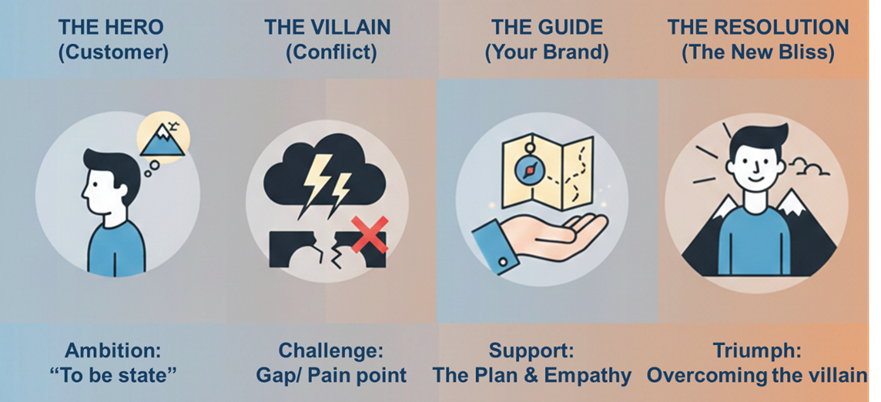
I often think of the old Axe body spray ads. They didn’t make the spray the hero. Instead, they showed a guy who wanted confidence but felt he was falling short. The spray was simply the guide that helped him reach the “bliss state” of feeling confident and successful.
Here’s another good read: Responsibilities and role of a brand consultant
Moving from “What” to “Why” with the Golden Circle
When we feel nervous during a pitch, our first instinct is to list features. For example, we talk about the 56-inch screen or the 10-day battery life. But your competitors are doing the exact same thing. To stand out, you have to move through the “Golden Circle”:
- The What (Outermost Ring): These are your features. They are necessary but rarely the reason someone chooses you over a competitor.
- The How (Middle Ring): This is your unique selling point (USP) or differentiator. While important, even this has become oversold in recent years.
- The Why (The Core): This is your purpose. Why should anyone care?
In my 9 years of selling CRM software, I learned that no one cares about the mobile app or the specific buttons in the interface. But the moment I tell them, “I have a magic pill that will help you have lasting customer relationships,” they listen. I’m not selling software; I’m selling the purpose of better connection.
Another interesting read: How to become a brand manager
The Science of Emotion in Decision Making
We like to think we are logical beings, but the truth is the opposite, especially in business. Whether it’s a B2C purchase or a major B2B procurement, emotion is the primary driver. In my experience, there are two main emotional triggers:
- The Fear of Failure: Nobody wants to wake up and fail. If a brand can show that not using their product creates a risk of staying behind, it becomes a powerful motivator.
- The Desire for Growth: Every story is driven by the hope that a product or service will take the customer from where they are to somewhere incredible.
Emotional Storytelling for Brand Loyalty
To tell a story that hits home, you have to identify the real villain in your customer’s life. Often, the perceived villain isn’t the actual one.
For instance, when companies like Dunzo or Zepto arrived, what were they solving? It wasn’t just “delivering groceries.” The real villain was the mental anxiety and time lost when you realized you forgot an important file at home or ran out of a staple while cooking. The villain was inconvenience.
In tech sales, I often tell my customers that their “legacy systems” are the villains. These old systems are holding their company back, forcing them to spend more time on maintenance than on gaining value. By framing it this way, I’m not just a salesperson; I’m a guide helping them defeat a villain that is costing them money and growth.
Take a glimpse: What is Consumer Behavior? Why is it Important?
Conclusion: Your Story is Your Strategy
Brand storytelling is not just a marketing tactic; it is the heartbeat of how you connect with the world. By identifying your hero, confronting the villain, and leading with your “why,” you create a message that people actually remember. If you’re looking to master these skills and dive deeper into the world of strategic branding and business communication, exploring MAHE’s Online MBA program with a specialization in Marketing is a great next step. This course is designed to help you move beyond the “as-is” state of your career and reach that “to-be” state of professional success – with you as the hero of your own story.
Prepare for your next career milestone with us


Explore Similar Blogs
View All
 19 Oct 2026
 9 mins
 11 Sep 2026
8 mins
11 Sep 2026
8 mins
 08 Sep 2026
6 mins
08 Sep 2026
6 mins
 07 Sep 2026
6 mins
07 Sep 2026
6 mins