
Listen to this blog

According to the report of Risk Management Market (2025 – 2033), the global risk management market was valued at USD 15.4 billion in 2024 and is expected to grow significantly, reaching USD 19.8 billion in 2026 and USD 52.0 billion by 2033.
A decade ago, if you told someone you wanted to work in risk management, they probably pictured a quiet back-office job; someone checking boxes so the real business could keep moving. That picture is badly out of date now. Risk professionals are increasingly the ones sitting in the room when big decisions get made, not because the job got glamorous, but because the world got a lot harder to predict.
Between tighter regulations, faster digital adoption, and a genuinely unstable global economy, businesses everywhere are realizing that managing risk well is not a support function anymore. It is a survival skill. That shift is exactly why risk management has quietly become one of the fastest growing, best paying, and most stable career paths in finance and beyond.
What Risk Management Actually Involves
Risk management is essentially the identification, assessment, and mitigation of anything that could damage an organization’s financials, operations, or reputation. It could be a bank assessing whether a borrower will fail to repay, a manufacturer planning for a supply chain disruption, or a fintech company checking whether its algorithm could misfire and cost millions overnight.
Risk professionals typically start as analysts, gathering data, running models, and flagging exposure. With experience, they move into risk manager roles, where the job shifts from reporting problems to designing the frameworks that prevent them. At the top sits the Chief Risk Officer, who works directly with the board to shape how much risk the organization is willing to take on in the first place.
Why the Demand Is Rising So Fast
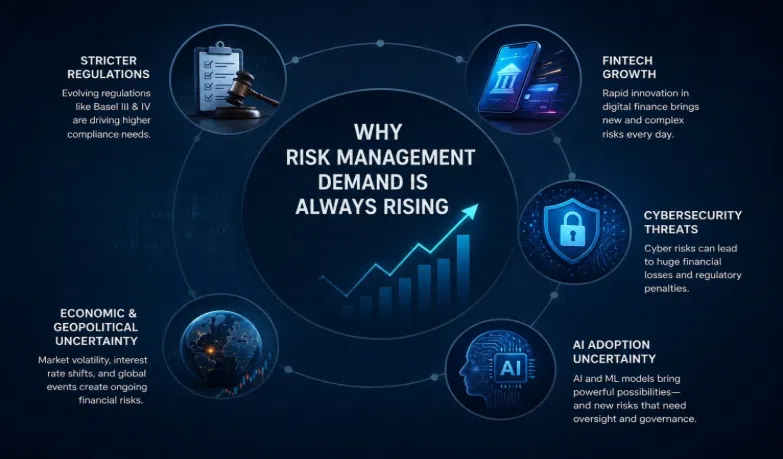
A few forces are driving this shift at the same time, and none of them are temporary.
Regulations keep getting stricter. In India, the Reserve Bank of India has been tightening norms steadily, and banks and NBFCs are racing to implement Basel III and Basel IV capital requirements. Every regulatory update means more compliance work, and compliance work increasingly needs people who understand both the rules and the underlying risk models, not just the paperwork.
Fintech growth has created new categories of risk. Digital lending, instant payments, and algorithmic trading move faster than traditional finance ever did, which means the potential for something to go wrong moves faster too. Companies need risk teams who can keep pace with products that did not exist five years ago.
Cybersecurity has become a financial risk, not just an IT problem. A single data breach or system outage can now cost an organization millions and trigger regulatory penalties on top of it. Risk teams are increasingly expected to understand cyber exposure alongside traditional financial exposure.
AI adoption has added a whole new layer of uncertainty. As companies plug machine learning models into lending decisions, fraud detection, and trading, someone has to answer for what happens when those models get it wrong. Risk teams are now being pulled into conversations about model governance and AI oversight that simply did not exist on this scale before.
Economic and geopolitical uncertainty never really goes away. Interest rate shifts, currency swings, and global conflicts all create financial risk on an ongoing basis, and businesses need people actively watching it rather than reacting after the fact.
Career Prospects in Risk Management
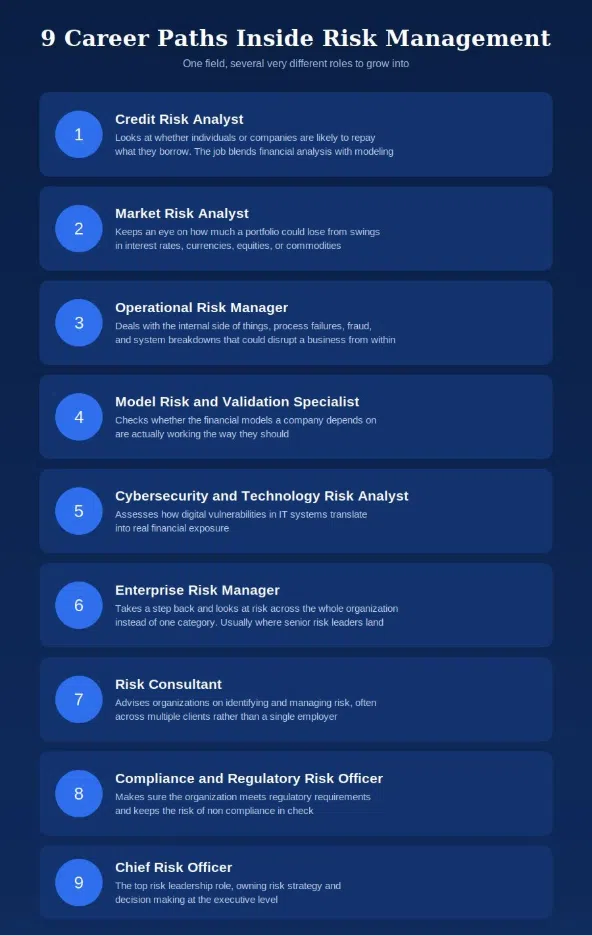
Credit Risk Analyst
This role comes down to one question: will the money actually come back? Analysts dig into financial statements, repayment history, and market conditions to put a number on that risk, using both judgment and quantitative models to get there.
Market Risk Analyst
Currencies move, interest rates shift, commodity prices swing overnight, and someone has to figure out what that does to a portfolio’s value. That person is the market risk analyst, running the numbers on exposure before a bad day turns into a bad quarter.
Operational Risk Manager
Not every threat comes from outside. A broken process, an internal fraud, a system that goes down at the wrong moment; these are the things that can quietly damage a business from within, and this role exists to catch them early.
Model Risk and Validation Specialist
Companies lean on financial models for everything from pricing to forecasting, but a model is only useful if it actually behaves the way it’s supposed to. This role is about pressure testing those assumptions before they cause real damage.
Cybersecurity and Technology Risk Analyst
A half technical, but half financial role. Digital vulnerabilities don’t stay digital for long; they turn into real money lost, and this analyst is the one connecting those two dots for the business.
Enterprise Risk Manager
Instead of owning one category of risk, this role sits above all of them, looking at the organization as a whole. It tends to be where the most experienced risk professionals end up, since it demands a wide view rather than a narrow specialty.
Risk Consultant
Rather than working inside one company, consultants move across several, bringing an outside perspective to how organizations identify and manage risk. The tradeoff for that variety is less continuity with any single client.
Compliance and Regulatory Risk Officer
Regulations change often, and someone in the organization needs to keep pace with them. This officer makes sure the company stays within those lines and limits the fallout when it doesn’t.
Chief Risk Officer
The senior most seat in the room when it comes to risk. Strategy, final calls, accountability to the board; it all lands here!
Why Are These Roles Harder to Automate?
Ironically, one of the biggest reasons risk management is growing is the same trend that is shrinking other finance jobs. As automation takes over repetitive reporting and back-office work, roles built purely around processing data are shrinking. But risk management is built around judgment, not just processing. Deciding how much risk an organization should tolerate, or how to respond to a scenario nobody has modeled before, is not something software can fully take over. That makes risk roles unusually resistant to the same automation pressure, hitting other parts of finance, which is part of why the field feels more future proof than most.
An Interesting Find: Why should MBA students learn about risk management in businesses?
How Online Manipal Prepares Students with Risk Management Certification
Online Manipal has taken this step further. MAHE online, becoming the second online institute in the country to earn recognition from the Institute of Risk Management (IRM), has integrated the IRM Level 1 certification into its MBA course, not as an optional add-on but as a mandatory part of the curriculum.
Through this affiliation, MAHE has built a Global Level 1 Enterprise Risk Management course, known as the Fundamentals of Risk Management, directly into its online MBA as a three-credit course in the second semester. The curriculum moves well past the old idea that risk begins and ends with finance and insurance. It walks students through more than 300 risk categories spanning environmental, strategic, operational, technological, governance, and financial domains, all mapped against two frameworks used across the industry, ISO 31000 and COSO 2017.
Students taking this course get access to a Foundations of ERM textbook from IRM India, a sector-wise case study book covering areas like aviation, pharma, and supply chain, close to 20 hours of recorded learning modules, and 10 hours of live sessions with Indian and international risk experts. On completing the course, they also receive a separate international certification from IRM UK, which exempts them from the Level 1 exam if they choose to continue up IRM’s five level global certification pathway later in their career, whether that means moving into a dedicated risk role, applying risk thinking to a family business or startup, or simply carrying a sharper risk lens into whatever they do next.
We think you will like this: Future of Work: What AI Leaders from OpenAI, JP Morgan, and MAHE Told Online Learners at Panorama 2026
Conclusion: Why Risk Management is One of the Most Promising Careers Today
Risk management has moved from a background function to a genuinely strategic one. For students and professionals looking for analytical depth, real business impact, and long-term stability, few fields are as well positioned for the next decade.
So, the real question is not whether risk management has a future. It is whether you are ready to be the person organizations turn to when uncertainty becomes the only certainty they have.
Reference
https://www.grandviewresearch.com/industry-analysis/risk-management-market-report
Prepare for your next career milestone with us