Listen to this blog

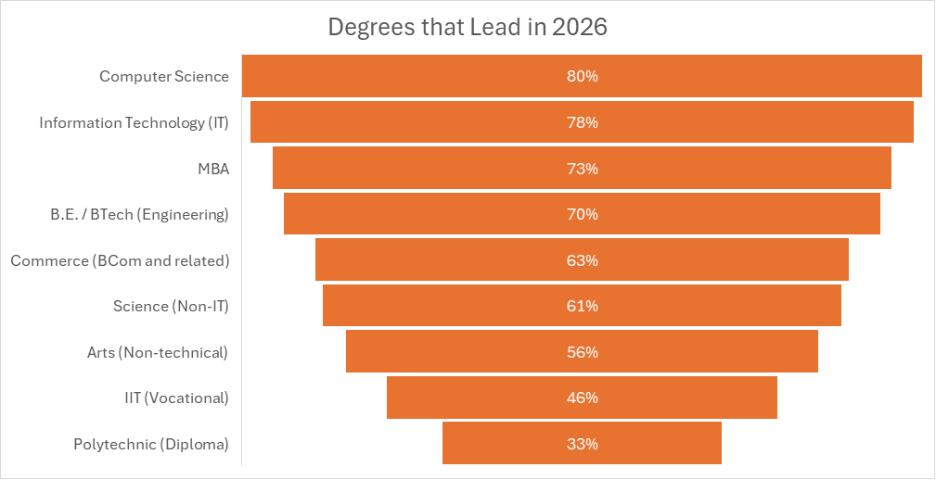
Indian Skills Report 2026 shows that the employability chart is led by Computer Science (80%) and IT graduates (72.76%).
The above data mirrors the success stories of several professionals where career growth is closely tied to digital and technical expertise. Over the past few years, it is observed that, when it comes to promised employable degrees, technology has sat at the forefront, while management and vocational jobs have taken a backseat.
But this time’s India Skills Report of 2026 suggests something entirely different. Yes, technology still dominates. But beneath the headline numbers, a more nuanced story emerges. MBA employability is softening, commerce is staging a strong comeback, and vocational education is steadily gaining relevance in a skill-first economy.
Looks like the script is being edited.
This blog has pulled in details from the report and has come up with a clear picture of the job opportunities available in 2026 and provides further information on how employability is evolving.
Employability Snapshot: Degrees That Lead in 2026
According to the India Skills Report 2026, employability rates across major streams are shown below. Though they might land well at first glance, when you look again, the subtlety of change hits.
Let us break this down to understand it better.
Tech Degrees Still Lead, and for Good Reason
Yes. Agreed. Tech degrees remain the most employable in India. And it looks like this dominance is not accidental or temporary. This stream provides the backbone for jobs in AI, data analytics, cloud computing, and automation across industries.
Nowadays, with the emergence of AI, tech roles are no longer confined to tech firms. They are being adopted across BFSI, retail, healthcare, logistics, manufacturing, and more, as all these sectors require technology-enabled talent.
Below are the key factors that helps CS and IT degrees to stay on top:
- AI and data-driven hiring
Companies nowadays are scaling AI-powered decision-making, advanced analytics, automation, and more. Hence, this has created a sustained demand for tech graduates across several sectors.
- Digital fluency over narrow coding skills
Graduates with a strong technical skill set are highly valued by employers. Such professionals understand systems and data. They also recognize the broader business impact beyond programming languages, which makes them especially valuable to organizations.
- Strong alignment with fresher hiring
The IT sector is considered the largest recruiter, hiring nearly 35% of all fresh graduates. This is one of the reasons many learners prefer this course.
This again sums up that even in the coming year, learners choosing tech degrees in 2026 comes with the safest, high-probability path when paired with specializations in AI, data science, or cloud technologies.
A good read: Top 30 latest trends in technology
Why MBA Employability Is Slipping
When carefully analyzed, it seems like MBA is slowly hitting a hard rock. This is a striking find with a surprising take. Though the report suggests a strong growth of 72.76%, considering previous reports, it is clearly dipping. This decline does not mean the MBA is losing relevance. It means the traditional MBA is being redefined.
Below is the list of justifications which will explain why the MBA could be slowly slipping down:
- Employer preference for hybrid profiles
Recruiters nowadays are looking for employees who can combine business thinking with digital literacy. Further, engineering-plus-management MBAs and analytics-focused MBAs are outperforming generalist MBAs.
- Applied skills over theoretical frameworks
Having operations led by AI, there has been a rise in dynamic business models, remote teams, agile processes, data-savvy decision makers, and so on. These are some preferred qualifications rather than textbook strategies.
- Rising competition from commerce and tech graduates
With the right domain depth and digital skills, commerce graduates are rising to the challenge, offering cost-effective alternatives to general MBAs for many business roles.
The takeaway is clear. MBA still works, but only with specialization. Generic management degrees no longer guarantee strong employability.
Commerce Is No Longer a Backup Plan
One of the quiet success stories of the India Skills Report 2026 is the resurgence of commerce. With at least 62.81% of employability rates, commerce has had a strong standing and below are the reasons behind it:
- Swift growth in BFSI and fintech jobs
- Demand for domain knowledge in finance, operations, compliance, and analytics
- Employer preference for focused, job-ready talent over broad managerial profiles
Apart from the above, job providers look for candidates who are enthusiastic about analytics, digital finance, or operation tools and add them to their skill set. As in the past, commerce is no longer a fallback option, but rather a strategic career pathway.
Science and Arts: Relevance Through Interdisciplinarity
With 61% and 55.55% of science graduates (non-IT) and arts graduates, respectively, it is great to see these numbers, as they show relevance to interdisciplinary roles. Data-driven research, behavioral analysis, content strategy, UX research, policy analysis, and hybrid business roles increasingly value diverse academic backgrounds. Employability here is less about the title of the degree and more about how graduates blend their core discipline with analytical and digital skills.
Vocational Education Is Gaining Ground
Vocational education is the training that emphasizes practical skills and real-time learning for specific jobs or careers. And in this year’s report, there has been steady progress in vocational education outcomes such as:
- ITI graduates: 45.95%
- Polytechnic diploma holders: 32.92%
With the rise of EVs, renewable energy scaling, and so on, the manufacturing sector has also expanded, providing employees to be more tech-enabled, hands-on, and job-ready. This is what vocational graduates bring to the table. Though they might not be at the top of the charts, the report offers clear signs of an upward trajectory for this category as well.
What This Means for the Future Workforce
Breaking down the India Skills Report 2026 across students, universities/colleges and employers, this is what it suggests.
For learners
Going with a degree that best fits a student matters but having the right skills within that course matters more. Tech degrees rule the charts; vocational degrees are becoming relevant, and commerce is seeing a big boost to stable employment. An MBA works best with a specialization.
For universities and colleges
Curriculum redesign is essential. Business and tech can no longer exist in silos. Industry-linked projects, applied learning, and digital integration are now non-negotiable.
For employers
The talent pipeline is expanding. Recruitment approaches that value domain-specific skill sets, digital fluency, and hands-on skills will be the main focus, overruling traditional degree hierarchies.
The Bottom Line
The jobs for 2026 will be more aligned towards domain depth, digital transformation, and real-world application. It is time learners understand this shift and choose their career paths accordingly. Further, for working professionals who are looking to scale up, online degrees have always been a great ally to complete their passion.
Online Manipal has been prominent in the online degree space, helping several learners fulfil their educational goals. With the report, learners can understand the trend and enrol on the courses as well. With Online Manipal’s universities, such as Manipal Academy of Higher Education, Manipal University Jaipur, and Sikkim Manipal University, learners can choose from any field they desire to study. Our courses page boasts programs from all fields that are trending and at the top of charts. With flexible schedules and a detailed course structure, learners can choose promising career paths.
The future of employability is not about the degree alone. It’s about how well that degree prepares you to work in a digital, data-driven, skill-first world. In other words, it’s no longer just what you study. It’s how future-ready you make it.
Become future-ready with our online MBA program