
Listen to this blog

Landing an interview is just half the battle. Walking in prepared is what sets candidates apart. Whether you’re a fresher or a seasoned professional, knowing the top 20 interview questions and answers beforehand gives you a real edge, not to script your responses, but to think them through before the pressure is on.
Here’s a breakdown of the most expected interview questions, what interviewers are actually looking for, and how to answer them well.
What Do They Ask in an Interview?
Before getting deeper, let us understand the intent. What they ask in an interview generally falls into three buckets, that is, who you are, what you can do, and how you think. Most questions, however creative, trace back to one of these.
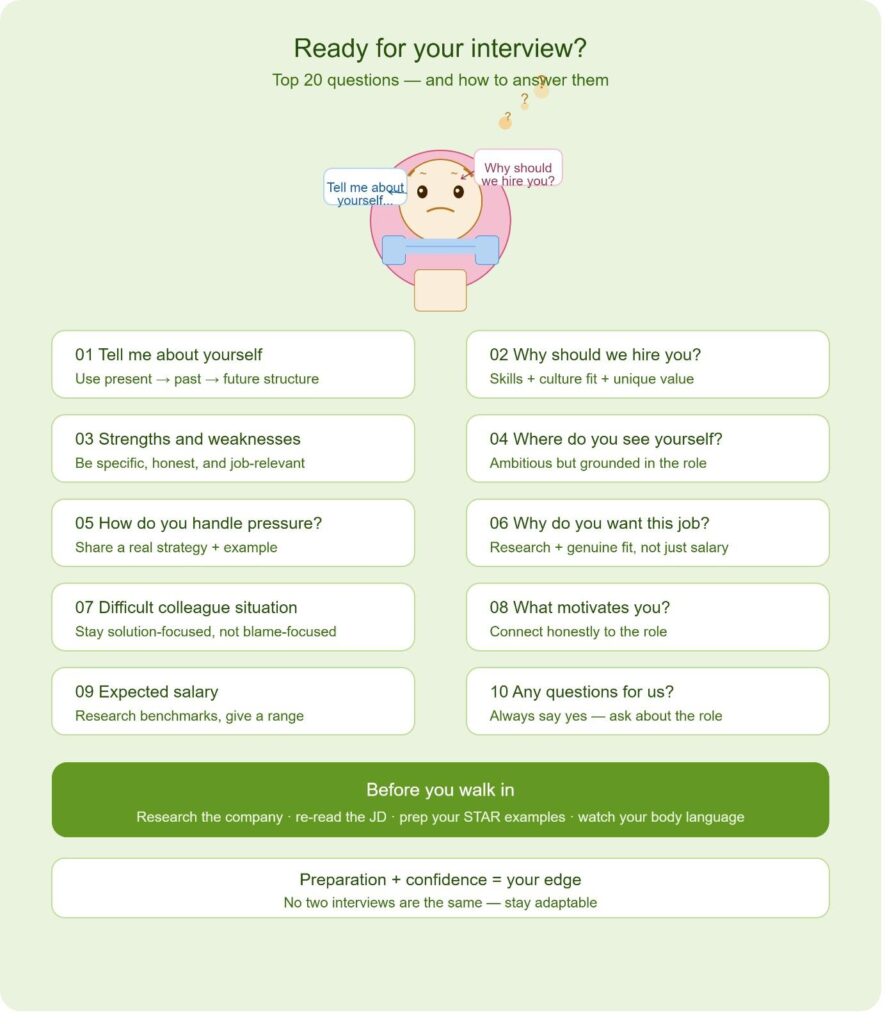
Top 20 Interview Questions and Answers
1. Tell me about yourself.
The most common opener, and the one most candidates underprepare for. Skip the life story. Use a present-past-future structure: what you do now, how you got here, and why this role excites you. Establish your skills and interests and something you have done preciously that could interest the interviewers.
2. Why should we hire you?
Your chance to pitch yourself directly. Cover three things: you can do the job well, you’ll fit the team, and you bring something the other candidates don’t.
3. What are your strengths?
Be specific and connect each strength to the role. “I’m a good communicator” means little — “I’ve led cross-functional projects and consistently kept stakeholders aligned” means a lot.
4. What are your weaknesses?
Pick something real, not a disguised strength. Show self-awareness and — more importantly — what you’re doing about it.
5. Why do you want this job?
Interviewers want to know you’ve thought about this role specifically, not just any job. Research the company and tie your answer to their work and culture.
6. Where do you see yourself five years from now?
Show ambition, but keep it grounded. Talk about developing expertise in your domain and growing into a senior or leadership role — aligned with what the company can offer.
7. What are your short-term and long-term goals?
Short-term: something achievable within the role. Long-term: broader professional growth. Make sure both are realistic and connect to the position you’re applying for.
8. How do you handle pressure and tight deadlines?
Don’t dodge this one. Talk about a real strategy — prioritising tasks, breaking down work, communicating proactively — and back it with a specific example if you can.
9. Tell me about a difficult situation you faced with a colleague.
Interviewers are testing your communication, emotional intelligence, and conflict resolution skills here. Keep the tone solution-focused, not complaint-focused.
10. How do you manage your work under pressure?
Similar to question 8, but broader. Mention systems you use — to-do lists, time-blocking, check-ins with your manager — rather than just saying “I stay calm.”
11. In what ways can you contribute to this organisation?
Connect your skills directly to their needs. Read the job description carefully and use it as your guide. This is not the place for generic answers.
12. What do you know about our company?
Always research before you walk in. Mention specific things — their recent work, values, or industry position — to show genuine interest.
13. What are the key issues in your field today?
This one tests whether you’re keeping up with your industry. Know the current challenges in your domain and have a point of view on them.
14. Describe a time you showed leadership.
Use the STAR method — Situation, Task, Action, Result. Pick an example where your initiative made a tangible difference.
15. How do you handle feedback and criticism?
Show that you take it constructively. Give an example of feedback you received and what you changed as a result.
16. What motivates you?
Be honest, and connect it to the role. Interviewers can tell when an answer is performative — “I’m motivated by solving complex problems that have real impact” lands better than “I’m a hard worker.”
17. Are you a team player or do you prefer working independently?
The right answer is both, depending on what the task needs. Give examples of both scenarios.
18. What is your expected salary?
Research market benchmarks before the interview. Give a range based on your experience and the role, and signal that you’re open to discussion.
Check out: The ultimate guide: How to negotiate salary and benefits packages?
19. Why are you leaving your current job?
Keep it professional. Focus on what you’re moving towards, growth, new challenges, better alignment, rather than what you’re running from.
20. Do you have any questions for us?
Always say yes. Ask about the scope of the role, team structure, growth opportunities, or what success looks like in the first 90 days. This signals genuine interest.
Check out: Life Skills Online Manipal Students Gained During their Learning Journey
Things to Consider Before Appearing for an Interview
Here are some things to keep in mind before you appear for an interview:
Knowing the expected interview questions is only part of the prep. Here’s what else matters:
- Research the company thoroughly: their work, culture, recent news, and the team you’d be joining.
- Re-read the job description: map your experience to what they’re asking for.
- Practice your introduction: a clear, confident self-intro sets the tone for everything that follows.
- Watch your body language: open posture, eye contact, and a steady tone all signal confidence before you’ve said a word.
- Prepare your examples in advance: for every behavioural question, have 2–3 STAR stories ready to adapt.
Also read: Launchpad 2026: Turning Potential into Possibilities with Online Manipal
Be interview-ready with Online Manipal placement assistance services
To make sure that all students pursuing various online courses through Online Manipal secure jobs right after completion of their courses, Online Manipal provides placement assistance services which include resume building, interview preparation tips, skill assessment & advancement, industry-readiness sessions, and placement drives. By participating in these placement training activities, students can improve their chances of getting a job.
Conclusion
No two interviews are identical, and no list of top 20 interview questions and answers can cover every curveball. But walking in with clear, practised responses to these expected interview questions — and genuinely understanding what they ask in interviews and why — puts you well ahead of most candidates. Prepare thoroughly, stay adaptable, and let your answers speak for themselves.
Prepare for your next career milestone with us