Blogs

The Sales Funnel Simplified: Making Every Lead Count
Listen to this blog

A customer can like your product, appreciate your presentation and still disappear. I’ve seen this happen many times in my sales career. The calls go unanswered. Emails get no response. Even WhatsApp messages are seen, but nothing moves forward. You start wondering what went wrong.
This is where understanding the sales funnel and the customer journey becomes important. A sales funnel doesn’t just show where we think a customer is. The customer journey tells us where the customer actually is.
With almost 14 years of sales experience across telecom, newspapers, software and banking, I’ve learned that converting a lead into a customer isn’t about pushing a product at every stage. It’s about understanding what the customer is thinking and giving them the right reason to move forward.
Here are the seven stages I use to understand that journey:
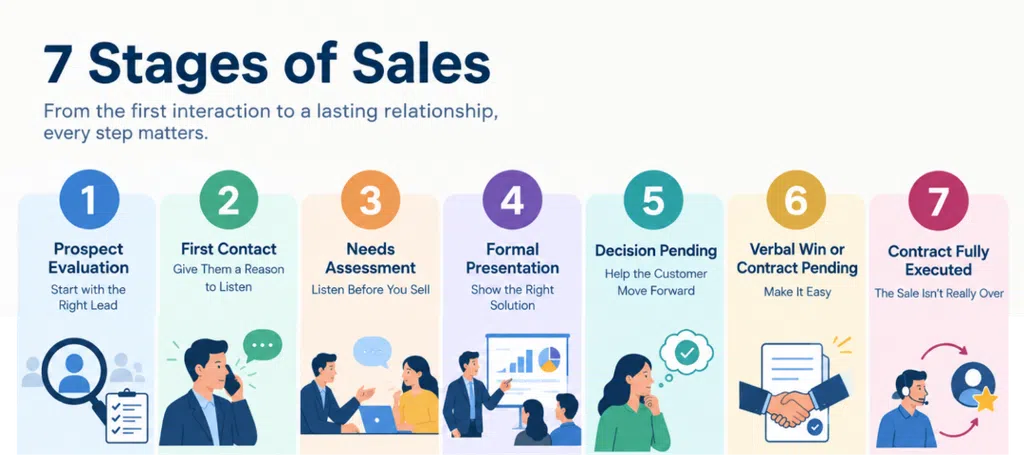
1. Prospect Evaluation: Start with the Right Lead
The first mistake many salespeople make is calling every name on a database. Imagine your manager gives you a list of companies and asks you to start making calls. You could pick up the phone and pitch your product to everyone. But that isn’t really selling. It’s just calling.
The first step is to identify and prioritise the right leads.
- Understand what product or service you’re selling.
- Identify which companies are likely to need it.
- Find the right person within those companies.
- Research the company and its industry.
- Understand whether your offering actually fits their business.
For example, if you’re selling automotive spare parts to a Hyundai dealer, you need to know whether the dealer can purchase from the outside market or already has an arrangement with its OEM. The customer’s mindset at this point is simple: I may have a problem, but I don’t know you yet. Do I even need to change anything? So, remember this: you may have identified the customer, but the customer hasn’t identified you yet.
An interesting read: How to understand the importance of sales in organizations
2. First Contact: Give Them a Reason to Listen
Once you’ve identified the right prospect, you need to make contact. This could happen through a phone call, email or even a face-to-face visit. But your first contact has one job: create relevance. I’ve used LinkedIn many times to identify the right person before walking into a company. Instead of asking the receptionist for whoever handles a particular function, I would find the person’s name first and ask for that person directly. That small difference can change the conversation.
Once you’re speaking to the right person, don’t spend too much time explaining how old your company is or listing everything it does. You’ve already done your research. Get to the point. The customer is asking:
- Why should I listen to you?
- Is this relevant to my role?
- What value does this bring to me?
- Is it worth giving you more of my time?
Your first impression needs to be your best impression. Relevance and credibility move the customer forward.
3. Needs Assessment: Listen Before You Sell
This is where the conversation becomes more meaningful. The customer has shown some interest and agreed to speak with you. Now your job isn’t to prove how much you know about your product. It’s to understand how much you know about the customer.
I often tell salespeople not to ask for an hour or two hours at the beginning. Ask for 10 minutes. Create an impact in those first 10 minutes, and that conversation can naturally become much longer. During the needs assessment, focus on:
- Understanding the customer’s business.
- Identifying the underlying problem.
- Listening carefully to their needs.
- Understanding the risks involved.
- Connecting your product or service to their business.
- Establishing the value of solving the problem.
I’ve experienced this myself while selling banking products. Customers would compare our offerings with HDFC, ICICI and Axis Bank. Their question wasn’t simply, “What does your product do?” They wanted to know whether changing their existing process was worth it. That distinction matters. ‘Needs’ assessment isn’t where we prove how much we know about our product. It’s where we prove how much we understand about the customer.
4. Formal Presentation: Show the Right Solution
Once you understand the customer’s needs, you can build your formal presentation. This shouldn’t be a generic presentation. It should reflect what you learned during the needs assessment. I believe a formal presentation needs to be around 90 to 95 percent accurate because you’re presenting a specific solution based on what the customer has told you.
At this stage, the customer is thinking:
- Does this solution match my priorities?
- What measurable improvement can I expect?
- How easily will it fit into my existing process?
- What will implementation involve?
- Am I confident enough to move forward?
A great presentation isn’t about showing everything your company can do. It’s about showing the customer that you can solve what they told you matters.
Read more: 8 effective ways to increase sales for your business
5. Decision Pending: Help the Customer Move Forward
At this stage, you’ve shared the relevant information. The customer may also be researching your product, checking competitors or waiting for internal approval. This can be a difficult stage. The customer may think, I see the value, but am I confident enough to say yes? They may worry about risk, business priorities or whether the decision is right for their organisation. This is where patience matters.
You need to stay connected, reassure the customer and reinforce how your solution addresses the concerns they’ve already shared. Don’t assume that silence means the opportunity is dead. Sometimes the customer is simply dealing with other priorities.
6. Verbal Win or Contract Pending: Make It Easy
A verbal “yes” feels like a win. But it’s not a completed sale. There may still be applications, approvals, signatures, documentation and internal processes to complete. This is also a stage where customers can step back, even after agreeing to move forward.
I’ve seen how important this can be through a simple example. If you lose your SIM card, you don’t want to wait 24 hours for a replacement. You want the solution quickly. The same principle applies to sales. Once the customer agrees, make the process clear and seamless.
- Explain what needs to happen next.
- Set a clear timetable.
- Identify who is responsible for each step.
- Explain why documents are required.
- Keep the customer accountable.
- Reassure them throughout the process.
Don’t make the customer feel that the process is harder than the product itself.
You may like this: Top 10 Online Degree Courses With the Highest Demand in India (2026)
7. Contract Fully Executed: The Sale Isn’t Really Over
Once the contract is executed and the solution is delivered, many salespeople think the job is finished. I don’t see it that way. For me, completing the contract is about 95% of the journey. The remaining 5% continues for as long as the customer stays with you.
Issues will come up, products may have glitches, services may face problems. When that happens, the customer wants someone who understands the relationship and can help. I believe the salesperson should remain a point of contact whenever possible. If I can solve an issue directly instead of simply giving the customer a customer-care number, I build more trust.
I’ve handled 600 to 800 customers in a month, and I’ve seen customers continue to follow the salesperson even when the salesperson changes companies. That’s why I always say: make your brand rather than letting the brand make you.
Sales, Marketing and Customer Engagement Must Work Together
Sales and marketing aren’t the same thing. Marketing puts the product or service in front of the market. Sales works directly with customers and helps them make a decision. After acquisition, customer engagement becomes important for retaining the relationship, developing the account and creating opportunities for upselling or cross-selling. The three work together.
Better marketing brings the right customer in. Better sales help the customer make the right decision. Better customer engagement gives the customer a reason to stay. – Viswanath Nallam
That is the larger lesson behind the sales funnel. A sales funnel isn’t simply a series of boxes that leads to a purchase. Every stage reflects a different customer mindset. If we understand that mindset, we can stop treating every lead the same way.
For those looking to build these skills through structured management education, MUJ’s Online MBA with dual specialisation in Marketing and BFSI offers an opportunity to develop a broader understanding of marketing, management and the financial services sector. It can help learners connect business concepts with the realities of customer needs, market dynamics and sales, building a stronger foundation for careers in marketing and BFSI.
Because ultimately, selling isn’t just about getting a customer to say yes. It’s about giving them a reason to keep saying yes.
Prepare for your next career milestone with us


Explore Similar Blogs
View All
 22 Oct 2026
 7 mins
 19 Oct 2026
9 mins
 11 Sep 2026
8 mins
 08 Sep 2026
6 mins