
Listen to this blog

BBA has become one of the most preferred undergraduate choices for students right after Class 12, because it blends practical business studies with real-world exposure, highly equipping students for different career paths, and also higher studies, like MBA. Hence, the rise of BBA is everywhere.
BBA blends practical business learning with real-world exposure, preparing students for diverse career paths and higher studies like MBA. With the rise of startups and digital businesses, the demand for management graduates is growing rapidly.
As India’s job market leans harder into retail, fintech, e-commerce, and consulting, more students are choosing this path over general degrees because it builds practical, employable skills from year one, not after a postgraduate degree.
This blog looks at what is driving this shift, what a BBA program actually prepares students for, and how to choose the right one.
Why Are More Students Choosing BBA Over Other Undergraduate Degrees?
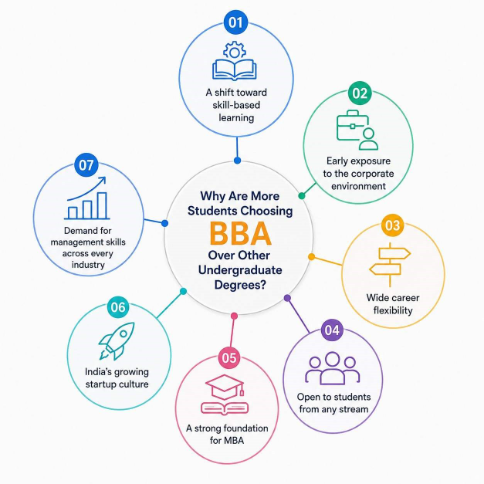
1. A shift toward skill-based learning
For the longest time, BCom and a general BA were just the default choice if you were headed into business or commerce. That’s changing now, and this shift is really at the heart of the rise of BBA as a preferred choice. Students are leaning toward courses that involve presentations, case studies, and actual industry exposure instead of sitting through textbook theory, and a BBA degree happens to fit that shift almost perfectly.
2. Early exposure to the corporate environment
A lot of BBA programs now build internships right into the course structure. So instead of getting their first real taste of a workplace after graduation, students start picking up on how businesses actually function, how professionals communicate with each other, and how to start building a network, all while they’re still in college. This early, hands-on exposure is one of the quieter reasons behind the rise of BBA among Class 12 students planning their next step.
3. Wide career flexibility
A BBA course doesn’t really lock you into one path. Over three years, students get a look at marketing, finance, HR, operations, entrepreneurship, and now analytics and digital roles too. Later on, they can actually choose a specialization on what interests them. That flexibility is a big part of why the rise of BBA has continued steadily rather than fading as just another trend.
4. Open to students from any stream
Unlike degrees that expect you to come from a commerce background, a BBA degree welcomes students from science, arts, or commerce equally. That’s a big part of why it appeals to so many candidates, especially those who only decide on a business career after Class 12, once other options feel more locked in. It’s also one of the clearest drivers behind the rise of BBA across non-commerce students specifically.
5. A strong foundation for MBA
B-schools and recruiters usually prefer candidates who already have some grip on core management concepts. Students who’ve already been through case studies and presentations during their BBA program tend to walk into an MBA classroom, or an interview, with a bit of a head start. That’s largely why BBA followed by MBA has turned into one of the more common and well-regarded routes into senior management roles in India, and it explains why the rise of BBA and the demand for MBA seats have grown almost hand in hand.
6. India’s growing startup culture
With government-backed initiatives like Startup India, entrepreneurship doesn’t feel like some far-off idea anymore, it’s a realistic path. A BBA degree’s grounding in business planning, market research, and financial basics works well for students who’d rather build something of their own than go the traditional job route. Startup culture alone has given real momentum to the rise of BBA in recent years.
7. Demand for management skills across every industry
Healthcare, IT, retail, education, pretty much every sector need people who know how to manage work well. That kind of demand means a BBA graduate isn’t stuck with just one industry option the way someone with a narrower degree might be, which ties back to why the rise of BBA shows no signs of slowing down.
Read More: Courses to Do After BBA: Career Options, Salary, Skills & More
What Skills Does a BBA Program Build?
The BBA program is designed to develop business knowledge and soft skills ready for the workplace:
- Business communication, presentation skills
- Managing a team and leadership
- Financial literacy & basic accounting
- Knowledge of marketing and consumer behavior
- Data-driven decision making (particularly for programs with an analytics component)
- Practical exposure through case studies and live projects
These are the very same skills recruiters are actively screening for entry-level business roles, which is a big part of the reason BBA graduates are considered job-ready sooner than graduates of purely academic degrees.
What Are the Career Options After BBA?
A BBA opens doors across marketing, sales, operations, HR, and finance functions in almost every industry, from retail and banking to consulting and e-commerce. Common entry-level roles include:
| Job Role | Average Salary Range (India) |
| Business Development Executive | ₹3.3 LPA – ₹7.5 LPA |
| Marketing Executive | ₹3 LPA – ₹6 LPA |
| HR Executive | ₹3 LPA – ₹5.5 LPA |
| Operations Executive | ₹3 LPA – ₹5.5 LPA |
| Financial Analyst (entry-level) | ₹4 LPA – ₹7 LPA |
Salary ranges are indicative, based on Glassdoor India salary data, and vary with company, location, and specialization.
Those who go on to do an MBA or relevant certification (say a business analytics or digital marketing course) typically see a sharp jump in both role seniority and pay within a few years of starting out.
Is BBA Better Than BCom or BA for a Business Career?
BBA is generally the better choice for students who wish to work in management/corporate roles as it is designed for that path; BCom and BA are more academic degrees. BCom remains a solid choice if a student is set on chartered accountancy or a pure finance/accounting career, since it goes deeper into those subjects. But for students who want exposure across marketing, HR, operations, and finance, plus the soft skills recruiters look for, BBA offers a more direct route into business roles right after graduation.
How Is Online Manipal Making BBA Education Accessible?
At Online Manipal, three universities are offering online BBA, so students can choose a program that fits their budget, specialization interests, and career goals without ever needing to relocate.
MUJ, MAHE, and SMU each offer an online BBA, and MUJ has the widest elective spread (7 options). MAHE offers an Honors year for deeper specialization. SMU is the most affordable of the three. All are UGC-entitled with placement support!
If you’re weighing a BBA after Class 12, the real decision isn’t whether to do it. It’s which university and specialization best match where you want your career to go.
An Interesting Read: Which BBA electives have good scope?
Conclusion
BBA’s rise is not a trend; it’s a response to what today’s job market rewards: practical skills, early exposure, and flexibility across industries. For students who know they want a business career but aren’t ready to specialize on day one, it remains one of the smartest starting points after Class 12. And with options like Online Manipal’s programs through MUJ, MAHE, and SMU, that starting point no longer requires choosing between a good education and a flexible one.
Reference
Prepare for your next career milestone with us