Blogs
Blogs 
Why a Master’s Degree is One of the Smartest Career Investments for Working Professionals

Listen to this blog

Your career is growing, and you have a track record of success. Still, a question quietly nags: Is my bachelor’s degree enough to unlock the next level of my ambitions?
For a growing number of Indian professionals, the answer is no – and the numbers back it up.
India is in the middle of a remarkable professional upskilling wave. The country’s online higher education and upskilling market, valued at ₹30,000 crore in FY23, is on track to reach ₹85,000 crore by FY28, which is growing at a compounded annual rate of 23.1%. Meanwhile, the Indian online education market is expected to grow from USD 2.92 billion in 2024 to nearly USD 21 billion by 2033. The question isn’t whether Indian professionals are investing in further education – they clearly are. The real question is: Does a master’s degree actually pay off?
This blog breaks down the return on investment (ROI) of pursuing a master’s degree in India, why the current job market makes it more relevant than ever, and how an online master’s is the most practical way to get there.
India’s Upskilling Boom: Why Professionals Are Investing in Higher Education
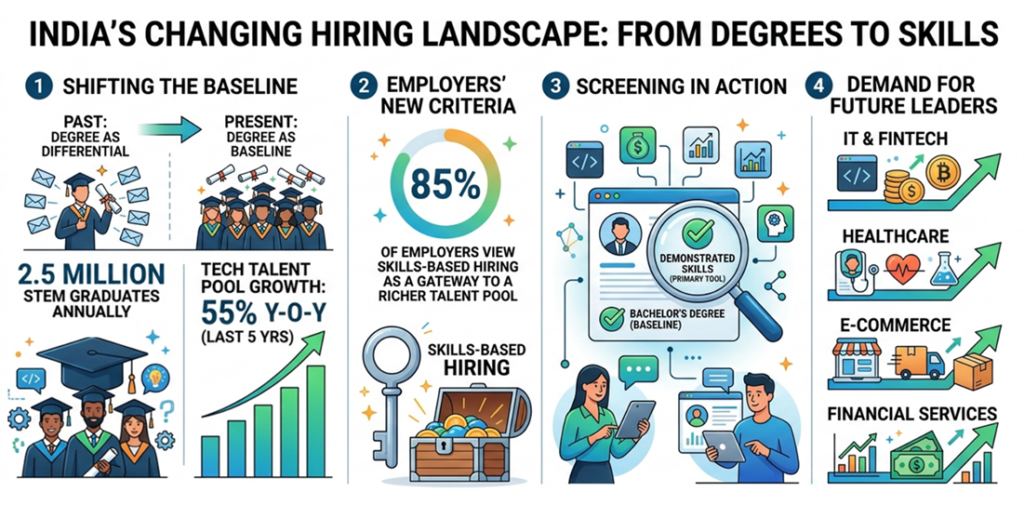
Not long ago, a bachelor’s degree was a strong differentiator in India’s hiring landscape. That’s no longer the case. With 2.5 million STEM graduates entering the workforce each year and undergraduate education becoming more widely accessible, a bachelor’s degree has become the baseline, not the benchmark.
India’s tech talent pool alone has grown by 55% year-on-year over the last five years. In this environment, employers have shifted their criteria. According to a 2026 talent trends report, 85% of employers see skills-based hiring as a gateway to a richer talent pool, and Indian recruiters are already using demonstrated skills as their primary screening tool. At the same time, sectors such as IT, fintech, healthcare, e-commerce, and financial services are expanding rapidly, creating demand for professionals with both domain expertise and strategic thinking.
A master’s degree sits squarely at this intersection. It is no longer just an academic achievement; it is a signal of specialization, commitment, and readiness for leadership.
The Financial ROI: What the Data Shows for Indian Professionals
Let’s talk numbers.
Research comparing salary levels across educational qualifications in India shows that master’s degree holders earn approximately 20–30% more than their bachelor’s degree counterparts in the same roles. That premium compounds over a career. For a professional currently earning ₹8–10 lakh per annum, a 30% bump translates to roughly ₹2.5–3 lakh more every year, easily recouping the cost of most online master’s programs within the first year alone.
The cost of a master’s or postgraduate program in India typically ranges from ₹1.6 lakh to ₹4.8 lakh, with an MBA costing up to ₹30 lakh. When weighed against a salary increase that kicks in relatively quickly, the financial case is compelling.
The MBA, India’s most popular postgraduate business degree, tells a particularly strong story. The average annual salary for MBA graduates in India ranges from ₹8.4 lakh to ₹12 lakh, according to data. Employability among business administration graduates has jumped sharply: from 47% in 2021 to 78% in 2025, reflecting just how strongly the market now values this qualification.
Beyond the Paycheck: The Non-Financial Returns
Salary increases are the most visible return on a master’s degree, but they’re not the only one.
Here is what the data and lived experiences of Indian professionals reveal:
Credibility and Confidence at Work
- In India’s hierarchical workplace culture, a professional’s designation and educational background carry significant weight. A master’s degree doesn’t just open doors; it changes how colleagues, clients, and management perceive and interact with you. This ‘credential premium’ is harder to quantify but very real.
Dive deep: Debunking 5 myths HR managers have about online degrees
Access to Leadership Roles
- Indian companies, particularly in IT, BFSI, and consulting, often have informal educational gatekeeping for senior roles. A master’s degree, whether an MBA, MCA, or MCom, is frequently the unspoken prerequisite for promotion into middle and senior management. Without it, professionals can find themselves in a career plateau despite solid performance.
Network Expansion
- Graduate programs, even online ones from reputed universities, connect you with a cohort of professionals across industries and geographies. In India’s relationship-driven business environment, this alumni network can translate directly into referrals, partnerships, and career opportunities that simply wouldn’t exist otherwise.
Career Pivoting Power
India’s job market is undergoing structural shifts driven by AI, automation, and digital transformation. The World Economic Forum estimates that 54% of employees will need reskilling in the coming years. A master’s degree allows professionals to make a meaningful pivot from traditional marketing to analytics, or from general IT to AI/ML, with credibility and institutional backing.
Tier 2 and Tier 3 City Advantage
Upskilling demand is growing fastest in cities such as Vadodara, Coimbatore, Jaipur, and Kochi[A[1] , but access to high-quality on-campus programs remains limited in these regions. Online master’s degrees from nationally recognized institutions democratise access to high-quality education for professionals in non-metro India, without requiring relocation.
Also read: How Online Degrees Improve Employability in Tier 2 and Tier 3 Cities
Why Working Professionals Are Going Back to School in India
The average age of online learners in India has risen from 23 in 2020 to 32 in 2025 – a clear indicator that working professionals, not fresh graduates, are now the primary audience for online degree programs. Enrolment in online degree programs across Indian universities has grown by over 50% since 2021, and UGC-approved universities offering online programs have more than doubled, from 40+ in 2021 to over 100 in 2024.
Why now? Several forces are converging:
- The skills economy is real. Automation is displacing routine roles while creating demand for advanced, specialized skill sets. Professionals who don’t actively upskill risk being left behind.
- The employer’s market is returning. After a brief period of candidate-driven hiring post-pandemic, companies have become more selective. A master’s degree helps professionals stand out in a more competitive environment.
- Government support through initiatives like the National Education Policy 2020 and the Skill India Mission has lent legitimacy and structure to online learning, encouraging more employers to recognize UGC-entitled online degrees on par with traditional campus degrees.
- And finally, flexibility has become achievable. Unlike a decade ago, today’s online programs from accredited universities are genuinely designed around the schedules of working adults, with live sessions, recorded lectures, mobile-accessible LMS platforms, and no mandatory on-campus attendance.
The “Opportunity Cost” Gap
1. The Cost of Not Pursuing a Master’s Degree
In India’s rapidly evolving labor market, staying static is regressive. Professionals who defer further education often find that the window for career transitions narrows with time, that salary increments plateau earlier, and that leadership roles become increasingly inaccessible. The ROI of a master’s degree must be measured not just against what it adds, but against what is lost by waiting.
2. The Gender Dimension
According to a report, more male than female professionals enrolled in upskilling programs in India, and the gender gap widens sharply at senior levels, where time constraints and a lack of confidence were cited as key barriers for senior women. An IIM-Ahmedabad study found that while women at the individual contributor level earn only 2.2% less than men in similar roles, the gap widens significantly at manager, director, and senior executive levels, underscoring why continuous education and upskilling at every career stage matters more for women than for men.
You may find this interesting: 5 Inspiring Women and the Stories That Define Strength
How to Evaluate the ROI of a Master’s Program
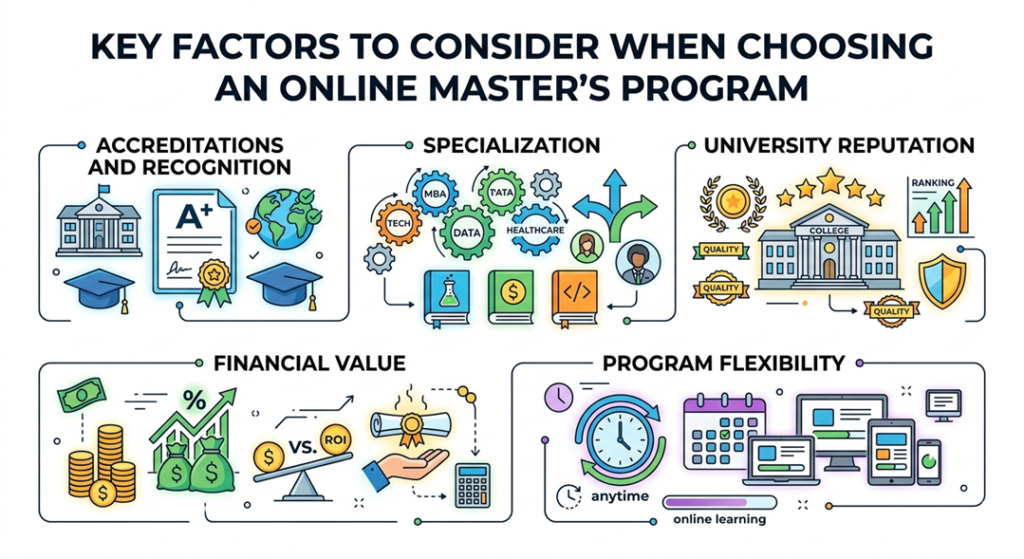
Not all master’s programs offer the same return on investment. Before enrolling, Indian working professionals should weigh the following:
- Accreditation and recognition are non-negotiable. Ensure the program is UGC-entitled and that the university holds NAAC accreditation. These are the benchmarks that employers, higher education institutions, and government bodies use to validate online degrees in India.
- Specialization alignment matters more than the degree itself. A generic MBA adds value; an MBA with a specialization in Analytics & Data Science, Marketing, or Finance adds even more, as it maps directly to high-demand roles that command salary premiums.
- University ranking and alumni network influence hiring outcomes. A degree from a nationally ranked institution opens doors that an equivalent degree from an unrecognized institution does not.
- Program cost vs. expected salary uplift should be modeled explicitly. For most accredited online master’s programs in India, which range from ₹1 lakh to ₹3 lakh, the salary differential they generate makes them financially self-liquidating within 12 to 18 months.
- Flexibility for working adults is essential. Look for programs that offer recorded lectures, weekend live sessions, mobile-friendly platforms, and a reasonable exam schedule that doesn’t require career interruption.
Also read: Boost Employee Growth with Online Learning During Appraisals
The Benefits of an Online Degree: Earn While You Learn
One of the most significant structural advantages of online master’s programs, one that traditional on-campus programs cannot offer, is the ability to continue working full-time while earning the degree. This means the ROI calculation is fundamentally different from a full-time program:
- You continue drawing your salary during the program.
- You can immediately apply what you learn in your current role.
- You graduate with both the degree and the additional work experience.
- You avoid the income gap that full-time students typically face.
For Indian working professionals supporting families, managing EMIs, and navigating the realities of adult life, this is not a small advantage; it is often the deciding factor.
Final Word: The Best Time to Invest Is Now
India’s economy is expanding, its job market is evolving rapidly, and the premium on advanced education has never been higher. A master’s degree for a working professional is not a pause in your career; it is an accelerator for it.
The data is clear: professionals with a master’s degree earn significantly more, advance faster, and are better positioned to navigate career transitions. The non-financial returns, such as confidence, credibility, network, and options, are equally substantial. And with online programs from accredited institutions now making this possible without career disruption, the barriers to entry have never been lower.
The question is no longer whether a master’s degree is worth it. For most Indian working professionals, the question is how much longer you can afford to wait. In short, is a master’s degree worth it? Absolutely.
Take the Next Step with Online Manipal
If you’re a working professional ready to unlock the next chapter of your career, Online Manipal offers a range of industry-aligned, UGC-entitled master’s programs designed specifically for you without requiring you to press pause on your professional life.
Offered by three NAAC-accredited institutions: Manipal Academy of Higher Education (MAHE), Manipal University Jaipur (MUJ), and Sikkim Manipal University (SMU), all programs are 100% online with live and recorded sessions, industry-relevant curriculum, and dedicated career support services. You don’t have to choose between your career today and your ambition for tomorrow.
Explore Online Manipal’s master’s programs at www.onlinemanipal.com and take the first step toward a career that reflects what you’re truly capable of.
References
Prepare for your next career milestone with us



Explore Similar Blogs
View All
 06 Oct 2026
 5 mins
 18 Sep 2026
7 mins
18 Sep 2026
7 mins
 18 Aug 2026
8 mins
18 Aug 2026
8 mins
 18 Aug 2026
9 mins
18 Aug 2026
9 mins