Blogs
Blogs 
GitHub, Hackathons, and Internships: The Real Growth Trio for BCA Students

Listen to this blog

A degree tells an employer what you studied. That is a given. But a resume stands out when it combines practical skills and relevant experience within that field. For instance, if you hold a BCA or Computer Science degree, an active GitHub profile, hackathon participation, and meaningful internships can make your resume far more compelling. When these elements align with your degree, you become a strong candidate in the eyes of an employer.
These three things tell them who you actually are as a developer. These mentions will work in the candidate’s favor, helping them leave a lasting impression on the employer. If you are a BCA student figuring out how to stand out in a competitive job market, stop waiting for placement season to save you. Start here.
GitHub: Your Living, Breathing Portfolio
GitHub is a cloud-based platform that allows developers to store, manage, and share their code. It uses a version control system called Git, which helps track changes in projects and enables multiple developers to collaborate efficiently. Many students and professionals use GitHub to showcase their coding projects, contribute to open-source software, and build a practical portfolio that employers can review.
Most BCA students treat GitHub as a submission folder: push the assignment, close the tab, and move on. That is the wrong way to think about it entirely. GitHub is not where you store code. It is where you build your professional identity, one commitment at a time. GitHub serves as tangible proof of a trusted source for hiring managers at start-ups and tech-focused companies.
When a recruiter opens your profile, they are not counting repositories. They are reading your story as developers. For instance, below is a pseudo-profile of a student named Rahul Sharma with a very well-maintained GitHub Profile.
 Note: The image is AI-generated to make readers understand a GitHub profile
Also read: Essential AI Tools to Boost Your BCA & MCA Learning Journey
What Recruiters Actually Want to See
Good GitHub portfolio tips for BCA students start with one uncomfortable truth: your profile is being judged right now, not after you graduate. Recruiters are actively searching, and an empty or stale GitHub profile is a silent rejection before the interview even begins. What they want to see is not perfection but progression.
A rough first-year project, followed by a cleaner second-year one, followed by something ambitious in your third year, tells a far better story than ten repositories pushed in one panicked week before placements. According to a study, around 78% of technical recruiters review candidates’ GitHub profiles when available.
Building Projects That Actually Matter
Building projects on GitHub for placements is less about the technology stack you choose and more about the intent behind what you build. Below are some ways you can uplift your GitHub profile by choosing the right projects.
- Projects built out of passion always turn out well. Hence, picking one based on your niche will be the best.
- When choosing a project, it would be highly appreciated if the outcome were very useful and used daily. This can also be something related to your college, hostel, and department.
- This will act as a great leverage during interviews, as it will garner a lot of attention for you as a problem-solver, which is a very valuable skill.
An interesting find: Top 15 BCA Final Year Project Topics and Ideas
The Open-Source Advantage
Beyond personal projects, contributing to open-source repositories, which might even be as small as fixing a typo in documentation, indicates something that personal projects alone cannot: that you can read someone else’s code, understand it, and improve it. That skill is rarer than most students think, and it separates candidates in ways that are immediately visible on a profile.
Hackathons: Where Pressure Becomes Progress
No semester teaches you how to make a decision when you have incomplete information, a ticking clock, and a teammate who disagrees with you. Hackathons do, every single time. They are not coding competitions dressed up with prizes – they are the closest simulation to real professional software development that a student can access for free.
How Hackathons Actually Shape Your Career
Understanding how hackathons boost coding careers means looking past the certificates and the podium moments. The real transformation is quieter. It happens when you scope a project at 10 PM, realize at 2 AM that your approach was wrong, pivot entirely, and still ship something by morning. That experience rewires how you handle pressure. It builds a kind of calm under constraint that classroom learning simply cannot be manufactured.
What You Walk Away with Beyond the Code
Every hackathon leaves you with three things that compound over time. First, a project – something built fast and scrappy, but real enough to put on GitHub and talk about in interviews. Second, a team – people who saw you work under pressure and chose to work beside you anyway, which is its own kind of professional reference. Third, a network of mentors, founders, and industry professionals who showed up to judge or guide – and who remember the students who asked good questions.
When to Start and Why the Answer Is Now
The most common hackathon mistake BCA students make is waiting until they feel ready. Competence follows participation, not the other way around. Register for the next one your college or city announces. Go alone if you have to. Lose badly if that is what happens. The learning curve of a single hackathon is steeper than an entire semester, and it begins the moment you show up.
Internships: The Bridge No One Else Can Build for You
There is a significant difference between knowing what a REST API is and spending three weeks debugging one in production while your manager waits on a fix. Internships put you firmly on the right side of that difference. They are where theory stops being theoretical and starts being consequential.
Finding One Before Everyone Else Does
The best internship strategies for BCA students share one common thread: they start early and proactively. They do not wait for their college placement cell to bring opportunities to their doorstep. Because, by the time those roles are announced, hundreds of learners are already competing for them.
One way to start an internship is by cold-mailing startups in your niche. Another way would be to message founders on LinkedIn. Moreover, walking into local tech companies and asking them to help will also be useful. Your request does not need to be polished — it needs to be genuine. Most students never send that email. The ones who do are already a lap ahead.
What Actually Happens Inside an Internship
When you walk into a company as an intern, the first thing you notice is how different real software development feels from anything you studied. Standups replace lectures. Pull request reviews to replace assignment submissions.
Deployment pipelines, client feedback, and sprint cycles — none of them appear in your coursework, and all of them appear on day one at your workplace. It is disorienting at first. And then, gradually, everything you studied starts to make sense in a way it never did inside a classroom.
The Context That Changes Everything
Internships give you something textbooks cannot: context. Suddenly you understand why data structures matter. Why clean code is not an aesthetic preference but a professional necessity. Why version control is non-negotiable when six people are touching the same codebase.
The concepts you studied in isolation now have real homes in real workflows, and that understanding is permanent. It reshapes how you study, how you build, and how you interview.
Why All Three Together Change Everything
Here is what makes this trio genuinely different from every other piece of career advice aimed at BCA students: each one feeds the others. It is not an additive. It is multiplicative.
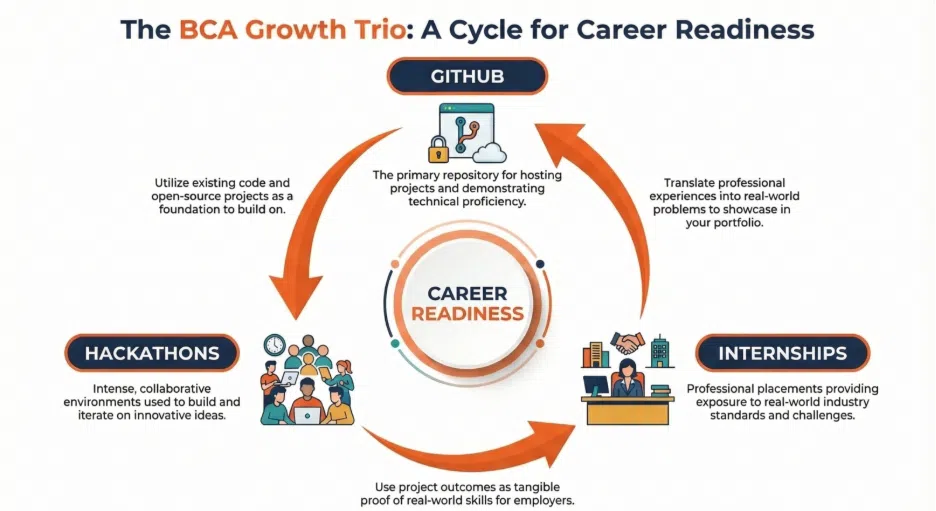
Your GitHub portfolio gives you something concrete to present at hackathons and in internship interviews. Your hackathon performance proves to interviewers that you can think and deliver under pressure. Your internship hands you real, meaningful problems — and the solutions become the strongest projects on your GitHub. This is the real logic behind using hackathons and internships for tech jobs: they are not isolated activities, they are a reinforcing loop that keeps compounding the longer you stay in it.
The students who feel most prepared during placement season are not the ones who studied hardest in their final semester. They are the ones who started building, competing, and working from their very first year. The gap between those two groups is visible in every hiring room, and it is entirely avoidable.
Conclusion
You do not need to be exceptional to begin. You need to be willing.
Apply the GitHub portfolio tips, show up to hackathons before you feel ready, and use every internship strategy available to get your foot in the door — not all at once, not perfectly, but consistently. Push something to GitHub this week. Register for the next hackathon. Write one cold email to a company you admire.
Most opportunities do not announce themselves. You have to go looking.
Your degree will open a door. But GitHub, hackathons, and internships? They are what you walk in with. And in a room full of candidates with the same qualification on paper, that difference is everything.
Prepare for your next career milestone with us



Explore Similar Blogs
View All
 14 Oct 2026
 16 mins
 08 Oct 2026
17 mins
08 Oct 2026
17 mins
 08 Oct 2026
16 mins
08 Oct 2026
16 mins
 17 Aug 2026
7 mins
17 Aug 2026
7 mins