Blogs
Blogs 
Digital Body Language in Online Learning: What It Can Indicate

Listen to this blog

If there is one drawback instructors consistently point to in online education, it is this: they cannot ‘see’ their students!
In a physical classroom, a teacher reads the room naturally- a furrowed brow, a wandering gaze, a student leaning forward or sinking into their chair. These quiet signals tell an instructor everything: who is lost, who is engaged, who checked out ten minutes ago. None of that exists online.
So how does an instructor know if a student is truly present? This is where digital body language steps in; the trail of silent signal students leave behind simply by interacting with their course. Not necessarily a teacher can ‘see’ the student but with each missed login, click, late submission or skipped discussion, it becomes quite clear.
In this blog, let us see what digital body language is,
What is Digital Body Language in Online Learning?
Digital body language refers to the behavioral patterns students leave behind through their interactions on an online learning platform – logins, clicks, submissions, response times, and participation, that silently communicate their level of engagement, motivation, and understanding.
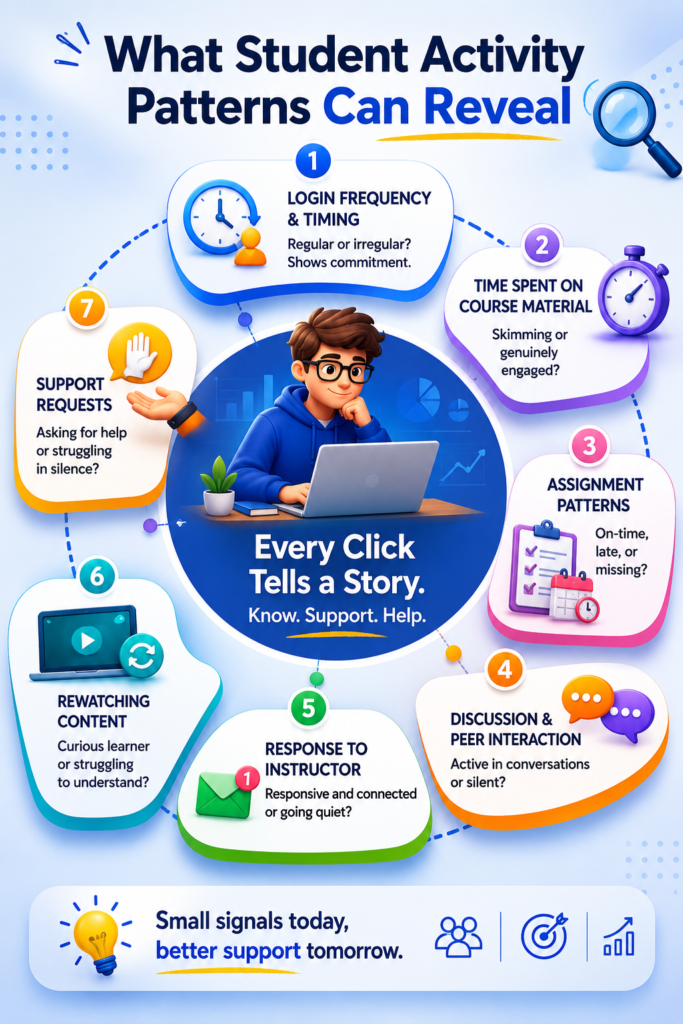
What Student Activity Patterns Can Reveal
Now, noticing this does not happen immediately. Here are a few things worth paying close attention to:
Login Frequency and Timing
Is the student showing up regularly, or are there long, unexplained gaps in activity? Consistent logins often reflect a student who is present and committed. Irregular ones may be the first quiet sign that something is off.
Time Spent on Course Material
Are learners genuinely working through the content, or completing it in seconds, skimming past what was meant to be absorbed? Time on task says a great deal about how seriously a student is engaging with what is in front of them.
Assignment Submission Patterns
Are they submitting on time, consistently late, or not at all? A pattern of delays or missing work rarely happens without reason. It is often one of the clearest indicators of a student who is overwhelmed, disengaged, or quietly falling behind.
Discussion and Peer Interaction
Are they contributing to conversations, or are they completely absent from them? In an online setting, discussion boards and peer interactions are among the few spaces where a student’s voice can actually be heard. Silence is worth noticing.
Response to Instructor Communication
Are they opening messages, replying, and staying connected, or going quiet when reached out to? A student who stops responding is often one who has already started to disengage.
Rewatching or Revisiting Content
Are they returning to a lecture repeatedly? This can mean two very different things, either a student is deeply curious and wants to go further, or they are struggling to grasp something and do not quite know how to ask for help. Both deserve attention.
Support Requests
Are they raising concerns and asking for help, or are they struggling alone in silence? A student who reaches out is advocating for themselves. One who never does may simply not know how or may have already given up trying.
Individually, each of these signals may seem small and easy to overlook. Together, they paint a remarkably clear picture of where a student truly stands; their motivation, their struggles, their pace, and their needs. In the absence of a physical classroom, digital body language becomes the closest thing an instructor can truly see in their students.
Read More: 5 Practical Ways to Prevent Burnout in Online Learning
The Risk of Ignoring Negative Digital Body Language
If these digital signs go unnoticed, students do not suddenly disengage; they drift away slowly. Unlike a physical classroom, where a teacher might catch the shift in a student’s expression or notice an empty seat two days in a row, online disengagement leaves no visible trace. By the time it becomes obvious, it is often already too late.
These signs can quietly turn into something far more serious like:
- Dropout rates rise as students who feel unseen eventually stop showing up altogether.
- Academic gaps widen when struggling students do not seek help, either because they do not know how to, or because no one reached out first.
- Deadlines pile up, and with them, the stress and pressure that make it even harder to catch up.
- Motivation fades and so does confidence; two things that, once lost, are not easy to rebuild.
- Isolation sets in when a student feels disconnected from their instructor, their peers, and the course itself. Burnout follows when personal and academic responsibilities go unmanaged for too long without support.
- Learning suffers which is not because the student was incapable, but because the warning signs were simply never addressed.
How Instructors and Learning Platforms Can Respond
Identifying digital body language is only the first step. What truly matters is what happens after that and how quickly the action is taken.
- A student who has gone quiet does not need a policy reminder. They need someone to notice. And often, the response does not have to be complicated.
- A simple check-in message from a mentor can remind a disengaged student that someone is paying attention to them.
- A gentle deadline reminder sent before a submission is missed, not after, shows students they are being supported, not just monitored.
- Additional academic guidance offered at the right moment can be the difference between a student pushing through or quietly giving up.
- Adjusting the pace of support for a student who is visibly overwhelmed can prevent a small setback from becoming a much larger one.
- Occasionally unmuting students, inviting them to speak, or designing activities that encourage participation from everyone can go a long way.
- Beyond all of this, something as simple as timely feedback and genuine attention from an instructor can make a student feel seen in ways no platform feature ever could.
These are small actions. But to a student who feels invisible in an online course or feels demotivated, they can mean everything. This is also where the learning platform plays a critical role.
An Interesting Read: The Evolution of Faculty Roles in Online Education
How Online Manipal Stands Out
The actual question is, how does Online Manipal stand out in understanding students?
Online Manipal brings together flexible learning, dedicated mentor support, and platform-based insights, as one connected experience designed to make sure no student feels lost along the way.
Students are not left to navigate their courses alone. Mentors check in regularly, track how learners are moving through the program, and step in with guidance before small struggles become bigger ones. LMS activity, assignment patterns, and engagement signals are all part of how Online Manipal stays attuned to where each student truly stands.
The result is something that online education does not always get right, that is a learning environment that feels personal. One where students are not just enrolled, but genuinely supported, consistently engaged, and motivated to see it through to the end.
Conclusion
In online learning, students may not always be seen, but they are constantly communicating through their digital behavior. Every click, pause, missed deadline, or moment of silence can say something important. The real question is: are we paying enough attention to notice it before a student quietly slips away?
Prepare for your next career milestone with us


Explore Similar Blogs
View All
 25 Sep 2026
 7 mins
 23 Sep 2026
6 mins
23 Sep 2026
6 mins
 20 Aug 2026
10 mins
20 Aug 2026
10 mins
 19 Aug 2026
10 mins
19 Aug 2026
10 mins