
Listen to this blog

According to reports, every year, India sends more than 10 million graduates into the job market. But here’s the uncomfortable truth; fewer than half of them are considered ready to work in the field they studied for.
What could be the possible reasons for this?
The answer often lies in the degree vs portfolio vs certification debate, and which one they chose to prioritize.
Having a degree is still integral for a successful career because it shows academic integrity and structured learning. It also demonstrates to an employer that an applicant has the discipline, conceptual understanding, and education that can develop into professional growth. While a degree continues to be useful for the first step of getting a job, it is no longer the only thing that guarantees you get the chance.
Today’s workforce has many options, so many more ways to prove yourself post-degree. This is the reason why employers are searching for more than just a type of academic success; they need to see evidence that you applied your education practically. The two most significant ways to demonstrate application are portfolios and certifications.
Portfolios contain concrete proof that you have developed skills through your work on actual projects, while the certifications are proof you have made an effort to develop knowledge of current industry tools and developments in trending areas.
In 2026, the most critical variable that will separate the best candidates will be the combination of these three components: a degree (academic success), having earned multiple industry-relevant certificates (applications), and maintaining an up-to-date portfolio (real evidence of skill). The combination of these components creates the ideal candidate (“skilled graduate”), who is the person recruiters will most likely hire.
Degree vs Certification vs Portfolio: What Each One Really Means
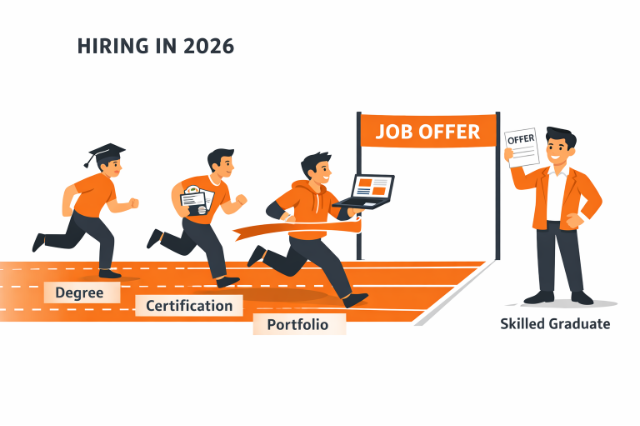
While most students know the difference between a degree, a certification, and a portfolio, what’s less obvious is what each term actually says to a recruiter. In 2026, employers aren’t just ticking boxes; they’re trying to figure out whether you’re genuinely ready to walk in and deliver.
Degree: Your academic foundation
- Shows you can grasp complex ideas and think in a structured way
- Reflects the kind of discipline and consistency that doesn’t come overnight
- Builds credibility, especially when you’re applying for formal roles or higher studies
- Helps employers understand whether you grasp the why behind what you do
- Still the first thing most hiring managers look for, that baseline of trust
Certification: Your relevance in today’s market
- Tells employers your skills aren’t stuck in a textbook from three years ago
- Shows you took the initiative to learn something the classroom didn’t teach you
- Proves you know specific tools or can handle specific roles
- Especially powerful in fast-moving fields like AI, cloud, analytics, and marketing
- Quietly signals: this person is keeping up, not falling behind
Portfolio: Your proof of execution
- Turns everything you claim into something people can refer to
- Shows how you think through and solve real problems and not hypothetical ones
- Can include projects, case studies, GitHub repos, campaigns, or work samples
- Lets a recruiter judge in minutes whether you can do the job
- Often the single thing that sets you apart in tech, creative, and analytical roles
In today’s job market, it’s rarely just one of these that lands you the role; it’s how well all three work together.
An Interesting Read: A comprehensive guide to online portfolios
Which Is Better in 2026: Degree, Certification, or Portfolio?
Here is a table for you to quickly scan before you come to any conclusion:
| Factor | Degree | Certification | Portfolio |
|---|---|---|---|
| Best for | Building strong academic foundation | Validating niche, industry-relevant skills | Demonstrating real-world execution |
| What it proves | Conceptual knowledge and discipline | Current market relevance and continuous learning | Tangible proof of ability |
| Recruiter value in 2026 | First-level credibility and eligibility | Shows adaptability to changing tools and trends | Often the strongest trust-builder in final hiring |
| Works best in | Traditional, managerial, regulated, and higher education pathways | Tech, AI, cloud, analytics, digital marketing, role-specific upskilling | Tech, design, marketing, product, analytics, and creative roles |
| Career impact | Helps open doors and qualify for opportunities | Strengthens specialization and boosts shortlisting chances | Helps candidates stand out as job-ready |
| Best outcome | Long-term growth foundation | Faster skill relevance | Faster hiring confidence |
The truth is, no single thing is going to set you apart on its own. Your degree tells employers you have the foundation. Your certifications show you’ve stayed relevant. Your portfolio proves you can actually do the work. It’s when all three come together that you stop being just another applicant, and start looking like someone who’s genuinely ready for the job.
Read More: How online certification courses can boost your resume?
The Current Hiring Scenario: Hybrid Evaluation Model
Something has quietly shifted in the way Indian recruiters make hiring decisions. It’s not just about your degree or your GPA anymore, and honestly, it hasn’t been for a while. In 2026, employers are looking at the bigger picture, not just the paper. That shift can be termed as the Hybrid Evaluation Model.
In simple terms, it means this: no single qualification gets you hired anymore. Recruiters now weigh a mix of three things:
- Where you studied and what you learned- your academic background and conceptual grounding.
- What you’ve built or done- projects, internships, and real-world problem-solving.
- How current and relevant your skills are- certifications, tools, and industry awareness.
| Do You Know? According to the India Skills Report 2026, the demand for AI, data, cybersecurity, and cloud skills is growing faster than people are being trained to fill them. AI roles are already seeing strong double-digit growth- and India’s AI talent base is expected to reach nearly 1.25 million by 2027. In other words, opportunities are there. The question is whether enough people will be skilled enough to claim them. |
Know More: 2026 Hiring Trends: Are Employers Prioritizing Skills Over Degrees?
How Online Manipal Helps?
Online Manipal is designed to give learners everything the 2026 job market is actually looking for, not just a degree, but the skills, projects, and support that make a real difference when you’re job hunting. Programs span across MBA, MCA, BCA, BBA, MSc Data Science, and PGCPs in Data Science, Business Analytics, and Logistics and Supply Chain Management. Every project is industry-relevant, which means by the time you graduate, you already have something worth putting in your portfolio as well.
Here are some points to consider:
- A UGC-entitled online degree that gives your profile the credibility
- Courses that are in-demand, and industry-specific specializations
- Industry-relevant projects and case studies that can help build your portfolio with
- End-to-end career support, that is, from polishing your resume to prepping for interviews and placement assistance
- A flexible learning model that fits around your life, whether you’re a student or already working
Conclusion
We saw the individual importance of Degree vs Portfolio vs Certification. So, what exactly makes the strongest profile in 2026?
As mentioned above, no single piece is enough on its own. But when all three come together, a degree that grounds you, certifications that keep you ahead, and a portfolio that proves you can deliver, you stop looking like just another applicant. Your profile could be worth hiring for.
Reference
Prepare for your next career milestone with us