
Listen to this blog

Have you ever gone to your favorite store to grab a can of Diet Coke, only to find the shelf completely empty? You might check another store down the street or look online, only to realize it is out of stock everywhere. The truth behind that empty shelf stretches thousands of miles away to shipping lane disruptions in the Strait of Hormuz. This is the reality of our global market: an event occurring on the other side of the world instantly changes whether a product is available to you.
Everything you see around you is part of a massive network of people, materials, and teams. For close to eight years, I have navigated this world across procurement, manufacturing, and digital transformation. Currently, as a delivery manager at an AI-led planning company, I see how fragile these networks can be. For decades, companies focused entirely on running lean, practicing just-in-time inventory to cut costs. However, recent global challenges have taught us a hard lesson: the most efficient supply chains are often the most fragile. To thrive today, companies must shift from mere efficiency to deep supply chain resilience.
What is a Supply Chain Network?
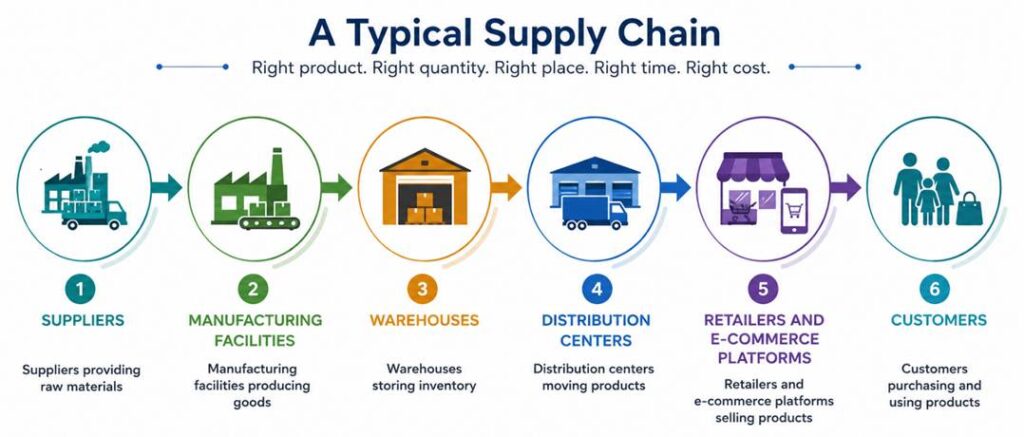
At its core, a supply chain network manages the flow of materials, information, products, and services across a business ecosystem. The goal is to provide the right product, at the right quantity, place, and time, at the right cost.
To understand its depth, look at an item like an iPhone. It appears as a single product, but it relies on a globally connected supplier network operating through distinct stages:
- Customer Demand: Triggered when an order is placed, managed by demand management.
- Forecasting and S&OP: Predicting sales to align our supply with market demand.
- Supplier Network: Coordinating with key partners like Samsung or Sony for components.
- Component Manufacturing: Overseeing the suppliers’ own sub-contractors via supplier management.
- Inbound Logistics: Transporting parts inside factory premises via air, sea, or road.
- Assembly Plants: Contract manufacturers like Foxconn assemble and test the final product.
- Production Scheduling: Determining how many quantities of a specific model (like a 256GB black iPhone) to produce.
- Warehouse Storing: Storing finished goods safely under inventory management.
- Global Distribution: Moving goods to distribution centers via transportation functions.
- Retail and E-Commerce: Fulfilling orders across online platforms and retail stores.
- Customer Delivery: Managing last-mile delivery and consumer experience.
- Returns and Services: Handling faulty goods through reverse logistics.
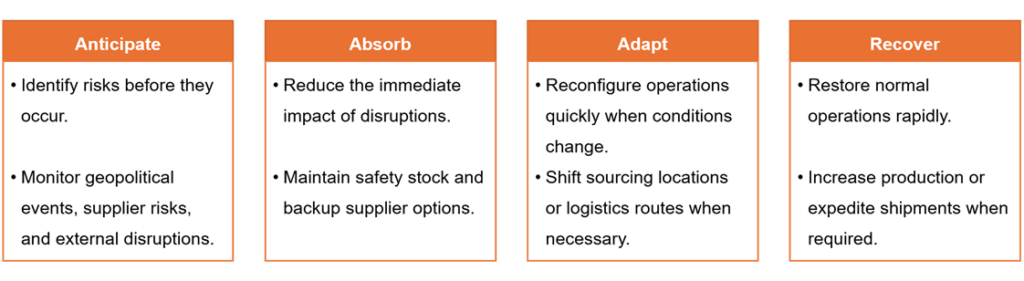
The Four Stages of Supply Chain Resilience
Supply chain resilience is the ability to anticipate, absorb, adapt, and recover from disruptions while maintaining business continuity. Achieving this requires mastering four distinct phases:
Organizations build this capability using five core structural levers:
- Visibility: Monitoring network nodes across the globe in real time.
- Agility: Setting up responsive operational lines to handle sudden changes.
- Collaboration: Engaging a diverse vendor network rather than relying on a single source.
- Flexibility: Keeping multiple logistics and transport routes open.
- Sustainability: Balancing long-term profitability with environmental responsibility.
Tracking Global Disruptions and Their Ripple Effects
Over the years, major disruptions like the 1956 Suez Canal crisis or the 2011 Japan tsunami have heavily strained global markets. More recently, the COVID-19 pandemic disrupted 94% of Fortune 1000 companies overnight. Demand patterns completely flipped: toilet paper became precious, while nobody wanted jet fuel. Furthermore, the 2021 Evergreen ship blockage disrupted $400 million of trade per hour, followed by the Russia-Ukraine war, which shook energy, grain, and aluminium markets.
Let us trace how a geopolitical conflict creates a local ripple effect using the Diet Coke example:
- Disruption: Conflict arises, disrupting trade in the Strait of Hormuz, where 20% to 25% of global trade and Middle Eastern aluminium exports pass.
- Shortage: Shipping disruptions cause freight costs to surge and aluminium supplies to tighten. Can manufacturers face extreme material shortages.
- Impact: Even though the beverage ingredients are ready, a lack of packaging halts production.
- Allocation: Distribution teams must prioritize inventory positioning. Stock is diverted from low-volume stores to high-volume hotspot locations (like a store in Mumbai selling 1,000 cans daily).
- Outcome: Consumers experience stock-outs on retail shelves, causing them to switch to Coke Zero or Pepsi Black.
When these uncertainties strike, every organization must answer six fundamental planning questions: how much to produce, where to position it, when to schedule it, how to transport it, from whom to source it, and how much inventory to hold.
Balancing Delays, Costs, and Inventory: The Iron Triangle
When unexpected delays happen, businesses lose far more than time. Delays translate to lost sales, idle production lines, and heavy penalties for missing service level agreements (SLAs). During the pandemic, a tiny 30-rupee semiconductor chip caused Ford to lose $1 billion in revenue in a single quarter because it halted vehicle production.
To address this, managers navigate the Iron Triangle: balancing speed, cost, and inventory. Optimizing all three simultaneously is impossible. If you prioritize speed and low inventory, cost will spike. Resolving this requires three strategic solutions:
- Production Scheduling: Aligning machine capacity, material availability, and production sequence with demand forecasting to prevent idle plants.
- Supply Planning: Placing inventory at the right locations and optimizing shipping routes to balance speed against freight costs.
- Inventory Optimization: Balancing carrying costs against stock-out risks. Excess stock blocks working capital and risks write-offs, while too little stock interrupts production. Tactical methods like safety stock optimization and ABC analysis help maintain this delicate balance.
Embracing a Digital and Autonomous Future
Transitioning to a digital supply chain is essential to handle demand volatility and accelerate decision-making. The evolutionary journey moves through distinct phases:
- Traditional: Siloed operations where separate departments manage data manually on local Excel sheets.
- Digitized: Deploying central ERP systems to bring organizational data into one visible location.
- Connected: Establishing real-time visibility across all nodes to see exactly how external factors affect inventory.
- Intelligent: Using machine learning models and AI analytics to extract predictive insights from data.
- Autonomous: Setting up a self-learning network that handles disruptions and executes decisions within defined human guardrails.
Reaching a fully autonomous supply chain may take five to seven years, but the march toward intelligent, AI-led planning is accelerating rapidly to support faster decisions.
Accelerate Your Career with Online Manipal
Disruptions are an inevitable part of modern globalization. The strength of a supply chain is defined by the ability of its professionals to answer the right questions under uncertainty. To stay relevant, professionals must master modern forecasting, data analytics, and resilience strategies.
If you are looking to build these future-ready strategic skills and lead complex operational teams, exploring Online MBA in Logistics and Supply Chain Management and PGCP in Logistics and Supply Chain Management at Manipal Academy of Higher Education is an excellent path forward. Developing expertise in digital tools and predictive strategies will empower you to transform market challenges into powerful competitive advantages.
Prepare for your next career milestone with us