Listen to this blog

Artificial Intelligence (AI) is rapidly changing how businesses work today, creating strong demand for professionals with AI skills across industries. If you’re planning to build a career in this field, choosing the right AI course is the first step.
AI courses in India are offered at different levels – from short-term certifications and bootcamps to undergraduate and postgraduate degrees. Each of them has its own eligibility criteria, duration, and fee structure.
This AI course guide covers everything you need to know before enrolling, including the types of AI courses available, eligibility criteria, course duration, syllabus, fee structure, career opportunities, and the future scope of AI in India.
What is an Artificial Intelligence Course?
An Artificial Intelligence course teaches learners to build systems that learn from data, recognize patterns, and make decisions with minimal human intervention. Depending on the study level, an AI course may cover areas like programming, mathematics and statistics, machine learning, deep learning, natural language processing, and generative AI, along with hands-on projects using real-world data.
AI courses are designed for a wide range of learners, including:
- Students: Class 12 students and undergraduates who want to build a career in AI, data science, or software development
- Graduates: Graduates seeking specialization in AI or ML through a diploma, PG, or Master’s program
- Working professionals: Professionals who want to upskill, add AI capabilities to their current role, or transition to AI-focused job roles
AI Courses at a Glance (2026): Duration, Eligibility & Fees
The table below gives a quick snapshot of the most common AI courses in India, along with their typical duration, eligibility, and approximate fees:
| AI Course | Duration | Eligibility | Approx. Fees |
|---|---|---|---|
| MCA in AI & Data Science | 24 Months | 10+2+3-year bachelor’s degree in Computer Applications/Computer Science/IT | INR 1.5 lakh to 2 lakh |
| MCA in AI & ML | 24 Months | 10+2+3-year bachelor’s degree in Computer Applications/Computer Science/IT | INR 2-2.5 lakh |
| AI Bootcamp | 2-6 months | UG and PG students from all academic streams | INR 10K – INR 1.75 lakh |
| Diploma in AI | 6-12 months | Varies by program; Class 10 with Maths and Science or a relevant degree | INR 2-3 lakh |
| BSc/BTech in AI | 3-4 years | 50-55% in Class 12 | INR 2.5-4.5 lakh |
| PG Diploma in AI | 1-2 years | 55% in a relevant Bachelor’s degree | INR 1-3.25 lakh |
Sources: IIT Delhi, IIIT-B, IIT Kanpur, IIT Madras
AI Course Syllabus & Key Skills You Will Learn
The AI course curriculum largely depends on the program level and specialization chosen. However, most courses cover core concepts that learners need to understand and apply AI in everyday environments. Advanced programs may also include some specialized fields, such as Generative AI and Deep Learning.
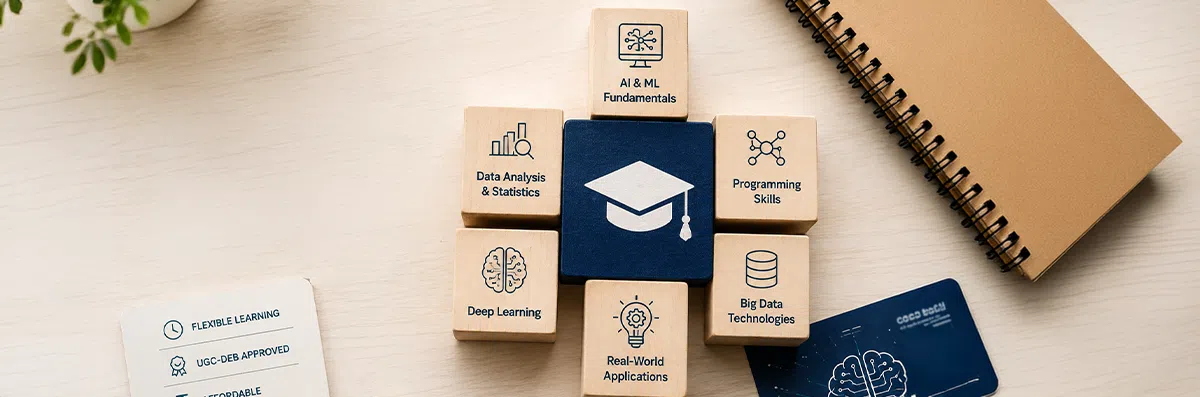
- AI and ML fundamentals: AI concepts, algorithms, supervised and unsupervised learning, and model development
- Programming and data: Python, data handling, statistics, data analysis, and database concepts
- Advanced AI topics: Deep Learning, Natural Language Processing (NLP), Computer Vision, Generative AI, and AI applications
Along with subject knowledge, AI courses also help learners build hands-on skills that employers are actively looking for:
- Technical skills: Python programming, data preprocessing, model building, and working with AI frameworks and tools
- Analytical skills: Statistical thinking, data interpretation, and evaluating model performance
- Problem-solving skills: Applying AI techniques to real-world business problems through projects and case studies
Factors That Influence AI Course Fees
AI course fees may vary significantly depending on the program, institution, and learning format. Considering these factors helps you compare courses and choose a program that best fits your learning needs and budget.
- Course level and duration: Degrees and advanced programs cost relatively more than short-term certificate courses.
- Institution and faculty: Programs offered by reputed universities or institutions may have higher fees based on their curriculum, faculty, and learning resources.
- Learning format and features: Live classes, hands-on projects, industry sessions, mentorship, placement support, and access to specialized tools can also impact the overall course fee.
Career Opportunities & Scope After an AI Course
An AI course can help learners build the required skills for careers across technology, data, automation, and other emerging fields. Roles may vary by course level, technical skills, experience, and specialization. The table below highlights some of the most prominent roles available after completing an AI course:
| Job Role | Responsibilities | Average Annual Salary (Approx) | Experience Level |
|---|---|---|---|
| AI Engineer | Designing and applying AI-based applications and systems | INR 15.4 – INR 17 LPA | with 1 – 6 years |
| Machine Learning Engineer | Building, training, and improving ML models | INR 12.8 LPA – INR 14.1 LPA | with 1 – 6 years |
| NLP Engineer | Developing systems that understand and process human language | INR 11 LPA – INR 13 LPA | with 1 – 8 years |
| Data Scientist | Analyzing data and using statistical and ML techniques to derive valuable insights from that data | INR 10 LPA – INR 22 LPA | with 1 – 5 years |
| Generative AI Specialist | Work with Generative AI models and applications for text, images, code, and other content | INR 4 LPA – INR 20 LPA | with 1 – 5 years |
Sources: AmbitionBox, Glassdoor
Future Scope of AI in India (2026 and Beyond)
AI is fast becoming an integral part of how businesses develop products, automate everyday work processes, analyze data, and deliver services. As organizations across industries continue to adopt AI technologies, professionals with relevant technical and problem-solving skills are likely to find lucrative opportunities across different sectors.
- Growing use across industries: AI is being adopted in multiple areas, such as IT, healthcare, banking, education, manufacturing, retail, and telecommunications, for automation, analytics, and decision-making.
- Demand for specialized skills: Areas such as machine learning, generative AI, natural language processing, computer vision, and AI engineering are creating opportunities for professionals with specialized knowledge in these domains.
- More AI-enabled roles: AI is also changing existing job roles by introducing new tools and workflows. This further increases the need for professionals who can combine domain knowledge with specialized AI, data, and digital skills.
How to Choose the Right AI Course for Your Goals & Budget
Among the various options available today, choosing the right AI course means looking beyond the fee and considering other essential factors. These include your career goals, current skill set, and preferred learning format. Comparing the course structure and program outcomes with your future career path can help you select a course that offers value within your budget.
- Align the course to your goal: Choose a certificate for specific skills, a bootcamp for hands-on learning, or a degree or postgraduate program for deeper, structured AI knowledge.
- Compare the total cost: Check tuition fees, exam charges, learning resources, tools, and other additional costs before enrolling.
- Check eligibility criteria: Make sure you meet the academic requirements and the foundational knowledge required for certain AI courses, such as a background in mathematics or programming.
- Review the course curriculum and career outcomes: Take a close look at the subjects, projects, faculty, mentorship, career support, and skills that you are likely to develop through the chosen AI program.
How an Online BCA or MCA with AI Specialization Compares to Standalone AI Certifications
An online BCA or MCA with an AI specialization offers a broader academic foundation along with specialized AI knowledge. Standalone certifications, by contrast, generally focus on specific tools or skills. The right option depends on your academic background, career aspirations, and the depth of knowledge you intend to build. The following table presents a comparative overview:
| Parameters | Online BCA/MCA with AI Specialization | Standalone AI Certifications |
|---|---|---|
| Qualification | Recognized undergraduate or postgraduate degree | Skill-based certification |
| Duration | 2-3 years | 1-12 months |
| Scope of learning | Covers core computing and AI concepts | Generally focuses on a specific AI skill or area |
| Career stage | Best suited for students, graduates, and working professionals (depending on the program chosen) | Ideal for upskilling or adding specific AI skill sets |
| Career progression | Supports entry into IT roles and paves the way for higher studies | Complements an existing degree or work experience |
Online BCA and MCA degree programs on Online Manipal are designed to help learners build computing knowledge while developing skills relevant to emerging technologies. Manipal University Jaipur (MUJ) offers an Online BCA in AI and Data Science covering programming, data science, AI, and ML concepts. The Online MCA in AI & ML from MUJ also helps graduates gain advanced knowledge in AI and ML and advance their careers.
For learners seeking a degree qualification rather than a standalone certification, Online Manipal programs offer a more structured learning path while still providing the flexibility and convenience of online study.
Common Myths About AI Courses — Busted
AI courses come in different formats, fee structures, and learning paths. Several misconceptions remain about who can take them and what they may lead to. Clearing up these myths can help you decide more confidently before enrolling.
- Myth: All AI courses are costly.
Fact: AI courses may range from low-cost certifications to higher-priced degree and advanced programs. The fee structure depends on the study level, institution, duration, and preferred learning format. - Myth: Completing an AI course guarantees a high-paying job.
Fact: An AI qualification alone does not guarantee a particular salary or job for any course graduate. Career outcomes depend on technical skills, practical experience, projects, specializations, and employer requirements. - Myth: Higher course fees guarantee better placements.
Fact: Higher fees do not necessarily lead to better placements or higher earnings. Career outcomes largely depend on the curriculum quality, practical skills taught, projects, specializations, and employer requirements. - Myth: You need an engineering or computer science degree to learn AI.
Fact: While technical programs may have specific eligibility criteria, many beginner-level AI courses are open to learners from different academic backgrounds. The right choice depends on the program and its specific entry requirements.
Conclusion
Choosing the right AI course starts with understanding your options well. AI courses in India are available at different study levels. Before enrolling, compare the course curriculum, learning format, hands-on exposure, total cost, and career outcomes to find a program that best aligns with your academic background, budget, and career goals.
FAQs on AI Courses in India
What is an AI course and who should take it?
An AI course teaches the key concepts, tools, and techniques used to build intelligent systems, such as machine learning, deep learning, NLP, and generative AI. It is ideal for learners planning a career in technology, graduates seeking further specialization, and working professionals keen to upskill or move into AI-focused roles.
What are the eligibility criteria for AI courses in India?
Eligibility for AI courses can depend on the program and institution. Beginner-level certificate courses may accept learners from different educational backgrounds, while undergraduate programs generally require completion of Class 12. Postgraduate and advanced programs typically require a Bachelor’s degree and may have additional admission requirements, such as a background in mathematics, programming, statistics, or computer science.
How long does it take to complete an AI course?
The duration of an AI course depends on the study level and course structure. Short certificate programs may usually take a few weeks or months, while diploma and postgraduate programs span around 1-2 years. Undergraduate degree programs in AI or related fields generally last 3-4 years.
What is the average AI course fee in India?
AI course fees in India vary by study level, institution, duration, and learning format. For instance, short-term certificate courses may range from INR 1-2 lakh, while advanced diploma, postgraduate, and degree programs can cost INR 2-5 lakh. Always compare the course curriculum, hands-on training opportunities, certifications, and other features along with the total course fee before enrolling.
Which AI course is best for beginners?
Beginners can start with a short-term AI certificate or bootcamp that covers Python, data basics, and machine learning fundamentals. Students who have just completed Class 12 and want a structured, long-term path can consider an undergraduate degree such as a BCA or BSc with an AI specialization. The best choice depends on your current skills, time commitment, and career goals.
Can non-tech/non-engineering students take AI courses?
Yes, students from a non-technical background can take AI courses, particularly beginner-level certificates and programs specifically designed for learners without a technical background. However, advanced AI programs may require some knowledge of mathematics, statistics, programming, or computer science. Check the eligibility criteria and other prerequisites before enrolling.
Are online AI courses a good alternative to offline programs?
Yes, online AI courses can be a good alternative to on-campus programs, especially for working professionals and learners who want flexible learning options. They are often more affordable than classroom-based programs because they have lower infrastructure and commuting costs. However, fees and quality may vary by institution, so always check the program’s recognition, curriculum, faculty, learning resources, and hands-on project opportunities before enrolling.
What is the career scope after completing an AI course in India?
An AI course prepares learners for career opportunities in areas such as artificial intelligence, machine learning, data science, automation, natural language processing, and generative AI. Depending on your qualifications and experience, you can explore in-demand roles such as AI Engineer, Machine Learning Engineer, Data Scientist, AI Developer, NLP Engineer, and more.
Prepare for your next career milestone with us