
Listen to this blog

If banking is where you want to build your career, a BCom is one of the smartest starting points you can choose. The degree covers accounting, economics, financial management, and business law, giving you exactly the kind of foundation that banks look for in entry-level hires.
But a BCom alone isn’t always enough to land the role you want. Knowing the right banking courses after BCom and banking exams after BCom to pursue can make a significant difference, both in how competitive your profile looks and how quickly you move up.
A BCom in banking and finance takes this a step further, combining core commerce knowledge with specialized skills in financial systems, risk management, and digital banking, making graduates an even stronger fit for both private and public sector banks.
So, if you’re wondering after BCom which course is best for banking, then you’re in the right place.
This blog covers everything you need to know to move from graduation to a banking career.
Requirements to Get a Bank Job After BCom
The requirements differ depending on whether you’re targeting a public sector or private sector bank, so it helps to know what each path looks like before you start preparing.
Public Sector Banks
To get into a government bank, you need to clear national-level competitive exams. These are the main banking exams after BCom to target:
- IBPS PO– for Probationary Officer roles in 11+ participating public sector banks including PNB, Bank of Baroda, Canara Bank, and Union Bank of India
- IBPS Clerk– entry-level clerical roles across participating public sector banks
- IBPS SO– Specialist Officer roles in IT, HR, finance, law, and marketing
- SBI PO / SBI Clerk– conducted separately by State Bank of India for PO and junior associate roles
- RBI Grade B– one of the most competitive exams, recruiting for policy and finance roles at the Reserve Bank of India
- IBPS RRB– for Officer and Office Assistant roles in Regional Rural Banks; considered more accessible than IBPS PO with lower competition
Age limit for most public sector exams: Typically, 20–30 years (varies by exam), with relaxations for SC/ST/OBC/PwBD candidates. Most exams assess reasoning, quantitative aptitude, English, and general/financial awareness.
Private Sector Banks
Private banks like HDFC, ICICI, Axis, and Kotak Mahindra don’t follow a common exam system. They recruit through their own selection processes, written aptitude tests, group discussions, and interviews. A BCom degree is the minimum qualification, though a BCom in banking and finance or a relevant postgraduate degree can significantly strengthen your profile.
Many private banks also hire directly through campus placements and online job portals like Naukri and LinkedIn.
General Eligibility (Both Sectors)
- Minimum qualification: Bachelor’s degree from a recognised university
- A background in commerce, finance, economics, or accounting is preferred, making BCom graduates naturally strong candidates
- Computer proficiency is essential across both sectors
- Additional certifications like JAIIB/CAIIB (from IIBF) or NISM modules can add weight to your profile
Read more: How to Get a Banking Job After BCom
Public Sector Banks (PSUs)
| Role | Eligibility | Salary |
|---|---|---|
| Bank Clerk (Clerical Cadre) | Graduation in any discipline from a recognized university. Age limit typically ranges from 20 to 28 years. | Up to INR 5 LPA |
| Probationary Officer (PO) | Graduation in any discipline from a recognized university. Age limit is generally between 20 to 30 years. Banks conduct competitive exams like IBPS PO. | Up to 7.6 LPA |
| Specialist Officer (SO) | Graduation in a relevant field (IT, Law, HR, Marketing, etc.). Additional qualifications or certifications in the specific area may be required. Age limits vary. | Up to 19 LPA |
| Bank Manager (Scale I, II, III) | Graduation in a relevant field, often with several years of banking experience. Higher scales may require additional qualifications like an Online MBA degree. Age limits vary. | Up to INR 15.7 LPA |
| Credit Analyst | Graduation in Commerce, Finance, or related field. Some positions may require an MBA in Finance. Relevant work experience is often preferred. | Up to INR 15.2 LPA |
| Loan Officer | Graduation in any discipline, preferably with knowledge of banking and finance. Relevant work experience or additional certifications may be required. | Up to INR 4 LPA |
To know more, check out BCom course details: All you need to know.
Private Sector Banks
| Role | Eligibility | Salary |
|---|---|---|
| Bank Clerk (Clerical Cadre) | Graduation in any discipline from a recognized university. Age limits vary. Private banks may have their own selection processes. | Up to INR 5 LPA |
| Probationary Officer (PO) | Graduation in any discipline. Age limits typically range from 20 to 30 years. Private banks may conduct their own recruitment processes. | Up to 7.6 LPA |
| Specialist Officer (SO) | Graduation in a relevant field, and additional qualifications or certifications as per the job role. Age limits vary. | Up to 19 LPA |
| Branch Manager | Graduation with several years of banking experience. Some positions may require an MBA. Age limits vary. | Up to 16 LPA |
| Relationship Manager | Graduation in any discipline, often with a preference for business or finance-related degrees. Good communication and interpersonal skills are crucial. | Up to 8 LPA |
| Financial Analyst | Graduation in Commerce, Finance, or related field. Additional qualifications like an MBA or CFA may be preferred. Analytical skills are essential. | Up to INR 11.5 LPA |
| Risk Analyst | Graduation in a relevant field, such as Finance or Risk Management. Some positions may require additional certifications. Analytical skills are key. | Up to INR 17.9 LPA |
Source: AmbitionBox
Eligibility criteria can vary among private sector banks, and candidates should refer to the specific requirements of the bank they are interested in. Additionally, gaining relevant certifications and work experience can enhance eligibility for certain specialized roles.
You may be interested to know more about banking job after BBA.
Government Banks or Private Banks: Which is a Better Career Choice?
As mentioned earlier, there are two paths that you can choose to land in the banking sector. But which is better for you? The answer certainly depends on your current circumstances, while both private and government bank jobs have their pros and cons.
| Aspect | Public Sector Banks | Private Sector Banks |
|---|---|---|
| Ownership & Control | In public or government banks, the control lies within the hands of the government of the state or the nation. The government has a major stake in the banks, and thus the functioning of the bank is decided according to the law. | In a private bank, the control is entirely in the hands of private entities or simply an individual. Some private banks can also be run by a trust or an organization. Private sector banks do not fall under certain laws laid down by parliament or the courts. |
| Recruitment Process | To get a job in government banks, you have to clear the qualifying examination conducted by the IBPS. | Getting into private sector banks is comparatively easier; you might get selected based on your interview performance. |
| Career Growth | Career growth in the public sector is comparatively slow compared to the private sector. As in the government banks, you are appointed through the qualifying examination; the growth remains stagnant for quite a few years. Generally, the promotion depends on the number of years you have provided your service to the bank and not on talent or hard work. | In the private sector, growth is purely based on hard work and talent. The main reason behind promotion in the private sector depends on merit and not age. |
| Salary & Hikes | Government banks decide your paycheck on your seniority and not your talent, so the pay can sometimes be less compared to a similar post in a private bank. | In private sector banks, as you can get a promotion very quickly based on merit, you can have a good pay package, and your salary may hike pretty easily. |
| Job Security | Government banks always provide higher job security compared to the private sector. | In the private sector, the competition is always on, and there are very high chances that you may lose your job if you don’t keep up with the competition. |
| Employee Benefits | Being a government employee, you can avail many benefits in loan rates, high-interest rates on deposits, pension schemes, and much more. | While being a private sector employee, you can’t have such benefits. |
Also read: Best PG courses for BCom graduates
Advantages of Choosing a Career in the Banking Industry
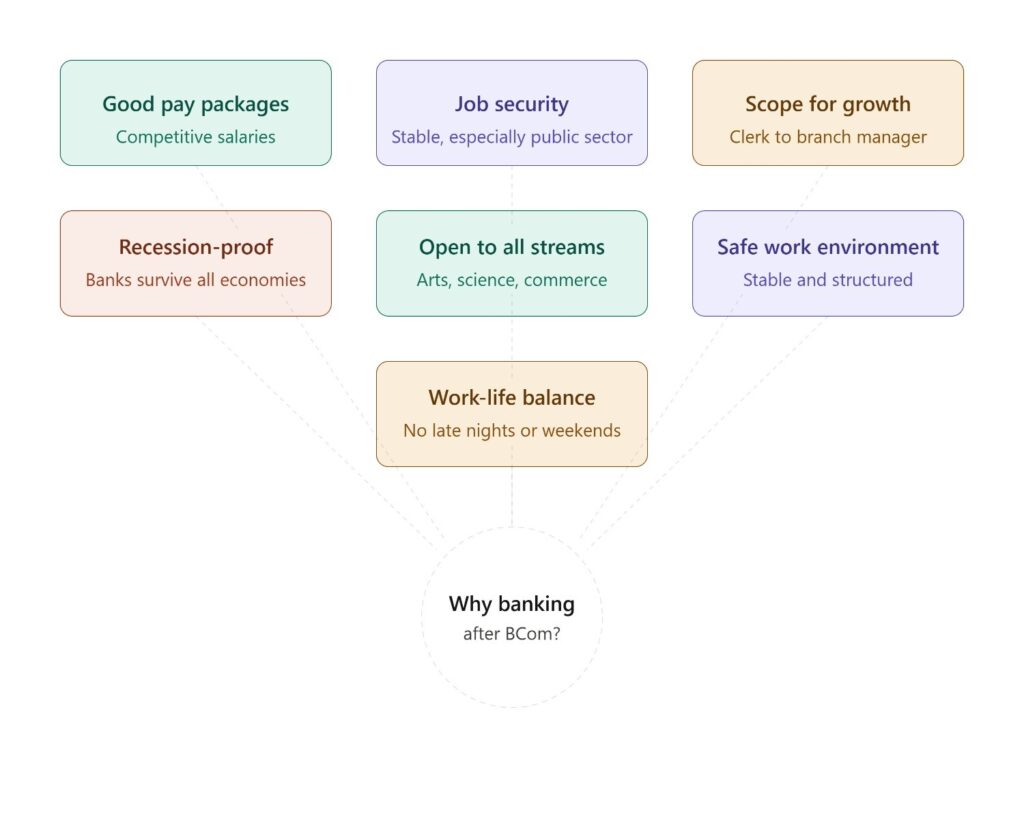
The banking sector has changed significantly over the past few years, and that’s actually good news for anyone exploring banking courses after BCom. More change means more roles, more specialisations, and more room to grow. Here’s why banking remains one of the strongest career choices for BCom graduates.
Good Pay Packages
Compared to most entry-level industries, banking pays well, that is, both in private and public sector roles. If you’ve just completed your BCom and are weighing your options, the salary structure alone makes banking worth considering, especially when paired with the right BCom in banking and finance specialisation.
Job Security
Public sector banking jobs in particular offer some of the strongest job security available. Once you’re in, stability is rarely a concern, making these roles especially attractive for those who value long-term career predictability.
Scope for Growth
Banking isn’t a dead-end career. Entry-level roles like clerk or PO can lead to branch manager, regional head, and beyond — with structured promotion cycles and internal exams like JAIIB/CAIIB helping you move up faster.
No Recessional Impact
People need banks regardless of economic conditions. As long as money moves, banks function — which makes this one of the most recession-proof industries to build a career in.
Open to All Disciplines
One of the most underrated advantages, banking exams after BCom are open to graduates from any stream. Commerce gives you an edge, but arts and science graduates compete equally in most public sector exams.
Safe and Comfortable Work Environment
Banking offers a structured, professional work environment with clear policies, defined roles, and institutional support — something that’s hard to find in more volatile industries.
Great Work-Life Balance
Unlike IT or consulting, banking rarely demands late nights or weekend work. It’s one of the few industries where after BCom, choosing a course best suited for banking can lead to a career that’s both rewarding and sustainable in the long run.
Check out: How to earn a BCom degree online
Steps to Prepare for a Bank Job
After B.Com bank jobs have become a trend setter for the commerce graduates. Let’s check how to get a bank job after BCom:
- Select the right commerce or finance degree
Select the appropriate degree in finance or commerce. For example, BCom or MCom.
Also read: MAHE Online BCom (Professional): Your Fast-Track to ACCA Qualification
- Prepare for the bank exams
Once you have completed the degree program, you can start preparing for the bank exam according to the syllabus.
- For positions at the senior level, get a master’s degree
If you are aiming for a senior post, it is recommended that you have a master’s degree in finance or commerce.
- Obtain certification in accounting or finance
If you are not willing to invest the required time in the master’s degree program, you can get yourself an online certification in accounting or finance to grab various bank jobs. They will certainly help you improve your job portfolio.
- Networking
Build and maintain strong connections with other professionals in the sector to have a fair idea about the domain.
Some Top Government and Private Banks that Recruit BCom Graduates
- State Bank of India
- HDFC Bank
- Bank of Baroda
- Canara Bank
- Axis Bank
- Kotak Mahindra Bank
- ICICI Bank
- IDBI Bank
- YES Bank
- Bank of India
Secure a High-level Banking Job with an Online Master’s Degree
Most of the banks do recruit BCom graduates as employees. But when it comes to directly landing on higher posts, a master’s degree is a must. Having a master’s degree gives you an upper hand over your competitors, and it can increase your growth rate and help you obtain higher pay packages.
Pursue any Finance or Commerce-related Degree through Online Manipal
Manipal University Jaipur (MUJ) and Sikkim Manipal University (SMU) now provide online degrees through their online platform, Online Manipal. With the help of these online courses, you can start learning at your own pace without having to step out of your comfort zone. The online courses provided by MUJ and SMU are comparatively cost-effective and tend to provide world-class education that can be accessed from a computer or mobile screen. Along with BCom and MCom courses, you can also pursue MBA in finance or MBA in BFSI courses to land your dream job in the banking sector.
To know more, you can check out Guide to MBA in finance course.
Conclusion
India’s banking sector isn’t slowing down. Digital payments, financial inclusion drives, new-age fintech partnerships, and expanding rural banking have all created a steady demand for skilled professionals, and that demand is only going to grow.
If you’re serious about building a career in this space, the right education makes a real difference. Whether you’re exploring banking courses after BCom or looking at a specialised BCom in banking and finance, Manipal University Jaipur’s online programs give you the academic foundation and industry-relevant skills to stand out.
And if you’re still figuring out after BCom which course is best for banking, the answer really depends on where you want to go. Want a public sector role? Start preparing for banking exams after BCom like IBPS PO or RBI Grade B alongside your degree. Want a private sector career? A specialization in banking and finance paired with certifications like JAIIB or NISM can get you there faster.
Either way, the window is open. The question is how prepared you are when you walk through it.
Frequently Asked Questions
1. What are the top competitive exams to get a banking job after BCom?
After completing B.Com, aspirants can appear for competitive exams such as IBPS PO, IBPS Clerk, SBI PO, SBI Clerk, RBI Grade B, and RRB exams to secure roles in public sector banks.
2. Can I get a banking job in the private sector without taking any exams?
A large number of private sector banks do not have an examination system for hiring, so you can go directly to the interviews and be selected on the basis of your marks, good communication skills, and work experience, that is, internships.
3. Which online courses can boost my chances of getting a banking job?
Pursuing online certifications in Banking and Finance, Financial Analysis, Risk Management, or a specialized MBA in Finance or BFSI can improve your profile and make you job-ready for both public and private banks.
Prepare for your next career milestone with us