
Listen to this blog

Technology has changed how nearly everything works, including education, and the shift away from purely in-person learning has only accelerated since the pandemic pushed millions of students to find new ways to keep studying. Today, most people looking at flexible education are presented with two options: online learning and distance learning. How do you choose between them? What is the difference between online and distance learning?
There’s genuine ambiguity in how these terms get used. As education has digitized, people frequently use “online learning” and “distance education” interchangeably, but they’re not the same thing, and in India, they are not even regulated the same way. Understanding the difference between online and distance learning matters well beyond semantics: it affects your degree’s recognition, your learning experience, and in some cases, whether your program is even legally allowed to be offered in that mode at all.
This blog breaks down the difference between online and distance learning in full, from meaning to regulation, so let’s get into both in detail.
Distance Education Meaning: What Exactly Is It?
If you’re looking for the straightforward distance education meaning, here it is: distance learning, historically also called a correspondence course, is a mode of education that doesn’t require physical presence at a learning center. Understanding the distance education meaning properly matters because the term gets used loosely online, students receive course materials and resources by post, email, or increasingly, a basic digital portal, and are expected to study independently with minimal teacher interaction.
This mode places heavy emphasis on self-study. Teachers and students rarely interact, sometimes only at designated study centers, and students are largely responsible for pacing themselves through the curriculum, though deadlines for exams and project submissions still apply. Some distance programs require occasional physical attendance, for workshops or practicals, these blended formats are often called hybrid or correspondence courses.
Also read: Affordable Online Degrees in India: UGC-DEB Approved Universities & Real Costs (2026)
Correspondence and Distance Education Difference
This is a genuinely common point of confusion, so it’s worth addressing directly. The correspondence and distance education difference isn’t as sharp as it once was, “correspondence” is really the older, more informal term for what today falls under the umbrella of Open and Distance Learning (ODL). Once you understand the correspondence and distance education difference this way, historical label versus current regulatory category, the rest of the terminology stops feeling so confusing.
Historically, correspondence courses meant exactly what the name suggests: materials mailed to students, minimal to no digital component, and almost no live interaction. Modern ODL, as formally regulated in India today, still centers on independent study but typically includes at least some digital delivery, recorded lectures, an online portal for submissions, occasional virtual sessions, even if it doesn’t reach the interactivity level of a fully online program. In practice, most institutions now use “distance education” and “ODL” as the current terms, with “correspondence” surviving mostly as informal shorthand rather than a distinct regulatory category
What Is Online Learning?
Online learning offers students considerably more flexibility, choosing when and where to study, without ever needing to visit a physical campus. As technology has matured, students now have access to a wide range of formats, from online master’s programs to undergraduate degrees, with many reputable institutions now offering genuinely competitive online MBA programs.
Compared to distance learning, online learning is far more interactive. Students get access to extensive e-learning content and both live and recorded lectures, with regular discussion between teachers and students through a digital platform. Online education’s popularity accelerated sharply after the Covid-19 pandemic, when it briefly became the only viable way for institutions to keep teaching, and it’s stayed popular well beyond that emergency period.
An Interesting Find: Grit in Online Learning: Why Persistence Matters More Than Pace
The Regulatory Framework: What Actually Separates Them in India
This is the part most content on this topic skips entirely, but it’s the part that actually matters if you are choosing between the two.
Both modes are governed by the UGC (Open and Distance Learning Programmes and Online Programmes) Regulations, 2020, amended in 2021 and 2022. Under these rules, institutions don’t get to simply decide to offer ODL or online programs, they need specific eligibility based on their NAAC score and NIRF ranking, and they must be listed as recognized on the UGC’s Distance Education Bureau (DEB) portal before you enroll. This is genuinely worth checking before you apply anywhere, since admission into a program from an unrecognized institution can leave you with a degree that isn’t valid.
A few concrete rules worth knowing:
- Certain disciplines are entirely prohibited from ODL or online delivery, including engineering, medicine and allied fields (physiotherapy, nursing, pharmacy, dental), law, architecture, agriculture, hotel management, aviation, and a handful of others. If a program in one of these fields claims to offer a fully online or ODL degree, that’s a red flag worth investigating before you enroll.
- MPhil and PhD programs across all disciplines are also prohibited in both ODL and online mode.
- Since the 2025-26 academic session, students enrolling in online or ODL programs need a DEB ID, linked to their APAAR ID, to track academic progress across modes of study consistently.
- Admission taken during a program’s recognized window generally stays valid through course completion, even if the institution’s recognition isn’t renewed for subsequent years, provided the program was offered in line with UGC norms at the time.
Differences Between Online Learning and Distance Learning
Here’s the practical online vs distance learning comparison, updated to reflect the current regulatory picture rather than vague generalities. If you’re scanning for a quick online vs distance learning snapshot before reading the detail below, this table is the fastest way in:
| Aspect | Distance Learning | Online Learning |
|---|---|---|
| Course delivery | Primarily printed materials or basic digital portals; limited live interaction | Entirely internet-based via a Learning Management System (LMS), with live and recorded sessions |
| Regulatory basis | Governed by UGC (ODL Programmes and Online Programmes) Regulations, 2020, under the ODL track | Governed by the same regulations, under the online track, generally requiring stronger institutional eligibility (NAAC/NIRF criteria) |
| Recognition | Valid if the institution is listed on the UGC-DEB portal for ODL; varies by institution otherwise | Valid if the institution is listed on the UGC-DEB portal for online programs; generally more consistently recognized among reputable providers |
| Student-teacher interaction | Limited, mostly through email or occasional sessions at study centers | Regular, through live classes, discussion forums, chat, and video conferencing |
| Peer interaction | Limited, occasional meetups or forums | Regular, through group projects, discussion boards, and collaborative activities |
| Learning materials | Traditional print modules, occasionally supplemented digitally | Digital-first: e-books, multimedia, interactive simulations |
| Practical/hands-on learning | Limited, and harder to implement remotely | Often includes simulations, virtual labs, or applied project work depending on the course |
| Exams | Typically at regional exam centers, requiring travel | Online, often web-proctored, from any location |
| Student support | Often limited to email or occasional phone support | Generally more robust: online tutoring, tech support, academic advisors |
| Career recognition | Depends heavily on institutional reputation | Widely accepted, especially from UGC-recognized, reputable providers |
Advantages of Online Learning Over Distance Learning
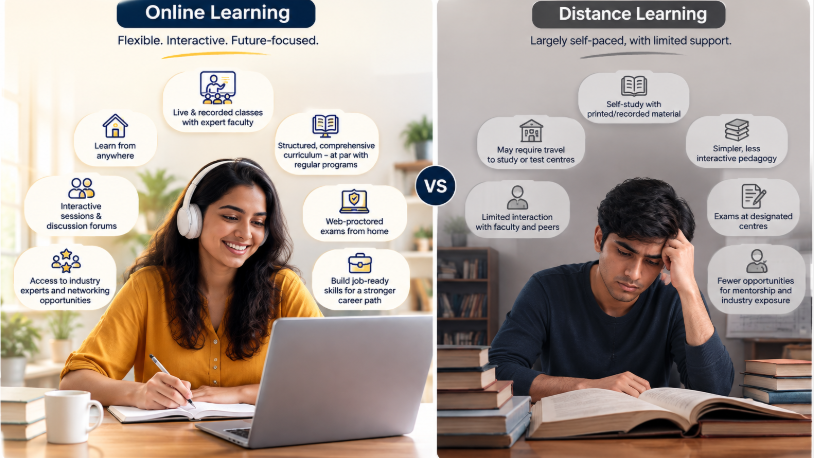
Convenient learning mode:
Online learning is entirely digital, with scheduled virtual classes overseen by an instructor who guides students through lessons and tasks, with digital assessment via the LMS. It isn’t location-specific, it just depends on internet access for both students and teachers. Distance learning, by contrast, still often requires travel to test centers and occasional in-person attendance at learner support centers.
Course structure mirrors regular classroom courses:
A well-run online course won’t shortchange you on course materials or examination rigor, you get the flexibility without giving up the substance of a traditional classroom course.
An online degree carries equal weight to a traditional one:
As long as it’s from a UGC-recognized university! This isn’t a myth to be debunked so much as a regulatory fact: a UGC-DEB-recognized online degree is accepted by employers just like a traditional one.
Better interaction:
Online programs typically use clearly defined virtual modules with a genuinely interactive pattern, blended digital learning, online group activities, one-on-one projects, and active discussion forums. Distance education interaction is comparatively sparse, and even sparser in rural areas where infrastructure access is more limited.
Effective pedagogy:
Online programs aim to simulate in-person instruction through blended teaching methods designed to keep learning engaging. Distance learning tends to be more straightforward: students receive material and work through it largely on their own pace.
Web-proctored exams:
Online learners typically take exams remotely, in a web-proctored setting, with administrative support available for rescheduling, placements, and internships. Distance learners generally need to travel to regional test centers.
Networking opportunities:
Online programs often connect students with industry experts and mentors (though with restrictions), in a way distance programs rarely do, and that access to guidance and insight is easy to undervalue until you’re actually job-hunting.
Choose the right university
UGC-DEB recognition: Non-negotiable. Confirm the specific program is listed as recognized on the UGC-DEB portal, not just that the university generally offers online programs.
Easy fee payments: EMI options make the financial commitment considerably more manageable for students and families.
Alumni network: A strong alumni base genuinely helps with career growth down the line.
Industry exposure: Look for programs with real industry tie-ins, not just theoretical coursework.
Career assistance: Resume support, interview prep, and placement assistance all matter more than they seem to at enrollment time.
DEB ID and APAAR ID readiness: Since these are now required for admission into recognized online/ODL programs, make sure the university’s admission process actually walks you through generating both correctly.
Also read: How Online Learning Is Influencing the Way Students Plan Careers?
Why You Should Consider Online Manipal for Online Learning?
- Learn at your own pace with a mix of live and recorded classes, making it easier to balance studies with work or personal commitments.
- Choose from industry-relevant specializations across business, technology, data science, healthcare, and media to align learning with your career goals.
- Build job-ready skills alongside your degree through access to additional certifications, hands-on projects, and industry-focused coursework.
- Stay connected with faculty and peers through interactive learning tools, discussion forums, and academic support throughout the programme.
- Earn a degree from a recognised university while benefiting from a learning experience designed specifically for online learners.
- Benefit from industry-linked learning through offerings such as IoA-accredited Data Science and Business Analytics programs and the Level 1 Enterprise Risk Management (ERM) certification from the Institute of Risk Management (IRM) from MAHE, designed to keep learning aligned with evolving industry expectations.
The online programs offered by MAHE, MUJ, and SMU are built around industry-relevant curricula developed by experienced faculty and subject experts, helping learners build skills that employers value today.
Conclusion
The difference between online and distance learning really comes down to this: online learning gives you interaction, structure, and consistent recognition; distance learning gives you maximum self-pacing with far less contact. Neither is wrong, but only one non-negotiable step protects your degree either way, confirm the institution and the specific program are genuinely UGC-DEB recognized before you enroll. Everything else is preference. That single check is what determines whether the years you’re about to invest actually count.
Prepare for your next career milestone with us