Blogs
Blogs 
Importance of a T-Shaped Professional in Emerging Workplaces

Listen to this blog

Picture this; An employee has spent 10 years becoming one of the best data analysts at his company. Numbers, spreadsheets, dashboards, everything; he could do it all in his sleep. Then one day, his manager asked him to present his findings to the leadership team. He prepared for weeks. The data was perfect. The insights were sharp.
But in the room, he lost them in the first five minutes. The reason being, there was too much jargon, and no connection or interesting story built to keep the leaders engaged. The insights died in the presentation.
The issue wasn’t the lack of skill but the inability to connect that expertise with adjacent disciplines and real-world collaboration!
Here is where a T-shaped professional comes in. The real value is not just about knowing a lot about an area. It’s also about being able to explain it work well with others and make your expertise useful to different teams and business situations. In today’s world only people with a range of skills, like a T-shaped professional, can really stand out.
What is a T-Shaped Professional and Their Unique Qualities?
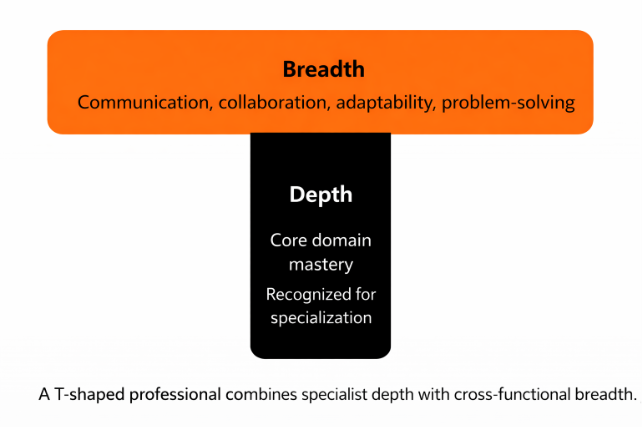
A T-shaped professional brings sharp, focused expertise in one area and the range to contribute far beyond it. They integrate across teams, bridge gaps others miss, and consistently deliver value that no single job description could contain.
“T” is just a metaphor for saying two things at once: how far down your expertise goes in a particular field, and how far across you can reach. But here’s the thing; what truly sets these professionals apart isn’t just what they know. It’s what they do with that knowledge for the people around them. A few unique qualities tend to define them:
- Deep- experts in one area
- Cross-functional understanding
- Good communication and story-telling skills
- Quick learners and adaptable
- Contextual thinking and problem-solving
In most modern workplaces, this combination is rare and incredibly valuable. These are the people who can go deep when a problem demands it and yet maintain the collaboration with other teams intact. In industries being reshaped by AI, a T-shaped is not just a preference but a necessity. A T-shaped professional is distinguished by the rare ability to pair specialist depth with cross-functional relevance.
5 Reasons T-Shaped Professionals Are the Smartest Hire You Can Make
1. Reduce dependency risk across teams
- T-shaped professionals help prevent problems when team members leave.
- They have deep expertise in their core area but also understand how other teams work.
- This means that if someone leaves or priorities change, the team can still get things done. It makes the business more stable.
2. Lower attrition through role mobility and growth
- One reason employees stay longer is that they can move into roles.
- T-shaped professionals are easier to reskill, redeploy, and grow into adjacent responsibilities, which gives them visible progression pathways inside the organization
- When employees see mobility instead of stagnation, they are more likely to stay.
3. Reduce the hiring–firing cycle
- The smartest economic advantage for all companies is the reduced hiring/firing cycle.
- Repeated hiring of niche specialists when business evolve is no longer required because reliability on T-shaped talent that stretches to adjacent domains is seen.
- The results are lowest replacement costs, shortened ramp-up time, and reduced the need for reactive workforce corrections
4. Improve decision velocity, not collaboration.
- The real value of a T-shaped professional is their fast-decision-making skills.
- They clearly understand the language of multiple stakeholders, and this leads to smoother and faster execution by reducing the translation gaps between teams.
- It helps companies get things done quickly as there is very little room for errors.
5. Future-proof organizations against AI and market shifts
- As AI is dominating every field now, it’s important to hire candidates who can combine domain mastery with judgement and communication.
- T-shaped hires have this blend and they are not just skilled for today’s role, but adaptable for tomorrow’s challenges as well.
- Hence, they are also a long-term investment for employers.
An Interesting Find: 2026 Hiring Trends: Are Employers Prioritizing Skills Over Degrees?
How to Build T-Shaped Skills in Your Career
Now the real question is how can you identify yourself as a T-shaped professional? Becoming T-shaped starts with getting genuinely good at one thing. From there, it’s about steadily stretching into connected areas over time. A few ways to get started:
- Master one core domain and become known for it
- Learn adjacent skills that support your role
- Learn to communicate your ideas clearly and tell the story behind your work
- Work with people outside your immediate team as often as you can
- Stay curious because the learning never really stops
- Say yes to projects that is out of your comfort space
How Online Learning Helps in Building a T-Shaped Professional
Online learning works particularly well for building T-shaped professionals. It lets people go deep into their core specialization while picking up adjacent skills like analytics, communication, leadership, and technology on their own terms and timeline.
With platforms like Online Manipal, this becomes even stronger through industry-focused curriculum, career support, and access to diverse learner cohorts, helping students grow both depth and breadth in a way today’s workplaces truly value.
If you are a working professional, who is looking to upskill yourself, online courses can be the best choice. You need not leave behind a job that pays you well, instead manage time to learn an online course and take the first step to be a T-shaped talent.
Conclusion
The workplaces of today and tomorrow will not be shaped by expertise alone, but by the ability to make that expertise travel across teams, ideas, and business challenges. That is what makes the T-shaped professional so valuable; depth gives credibility, while breadth creates impact.
As industries continue to evolve, the professionals who stay relevant will be the ones who keep learning beyond their core role and remain open to adjacent skills, new collaborations, and changing demands. Hence, the question of the hour is;
Are you only building expertise, or are you building the versatility that the future workplace will demand?
Prepare for your next career milestone with us


Explore Similar Blogs
View All
 30 Sep 2026
 15 mins
 23 Sep 2026
6 mins
23 Sep 2026
6 mins
 31 Aug 2026
9 mins
31 Aug 2026
9 mins
 31 Aug 2026
12 mins
31 Aug 2026
12 mins