Blogs

Why Online BCom with CA Is the Smart Combination for Aspiring Chartered Accountants

Listen to this blog

If you’re aiming to become a Chartered Accountant but aren’t sure what to study at the undergraduate level, pairing an online BCom with CA preparation is one of the most practical routes available. A Bachelor of Commerce gives you the subject foundation the CA curriculum builds on, and doing it online means you are not stuck choosing between classroom hours and CA coaching. This blog walks through what an online BCom actually involves, the online BCom with CA eligibility requirements you need to know, and how to think about which BCom is best for CA aspirants specifically.
What Is an Online BCom?
A Bachelor of Commerce (BCom) is a 3-year undergraduate degree covering finance, accounting, economics, marketing, management, and business law. Several universities now offer it fully online, which lets students learn at their own pace instead of being tied to a fixed campus schedule.
This flexibility is exactly why so many CA aspirants choose an online BCom with CA prep running in parallel. Your BCom classes and CA coaching rarely clash the way full-time college attendance would, since recorded lectures and flexible live sessions let you study on your own schedule.
Why Combine an Online BCom with CA Preparation
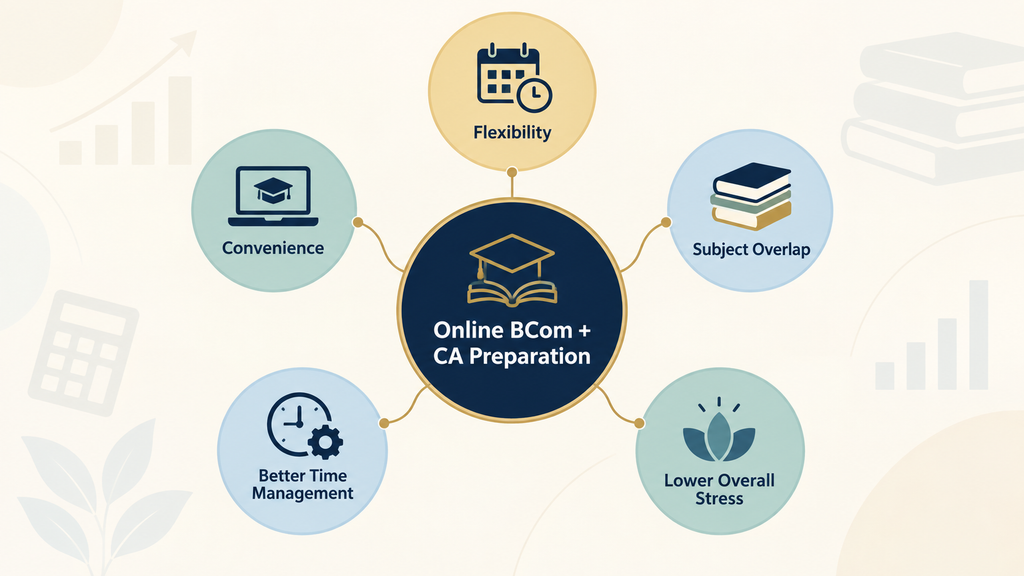
Here’s what makes running both together worthwhile rather than doing them one after the other:
- Flexibility: Online BCom programs are largely self-paced, so you can block out time for CA Foundation or Intermediate prep without requesting attendance exemptions from a physical college.
- Convenience: All lectures, notes, and assignments are accessible from a laptop or phone, so you’re not losing hours in commute time that could go toward CA study sessions.
- Subject overlap: BCom and CA share a meaningful chunk of their syllabus, so the effort you put into one often reinforces the other instead of feeling duplicated.
- Better time management: Studying remotely forces you to build a personal schedule early, which turns out to be a useful habit for the multi-year CA journey ahead.
- Lower overall stress: Juggling a rigid college timetable with CA deadlines is exhausting. Removing the timetable constraint doesn’t remove the workload, but it does remove one major source of friction.
Online BCom with CA Eligibility: What You Need to Know
There are actually two eligibility questions to answer here, and it’s worth being clear about both.
Online BCom with CA Eligibility: What You Need to Know
There are actually two eligibility questions here, and it helps to separate them clearly.
Eligibility to join an online BCom: This varies slightly by university, since eligibility criteria for an online BCom are set by the individual institution offering it, not by a single common standard. Most require 10+2 completion from a recognised board, though the minimum aggregate percentage can differ from one university to the next.
Online BCom with CA eligibility for ICAI’s Direct Entry Scheme: This is where your BCom score matters. Under the Direct Entry Scheme, commerce graduates need at least 55% aggregate marks in their BCom to skip CA Foundation entirely and register directly for CA Intermediate. Graduates from non-commerce backgrounds need at least 60%. If you clear this bar, you move straight from your BCom into CA Intermediate, complete the required orientation and IT training, and begin your articleship without ever sitting for CA Foundation.
So the online BCom with CA eligibility question really has two separate answers: your university’s admission requirement gets you into the BCom, and ICAI’s 55%/60% requirement is what determines whether you get to skip CA Foundation once you graduate.
Which BCom Is Best for CA Aspirants?
This is genuinely one of the more common questions students ask, and the honest answer is that which BCom is best for CA depends less on the university’s brand name and more on two things: how much the syllabus overlaps with CA subjects, and how well the schedule accommodates coaching hours.
A general BCom with strong coverage of accounting, taxation, auditing, and business law tends to serve CA aspirants better than a heavily specialised BCom (say, one focused entirely on digital business or e-commerce), simply because the core commerce subjects map more directly onto CA Foundation and Intermediate papers. When people ask which BCom is best for CA, this subject alignment should be the first filter, ahead of rankings or brand recognition.
An online, UGC-entitled BCom from an accredited university checks both boxes: broad commerce coverage, plus the scheduling flexibility that a fixed campus timetable can’t offer.
Understanding the CA Syllabus Your BCom Should Support
To properly judge which BCom is best for CA, it helps to know exactly what the current CA syllabus looks like, since ICAI restructured it under the New Scheme.
CA Foundation (4 papers): Accounting, Business Laws, Quantitative Aptitude, and Business Economics.
CA Intermediate (6 papers across two groups):
- Group I: Advanced Accounting, Corporate and Other Laws, Taxation (Income-tax Law and GST)
- Group II: Cost and Management Accounting, Auditing and Ethics, Financial Management and Strategic Management
Comparing this against a typical BCom syllabus, the subjects with the strongest overlap are:
- Financial and Cost Accounting → maps to Advanced Accounting and Cost and Management Accounting
- Business Law and Corporate Law → maps to Corporate and Other Laws
- Taxation → maps directly to the Taxation paper
- Auditing → maps to Auditing and Ethics
- Financial Management and Business Economics → maps to Financial Management and Strategic Management, and to the Foundation-level Business Economics paper
This is the real basis for answering which BCom is best for CA: look for a BCom syllabus that gives solid, exam-relevant coverage of these specific areas, rather than one that leans heavily into unrelated electives like digital marketing or e-commerce.
Comparing Online BCom Options for You to Choose
Rather than pointing you toward one specific university, here’s a neutral side-by-side of the online BCom programs currently available on the Online Manipal platform, since all three are offered through it and each comes with different eligibility and cost trade-offs.
| Detail | MUJ (Manipal University Jaipur) | SMU (Sikkim Manipal University) | MAHE (B.Com Professional) |
|---|---|---|---|
| Duration | 36 months (6 semesters) | 36 months (6 semesters) | 36 months (6 semesters) |
| Eligibility | 40% aggregate in 10+2 | Completion of 10+2 from a recognised board | 50% aggregate in 10+2 |
| Total course fee | INR 99,000 | INR 75,000 | INR 2,94,000 |
| Accreditation | NAAC A+ | NAAC A+ | NAAC A++ |
Source: Online Manipal admission pages
None of these is universally “better” for a CA aspirant. If cost and a straightforward 10+2 eligibility bar matter most to you, SMU’s fee structure is the lightest. If you want the MAHE brand specifically and don’t mind the higher fee, the BCom Professional route is an option. MUJ sits in between on both fee and eligibility. The right pick depends on your board percentage, budget, and which university’s brand matters for your future job applications, not on any one option being the objectively correct choice.
For Details on Curriculum, Eligibility and Scholarships:
Online BCom Degree from MUJ | Online Manipal
ACCA-accredited Online BCom (Professional) Degree from MAHE
Affordable Online BCom Degree from SMU | Online Manipal
Conclusion
Pairing an online BCom with CA preparation gives you a practical way to build your commerce foundation and chip away at the CA syllabus at the same time, without a rigid campus schedule pulling you in two directions. Once you have confirmed the online BCom with CA eligibility criteria on both sides (your university’s 10+2 requirement and ICAI’s 55%/60% Direct Entry threshold), the remaining decision is really about subject overlap and flexibility, which is what should guide which BCom is best for CA for your specific situation. Whichever university you choose from the options available, look closely at how its syllabus lines up with the CA Intermediate papers before deciding.
FAQs
1. What is the online BCom with CA eligibility for the Direct Entry Scheme?
You need at least 55% aggregate in your BCom (60% for non-commerce graduates) to skip CA Foundation and register directly for CA Intermediate.
2. Which BCom is best for CA aspirants?
Look for a BCom with strong coverage of accounting, taxation, auditing, corporate law, and financial management, since these map most directly onto CA Intermediate’s six papers.
3. Do all online BCom programs have the same eligibility criteria?
No. Eligibility varies by university. Some require just a 10+2 pass, while others set a minimum aggregate percentage, so it’s worth checking each program individually.
4. Can I do CA Foundation and an online BCom at the same time?
Yes. Since online BCom classes are largely self-paced or scheduled around working professionals, most students manage both concurrently without a timetable clash.
5. Do I need a specific BCom specialisation to qualify for CA Direct Entry?
No. Any BCom with the required percentage (55% for commerce graduates) qualifies you for the Direct Entry Scheme, regardless of specialisation.
Become future-ready with our online B.Com program



Explore Similar Blogs
View All
 05 Oct 2026
 13 mins
 10 Aug 2026
16 mins
 03 Aug 2026
11 mins
 31 Jul 2026
9 mins