Blogs
Blogs 
After BCom, Which Course Is Best? Here’s How to Actually Decide

Listen to this blog

There isn’t one universal “best” course after BCom, it depends entirely on what you’re optimizing for. If you want the highest ceiling and don’t mind a multi-year grind, Chartered Accountancy still wins on raw earning potential. If you want to stay relevant in a data-driven job market without starting from scratch, Business Analytics or Data Science is the strongest 2026-era pick. If you want to keep your job while you study, an online MCom or MBA gets you there without a career break. The rest of this guide breaks down exactly which fits which situation.
You’ve got your BCom, and now the real question kicks in: after b.com which course is best for where you specifically want to go? The honest answer is that “best” is doing a lot of work in that sentence, best for salary, best for speed, best for flexibility, and best for future job security are genuinely different answers. Here’s how to think about it properly.
Decide by goal, not by prestige
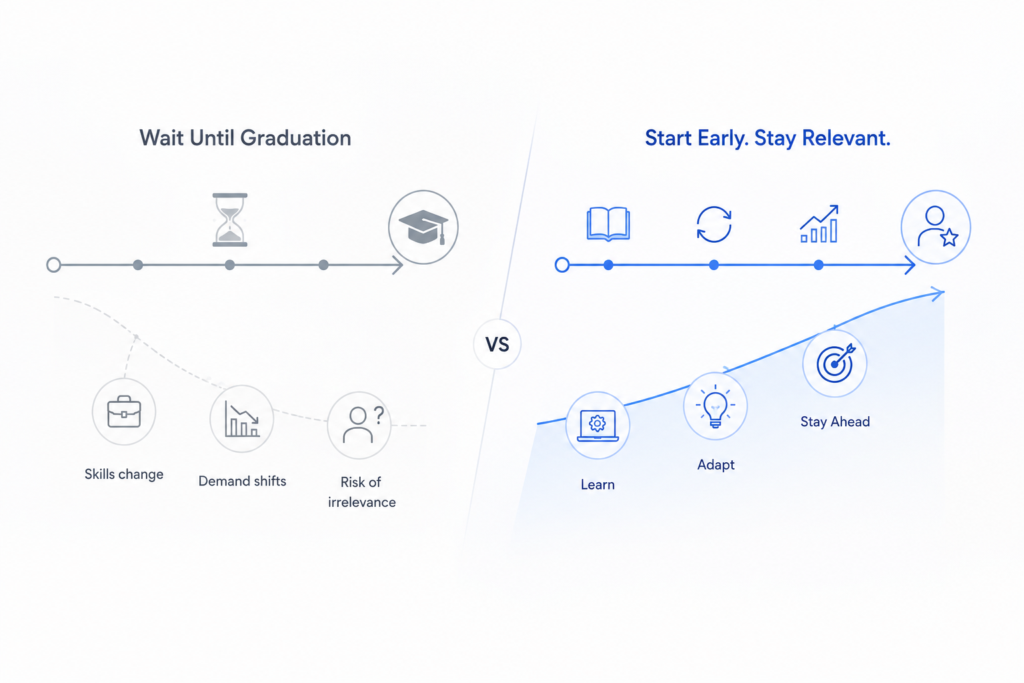
Before the deep dives, here’s the fastest way to narrow this down. Match your priority to the option:
| If your priority is… | Your strongest pick | Why |
|---|---|---|
| Highest long-term earning potential | Chartered Accountancy (CA) | Still the most respected, highest-ceiling credential for commerce graduates in India |
| Staying relevant in today’s job market | Business Analytics or Data Science (MSc or PGCP) | Analytics roles are among the fastest-growing across every industry, not just tech |
| Studying without quitting your job | Online MCom or Online MBA | Structured, UGC-recognized, and built around weekend/evening schedules |
| Fastest route to a credential | FMVA or CMA (US) | Both completable in well under a year with focused study |
| Global mobility | ACCA or CFA | Recognized well beyond India, useful if you want to work abroad eventually |
| A completely different field | LLB | The most direct bridge from commerce into a legal career |
Most In-Demand Courses After BCom
Let’s look at it like this. A BCom degree is your secret key to unlocking a huge variety of professional certifications and tech-driven programs, all designed to enable students to take the next big leap forward in their career journey. Some of the best PG courses after BCom are outlined below to help you get started:
1. Master of Commerce (MCom)
MCom remains the most natural next step and one of the most common pg courses after bcom, a two-year degree that goes deeper into accounting, economics, and financial theory than your BCom did. It’s not flashy, but it’s a solid, low-risk foundation, especially if you’re planning to stack a certification like CA or CMA on top of it later.
| Items | Details |
|---|---|
| Duration | 2 years (approx) |
| Career Opportunities | Accountant, Auditor, Financial Analyst, Tax Consultant, Investment Banker |
| Top Recruiting Companies | KPMG, Axis Bank, Wipro, P&G, RBI |
| Average Salary | ₹4-6 lakh for freshers, ₹10-15 lakh with a few years of experience or an added certification |
| Skills Developed | Problem-solving ability, quantitative aptitude, presentation, advanced technical knowledge in accounting, taxation, and financial modeling etc |
Source: AmbitionBox
2. Chartered Accountancy
This is typically considered the best course after BCom and is undoubtedly in high demand among graduates. One of the top reasons for its popularity is that the Chartered Accountant qualification is held in high esteem in society, and it paves the way for several lucrative career opportunities in taxation and accounting, to name a few.
| Items | Details |
|---|---|
| Duration | 4-5 years |
| Career Opportunities | Financial Manager, Consultant, Accountant, Auditor, Banker |
| Top Recruiting Companies | Deloitte, KPMG, Reliance Industries, ITC Limited, Tata Motors |
| Average Salary | INR10 Lakhs to INR13 Lakhs per year, with entry-level freshers typically starting around ₹6 Lakhs to ₹11 Lakhs |
| Skills Developed | Auditing, financial reporting, advanced accounting, tax compliance, data analysis |
Source: AmbitionBox
3. Business Analytics
This is emerging as one of the most popular options among courses after graduation in Commerce students. With foundational knowledge in accounting, finance, and economics, BCom graduates find it easy to transition into Business Analytics programs, leading to higher growth and strategic roles with higher pay.
| Items | Details |
|---|---|
| Duration | 3 months – 2 years (approx) |
| Career Opportunities | Business Analyst, Analytics Consultant, Data Scientist, Data Architect, Marketing Analyst |
| Top Recruiting Companies | BCG, TCS, Microsoft, American Express, McKinsey |
| Average Salary | INR 10 LPA (approx) |
| Skills Developed | Data analysis, quantitative analysis, data cleaning, data visualization, business strategy |
Source: AmbitionBox
4. Association of Chartered Certified Accountants (ACCA)
This is another popular certification in the list of after-graduation courses in Commerce, ideal for students aspiring to careers in auditing, international accounting, and financial analysis. It is a prestigious global qualification in accounting and finance, leading to high-paying, promising careers for graduates.
| Items | Details |
|---|---|
| Duration | 2-3 years (approx) |
| Career Opportunities | Financial Controller, Tax Consultant, Chief Financial Officer (CFO), Audit Manager, Forensic Accountant |
| Top Recruiting Companies | HSBC, JP Morgan, Accenture, Unilever, BDO |
| Average Salary | INR 9.9 LPA (approx) |
| Skills Developed | Audit, financial management, data analysis, critical thinking, and management accounting |
Source: Indeed
5. Master of Business Administration (MBA)
If you’re not sure commerce specifically is your long-term path, an MBA is the widest door. It’s a genuine consideration when people ask best course after bcom for someone who wants management-track roles, not just technical accounting or finance ones.
| Items | Details |
|---|---|
| Duration | 2 years (approx) |
| Career Opportunities | Private Equity Associate, Product Manager, Startup Founder, Strategy Consultant, Operations Manager |
| Top Recruiting Companies | Bain & Company, Flipkart, Deutsche Bank, Mahindra & Mahindra, Nestlé |
| Average Salary | INR 5-10 lakh from most institutes, INR 10-25 lakh+ from top-tier B-schools |
| Skills Developed | Decision-making, financial acumen, negotiation, collaboration, entrepreneurship |
Source: Glassdoor
Finance and Accounting Courses After BCom
The best part about choosing a BCom at the undergraduate level is that you will never find a dearth of options to pick post-graduation courses after BCom. No matter what field of commerce you lean more toward, there’s a wide range of possibilities to unlock in terms of the study options. Listed below are the best pg courses after bcom to take up in the field of finance and accounting after completing a BCom:
1. Chartered Financial Analyst
| Items | Details |
|---|---|
| Overview | Globally recognized postgraduate professional qualification awarded by the CFA Institute. |
| Duration | 3-4 years (approx) |
| Career prospects | Equity Research Analyst, Risk Analyst, Treasury, Portfolio Manager, Investment Banker |
| Top recruiters | Goldman Sachs, Fidelity Investments, Deloitte, ICICI Bank, Bloomberg |
| Average salary (approx) | INR 5-8 LPA for freshers (Level 1-2, no prior experience), rising sharply to INR 20-40 LPA+ for full charter holders |
| Skills developed | Financial analysis, portfolio management, data analysis, critical thinking, and financial modeling |
Source: AmbitionBox
2. Certified Public Accountant
| Items | Details |
|---|---|
| Overview | US-certified certification opening doors to numerous MNCs upon completion, with high pay packages |
| Duration | 1-1.5 years (approx) |
| Career prospects | Controller, Forensic Accountant, Public Accountant, Taxation Specialist, Compliance Consultant |
| Top recruiters | Genpact, Barclays, Unilever, Philips, Capgemini |
| Average salary (approx) | INR 6-12 LPA for freshers |
| Skills developed | Financial auditing, proficiency in accounting software, problem-solving skills, data security and analysis, and ethical judgment |
Source: Indeed
Law-Related Courses After BCom Graduation
Law is yet another discipline to explore after completing your undergraduate studies in Commerce. Hence, it is among the widely chosen professional courses after BCom.
1. Bachelor of Laws (LLB)
It is the most popular and typically the most direct route for BCom graduates who are keen aspirants of law programs after completing the program. They aim to gain a foundational understanding of the field of law, building on their knowledge of commerce, and to assume relevant roles in the legal domain.
| Items | Details |
|---|---|
| Overview | The Bachelor of Legislative Law (LLB) is an impactful program following a BCom, serving as a bridge between commerce and law, offering learners a dual advantage and unlocking several career prospects. |
| Duration | 3 years (approx) |
| Career prospects | Corporate Lawyer, Judicial Assistant, Litigation Lawyer, Magistrate, Public Prosecutor |
| Top recruiters | Khaitan & Co, Reliance, Wipro, Infosys, and Deloitte |
| Average salary (approx) | INR 4-10 LPA for most freshers, depending heavily on firm tier and city |
| Skills developed | Advocacy, communication, critical thinking and analysis, attention to detail, and legal research |
Source: Indeed
2. PG Diploma in Intellectual Property Rights (IPR)
This is yet another of the popular after BCom courses in the law domain—a specialized course that provides detailed knowledge of the legal and regulatory framework and the management of trademarks, patents, and copyrights.
| Items | Details |
|---|---|
| Overview | Ideal for graduates from both law and non-law backgrounds aspiring for high-growth roles in R&D units, law firms, and corporate houses. |
| Duration | 1 year (approx) |
| Career prospects | Trademark Specialists, Patent Analysts, IPR Consultants, Legal Associates, and more |
| Top recruiters | Oracle India, Siemens, Biocon, Bank of America, and Evalueserve |
| Average salary (approx) | INR 3-6 LPA for entry-level roles |
| Skills developed | Trademark and copyright management, patent drafting, prosecution, IP valuation, and case research and analysis |
Source: AmbitionBox
Professional Courses After BCom Graduation
Let’s now look at a few of the best courses after graduation in Commerce, which fall in the category of professional study programs and are particularly aimed at boosting the career prospects of the graduates.
1. Company Secretary (CS)
A premier professional course in governance, corporate law, and compliance, the Company Secretary program prepares students to assume roles in legal advisory, compliance, and corporate management upon completion of the BCom.
| Items | Details |
|---|---|
| Overview | Regulated by the Institute of Company Secretaries of India (ICSI), it prepares students for a rewarding career in corporate governance |
| Duration | 2.5-3.5 years (approx) |
| Career prospects | Legal Advisor, Practicing Company Secretary, Corporate Planner, Corporate Secretary, and Insolvency Professional |
| Top recruiters | Cognizant, Kotak Mahindra Bank, L&T, Trilegal, and ONGC |
| Average salary (approx) | INR 3-6.5 LPA starting out, rising to an average of INR 8-10 LPA |
| Skills developed | Legal interpretation, risk management, financial acumen, corporate governance, and due diligence |
Source: Glassdoor
2. Certified Management Accountant (CMA)
This is also among the highly preferred professional courses after BCom, as it is recognized worldwide. The course is designed for professionals in accounting and corporate finance.
| Items | Details |
|---|---|
| Overview | Offered by the IMA, this US course is a two-part professional certification program that teaches students financial analysis, effective decision-making, financial planning, and control. |
| Duration | 2.5-4 years (approx) |
| Career prospects | Financial Analyst, Financial Controller, Management Accountant, Cost Accountant, and Risk Manager |
| Top recruiters | KPMG, Morgan Stanley, Amazon, Coca-Cola, and Accenture |
| Average salary (approx) | INR 7-15 LPA |
| Skills developed | Financial planning, internal compliance, effective communication, cost accounting, and data analytics |
Source: Payscale
Skill-Based & Short-Term Courses After BCom
As stated earlier, there is a wide variety of study programs that aspiring learners can pursue after completing a BCom degree. In addition to the comprehensive after b.com which course is best list shared above, you can also opt for a whole range of skill-based or short-term certification programs after course completion.
1. Financial Modeling & Valuation Analyst (FMVA)
An industry-recognized program that prepares you for lucrative job roles in the finance industry at competitive pay packages, this skill-based course is the perfect answer to the question in your mind after graduation—” After BCom, which course is the best?”
| Items | Details |
|---|---|
| Overview | Certification offered by the Corporate Finance Institute (CFI) in 100% online mode to BCom graduates aspiring for roles in equity research, investment banking, and corporate finance. |
| Duration | 4-6 months (approx) |
| Career prospects | Investment Banking Analyst, Financial Analyst, Corporate Finance Analyst, Equity Research Associate, and Valuation Consultant |
| Top recruiters | McKinsey & Company, Fidelity Investments, Goldman Sachs, Microsoft, and General Electric |
| Average salary (approx) | INR 4-7 LPA |
| Skills developed | Valuation techniques, financial forecasting and analysis, sensitivity analysis, financial design and modeling, and corporate strategy |
Source: AmbitionBox
2. Business Accounting and Taxation (BAT)
A job-oriented postgraduate course, it enables learners to bridge the gap between academic learning and industry needs.
| Items | Details |
|---|---|
| Overview | Highly practical program; more focus on hands-on training in industry-relevant tools and technologies for high-paying job roles in taxation and accounting. |
| Duration | 3-6 months (approx) |
| Career prospects | Accounts Managers, Corporate Legal Assistants, Tax Consultants, Financial Analysts, and Tax Analysts |
| Top recruiters | EY, PwC, SBI, HUL, and Accenture |
| Average salary (approx) | INR 3-5.5 LPA |
| Skills developed | Bookkeeping, proficiency in accounting software, financial analysis and reporting, statutory compliance, and budgeting |
Source: AmbitionBox
How to Choose the Best Course After BCom?
With so many options right before you as soon as you graduate with a BCom degree in hand, the choice can be rather tricky and even overwhelming at times. From traditional postgraduate degrees in finance and accounting or law to short-duration professional and skill-based certifications, BCom graduates have no dearth of choices in courses after BCom. How do you choose the right one that best aligns with your interests and goals?
- Identify your interests – both personal and professional. The field of study that you are more inclined toward is more suited for you in terms of higher education, as you’re likely to stay motivated and committed to it.
- Clearly define your career objectives – short and long-term. They are the biggest motivators for you to move forward in your academic path.
- Review your choices. Whether you’d like to move forward with a traditional, formal degree program or pursue a shorter, skills-oriented path is entirely your choice.
- Consider the time and cost involved. This is a crucial factor to consider when choosing a postgraduate program after BCom. Evaluate the total time and cost to be incurred in each course and map it against your own bandwidth or resources.
Common Mistakes to Avoid While Choosing a Course
When choosing a future study program to pursue after a BCom, it’s crucial to remember that it is a one-time critical decision for your future that may have a serious impact on your career. Hence, it’s important to try to avoid any mistakes in the decision-making process:
- Don’t go for it simply because it “sounds good”: Making blind choices based on the popularity of a program or its prestige in society is not a good place to start. Instead, focus more on the course curriculum, the career opportunities it unlocks, and its alignment with your career goals.
- Avoid hurried research: Choosing a program without sufficient research on its potential career outcomes may result in the wastage of time, effort, and money because you may soon realize that there are no relevant jobs available after course completion.
- Don’t ignore your personal interests: Make sure to select a course that not only aligns with your career goals but also fits in with your everyday interests. Only when you’re passionate about something are you likely to stay motivated and continue it day to day; otherwise, the likelihood of a dropout is inevitable.
Online Courses After BCom: what’s actually worth considering
This is where most guides go thin, so here’s what’s genuinely available if you want a recognized qualification without pausing your career, using Online Manipal’s current catalog as a concrete example of what’s out there:
Online MCom — Manipal University Jaipur (₹1,08,000 total) and Sikkim Manipal University (₹75,000 total) both offer a UGC-entitled, 24-month online MCom. SMU is the more budget-friendly of the two if cost is a bigger factor than brand.
Online MBA — Available through MUJ (₹1,80,000), MAHE (₹2,92,000, generally expects some work experience), and SMU (₹1,20,000, dual-specialization format), all 24 months. Specializations run well beyond generic “MBA”: Finance, Business Analytics, Digital Marketing, HR, Healthcare Management, IT & FinTech, Logistics & Supply Chain, and more, so this isn’t a one-size-fits-all degree even within one platform.
Online MSc in Business Analytics or Data Science (MAHE) — Genuinely the standout addition worth knowing about: both are IoA-accredited, 24-month postgraduate degrees (not just certificates) priced at ₹2,80,000 each. If you’re taking the “stay relevant” advice from earlier in this guide seriously, this is the most substantial, credential-backed way to act on it without relocating or quitting your job. These programs are also IoA accredited.
PGCP certifications (MAHE) — For a lighter commitment, MAHE also runs 12-month postgraduate certificate programs in Business Analytics (₹1,40,000), Data Science (₹1,40,000), and Logistics & Supply Chain Management (₹1,20,000). These sit between a full master’s and a short course, useful if you want the credential faster and don’t need the full degree weight.
Explore the programs:
- Online MCom, SMU
- Online MCom, MUJ
- Online MBA comparison
- Online MSc Business Analytics, MAHE
- Online MSc Data Science, MAHE
- PGCP in Business Analytics, MAHE
Conclusion
The options for further study after a traditional BCom degree are numerous. What matters most is making the right choice for your career trajectory ahead. Whether you choose to pursue a conventional path, such as MCom, CA, or CS, or a professional program like MBA or specialized certifications such as ACCA, CFA, or Data Analytics, you can tailor your choices to align with the ongoing industry demand.
To pursue an online BCom degree from the comfort of your home, visit Online Manipal, a renowned platform that offers an Online BCom degree imparted by Manipal University Jaipur. Acquire the latest industry-relevant skills in the field of commerce to gain a foundational understanding of concepts, which you can then build upon through other specialized programs after graduation.
FAQs
1. What can I do after a BCom degree?
If salary is the main driver, after b.com which course is best comes down to CA in most cases, it still has the highest realistic ceiling for a commerce graduate in India. CFA and CMA aren’t far behind in specialized finance roles, and Business Analytics/Data Science roles are closing the gap fast at the senior level.
2. What are the best pg courses after bcom if I want to keep working?
Among the pg courses after bcom, Online MCom and Online MBA are the most structured options built specifically around not requiring a career break, both run on weekend/evening formats through UGC-entitled online programs.
3. Is Business Analytics really a legitimate best course after graduation in commerce pick, or is that overhyped?
It’s legitimate, and genuinely one of the stronger best course after graduation in commerce picks for the current job market. Commerce graduates already understand financial data and business context, the missing piece is usually just the technical/statistical layer, which is exactly what these programs add.
4. Which online courses after BCom are worth the money?
Among the online courses after bcom worth considering, an MCom or MBA makes sense if you want a full postgraduate degree, while a PGCP is the better fit if you want a faster, lighter credential in a specific skill like analytics or supply chain. Both are reasonable, it depends on your budget and timeline.
5. Is an MBA still worth it after BCom, or has that faded?
It’s still worth it, and remains one of the more dependable answers to best course after bcom if you’re not committed to staying in pure finance/accounting and want the option to pivot into management roles across industries.
6. Can I switch fields entirely after BCom?
Yes. Law, analytics, and even tech-adjacent roles (via an MCA or a data-focused MSc) are all realistic pivots, your BCom won’t lock you into finance-only roles, whichever of the pg courses after bcom you eventually pick.
7. Which course is best after BCom for government jobs?
If it’s government roles you’re after, after b.com which course is best shifts away from private-sector picks entirely: prepare for SSC, UPSC, State PSC, or Banking PO exams, often pursued alongside an MCom, LLB, or MBA to strengthen the overall profile rather than as a replacement for one.
Sources:
https://www.ambitionbox.com/profile/chartered-accountant-salary
https://in.indeed.com/career/chief-financial-officer/salaries
https://www.ambitionbox.com/profile/business-analyst-salary
https://www.ambitionbox.com/profile/investment-banker-salary
https://www.glassdoor.co.in/Salaries/private-equity-associate-salary-SRCH_KO0,24.htm
https://www.ambitionbox.com/profile/treasury-salary
https://in.indeed.com/career/certified-public-accountant/salaries
https://in.indeed.com/career-advice/finding-a-job/jobs-in-law
https://www.ambitionbox.com/profile/patent-analyst-salary
https://www.glassdoor.co.in/Salaries/company-secretary-salary-SRCH_KO0,17.htm
https://www.payscale.com/research/IN/Certification=Certified_Management_Accountant_(CMA)/Salary
https://www.ambitionbox.com/profile/tax-analyst-salary
https://www.ambitionbox.com/profile/financial-modeling-analyst-salary
Prepare for your next career milestone with us



Explore Similar Blogs
View All
 05 Oct 2026
 13 mins
 23 Sep 2026
8 mins
23 Sep 2026
8 mins
 03 Aug 2026
11 mins
03 Aug 2026
11 mins
 31 Jul 2026
9 mins
31 Jul 2026
9 mins