Listen to this blog

Are you finding that your Generative AI tools and chatbots aren’t consistently giving you the high-quality, targeted results you expect? If so, the secret isn’t in the tool itself, but in the instructions you provide. The quality of an AI’s output is completely dependent on the quality of your prompt. As someone who has worked extensively in data science and Gen AI, I can tell you that Prompt Engineering is the critical first step to communicating effectively with AI and unlocking massive productivity gains.
The Art and Science of Crafting Effective Instructions
What exactly is a prompt? It’s simply the input or instruction we send to the Large Language Model (LLM). If you pass in confusing or ambiguous instructions, the LLM will give you a confused or sub-par output. Prompt engineering is the art and science of refining these instructions, so the LLM clearly understands your intent and delivers the meaningful, high-quality results you desire.
It’s important to remember that prompt engineering is an iterative process. No prompt is perfect on the first try. You must craft it, analyze the output, and then rewrite the prompt to refine your result.
I often take a simple example to show the difference between poor and good prompting. If I just write, “write a professional email”, that’s generic. The model doesn’t know the role, the context, or the objective. A much better, target-oriented prompt is to specify the role: “Act as a sales manager, write a concise email to client, introducing our new AI services“. By setting the role, we ensure the output is exactly what we expect. AI replicates our clarity, not its intelligence.
Continue reading: Essential AI Tools to Boost Your BCA & MCA Learning Journey
Effective Prompt Engineering Techniques
When crafting your prompts, you should consider these core elements to make your instructions more effective:
Goal: Summarize customer feedback data to identify top issues.
| Element | Description | Examples |
|---|---|---|
| Instruction | This is the core task: what you want the model to do. | Analyze the customer feedback and summarize the top 3 complaintsTranslate the language into Spanish |
| Persona | This sets the role or expertise the model should adopt. This is crucial for getting domain-specific context and the right tone. | You are the AI engineerYou are the Python expertYou are the sentiment analyst |
| Context | Provide all relevant background information. In a chatbot, this might be the past conversation history. | The feedback is collected from an e-commerce platform’s last 3 months of reviews of electronic products. |
| Few-Shot Prompting | You can pass a few examples like an input and its desired output so the model can understand the tone and format you expect, and mimic it accordingly. | Input: Battery drains quickly, poor customer support, slow charging. Output: Battery issues and support responsiveness are the top concerns. |
| Input Data | The data you want the model to process. This is optional. | Customer feedback, document text, logs, etc |
| Output Format/ Indicator | Clearly specify the format you want your output to be in. | Output in the JSON formatOutput in the list formatOutput should be in bullet points |
An Example of a Complete Prompt:
You are a professional Customer Experience Analyst skilled in identifying trends and insights from customer feedback.
Analyze the following feedback and summarize the top 3 recurring complaints.
The feedback is from an e-commerce platform’s reviews for electronic products.
Input: [“The sound quality is great, but battery life is poor.”, “Delivery was late.”, “Customer support didn’t respond.”, “Battery drains fast even on standby.”]
Output Format: Bullet points summarizing top 3 complaints.
I always follow a prompt design framework called the CRISP Model where,
- C – Context: Provide background info
- R – Role: Assign AI a role
- I – Instruction: Give clear, specific commands
- S – Style: Define tone or format
- P – Parameters: Add constraints
Advanced Techniques for AI Communication
Once you master the basic elements, you can explore powerful techniques to solve more complex, reasoning-related problems.
Another interesting read: OpenAI’s study mode and Gemini student plan
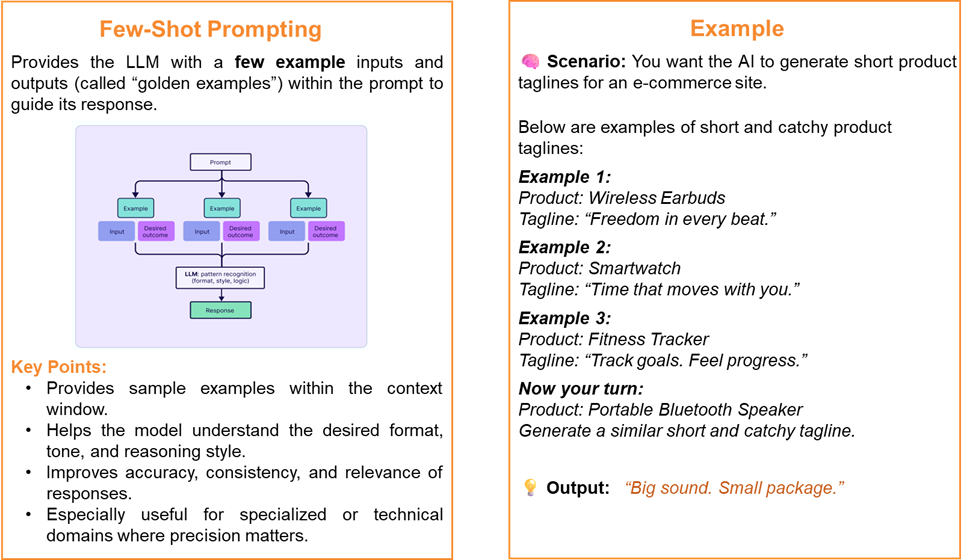
- Few-Shot Prompting: As mentioned above, using one or more examples to guide the model’s response.
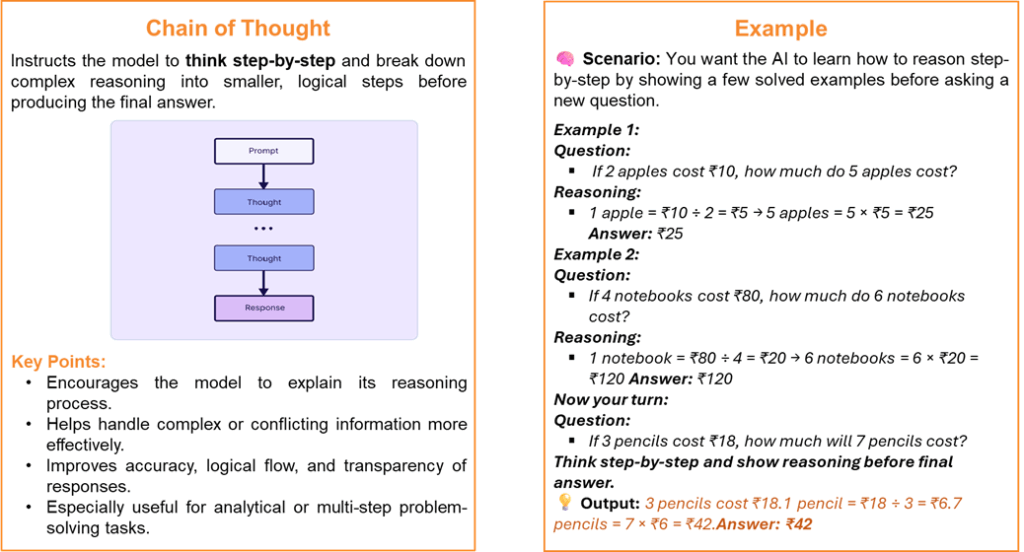
- Chain of Thought (CoT): A very powerful technique where you instruct the model to break down the solution into reasoning steps.
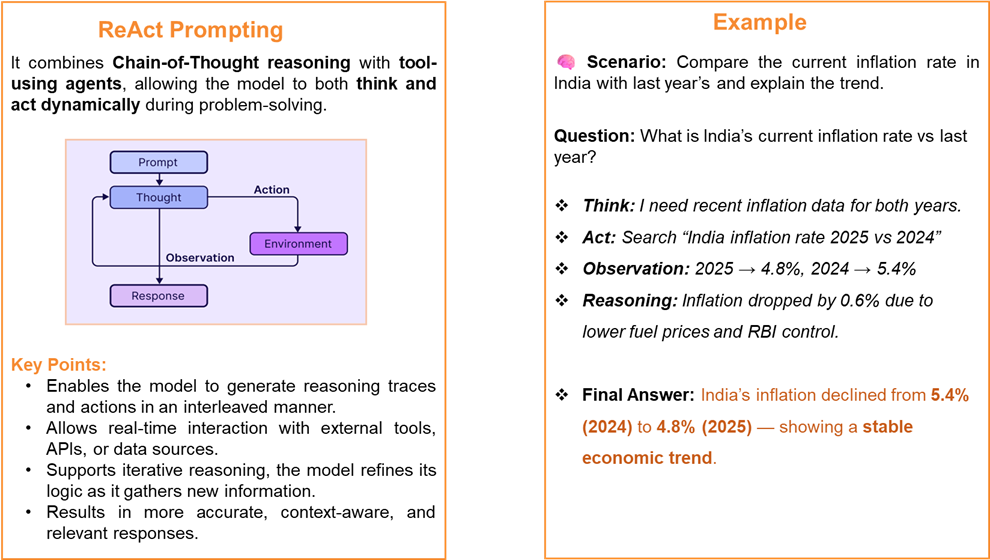
- ReAct Prompting: An advanced method that involves both reasoning and action, allowing the model to make decisions.
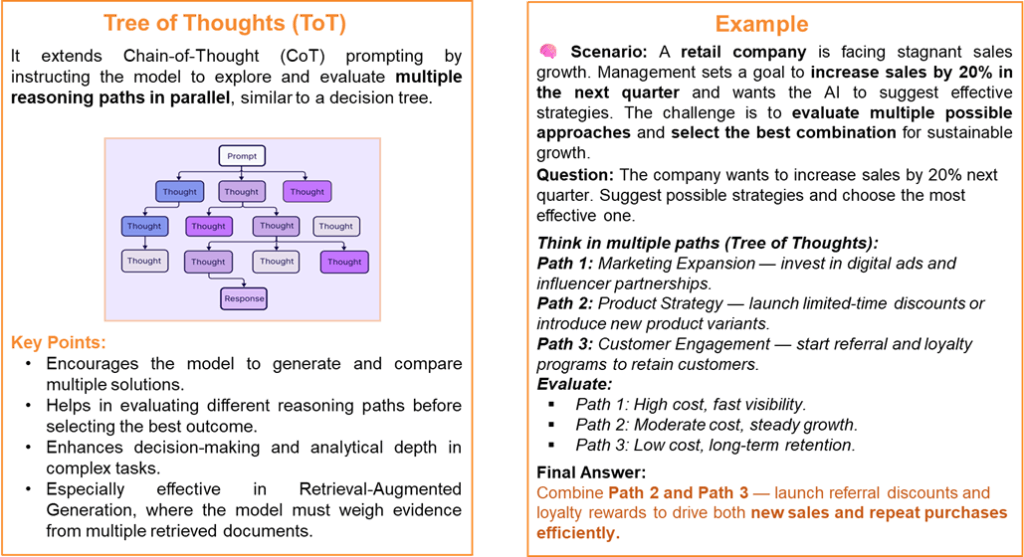
- Tree of Thoughts: An advancement of the Chain of Thought concept.
Best AI Tools for Prompt Engineering
Prompt engineering is the foundation for using any AI tool, because most tools are backed by LLM models. We can use AI to boost our productivity in many areas.
- Chatbots: ChatGPT, Claude, DeepSeek, Gemini, Grok, Meta AI, MS Copilot, Perplexity
- Image: Adobe Firefly, DALL-E, Midjourney, Stable Diffusion, FLUX.1, Ideogram,Recraft
- Video: Descript, Haiper AI, Runway, Sora, Luma AI, Pika AI, Krea AI
- Presentation: Beautiful.Ai, Gamma, Pitch, Plus, PopAI, Presentation.Ai, Slidesgo, Tome
- Coding Assistance: Askcodi, Codiga, Cursor, GitHun Copilot, Qodo, Replit, Tabnine
- Email Assistance: Clippit.Ai, Friday, Mailmaestro, Shortwave, Superhuman
- Writing Generation: Copy.Ai, Grammerly, Jasper, JotBot, writesonic, Sudowrite
- Graphic Design: AutoDraw, Canva, Design,com, Framer, Mirosoft Designer
- Data Visualization: Deckpilot, Flourish, Julius, Visme, Zing Data
Find out the Fastest Growing AI Job Skills in 2025
However, my most important advice is this: Do not completely rely on the tools. I have seen mistakes where people just copy-paste generated reports or references that are wrong. Instead of just copying and pasting the prompts or the output, you must understand the goal and ensure you are passing the correct elements (instruction, persona, context) to get the right output. Always read the generated output at least once and never depend on these systems entirely.
If you want to truly master the underlying technology behind Prompt Engineering, the Large Language Models, deep learning concepts, and the rigorous principles of data analysis, consider enrolling in MSc Data Science program provided by MAHE Online. My own work and background in data science, machine learning, and Gen AI have shown me that a strong foundation in these areas is what allows you to build, utilize, and communicate with AI systems most effectively.
Happy Learning!
Prepare for your next career milestone with us