Blogs

How to Verify if a University is UGC-DEB Approved (Step by Step)

Listen to this blog

Before you pay for any online or distance degree, take a few minutes to check its status on the official UGC Distance Education Bureau (DEB) portal. The university may say in general that it is “UGC approved” but this is not sufficient: you will need to confirm that the specific program, mode of study and admission session you are interested in are all UGC approved. This guide will walk you through the verification steps and explain the function of a DEB ID.
What Does UGC DEB status mean?
The University Grants Commission (UGC) regulates higher education in India. Its Distance Education Bureau (DEB) publishes information about higher education institutions (HEIs) and the programs they may offer through online or Open and Distance Learning (ODL) modes. The official portal uses status labels such as “recognized” and “entitled.” These labels reflect different routes under UGC rules, so do not treat a badge saying “UGC approved” as proof on its own.
For your decision, check the listing that matches the awarding university, exact program, mode, and admission session. Start at the UGC-DEB program and HEI list.
Read More: 8 UGC Rules Every Online Degree Student Must Know
How to Check a University and Program If UGC-DEB approved
Here is the step-by-step process on how to check if a university is UGC-DEB Approved:
1. Open the official portal
Type deb.ugc.ac.in into your browser or use the link here. Avoid relying on third-party lists, advertisements, logos, or screenshots as proof.
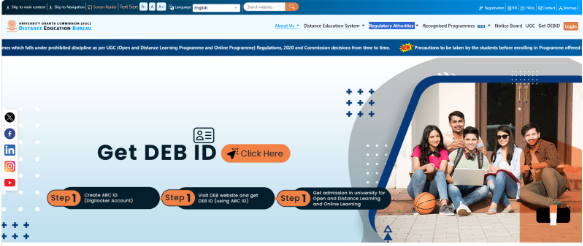
2. Click ‘Recognised Programmes’ in the top menu. It’s near the upper-right, just to the right of Regulatory Authorities.

3. A dropdown should open. Choose the option that matches your course mode: OL (Online) or ODL. For example, suppose you are checking for MUJ Online.
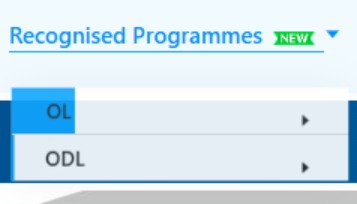
4. Choose “OL”
Select OL, which means online learning. Do not select ODL for this example; ODL means open and distance learning.
5. Choose the relevant list
The portal shows ‘Entitled’ and ‘Recognised’. For the MUJ example, start with Entitled.
Please Note: These are two UGC-DEB status categories, not ratings of university quality. They are not quality rankings, and one is not automatically better than the other. Check the category in which the university is listed, then verify that your program is approved for your chosen mode and admission session.
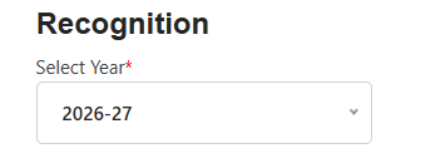
6. Select the admission year and session
Choose the year and session in which you plan to enroll. Use the same session throughout the check. A result for a different year or session does not confirm approval for your intake.
7. Find the awarding university
From the document that appears search for Manipal University and check that the state shown is Rajasthan. The UGC-DEB listing uses “Manipal University” for MUJ, so searching only for “MUJ” may not find it.
8. Match the exact program
Find the program you plan to take, such as BBA, BCom or MBA. Confirm that it appears in the entry for Manipal University, Rajasthan, under Online, for your chosen year and session. A university appearing on the list is not enough if your program is missing.
9. Check the restrictions and delivery details
Review the UGC-DEB notices for restrictions that apply to the university or program. Make sure the university offers the program directly and that it is not being offered through an unauthorized private provider or franchise.
Why the verification matters
UGC-DEB status is specific to the program and the admission period. A university’s listing for one intake does not prove that the same program is approved for a later intake, or in a different mode. UGC advises students to confirm the status for the session they plan to join. If your exact program is missing or the listing does not match, pause the payment and seek confirmation from UGC-DEB rather than relying only on a counsellor’s message or a university letter.
A qualifying online or ODL degree is treated as equivalent to its corresponding conventional degree under UGC regulations. That does not guarantee eligibility for every job, examination or postgraduate course; employers, recruiting bodies and universities can set additional criteria. Check the rules that apply to your goal before enrolling.
Red flags While Checking to Keep in Mind
1. The counsellor can’t say exactly which course, mode and session you’re joining, and shows a logo, an old screenshot or some other website’s list instead.
Approval is checked for one specific course, in one mode (online or distance), in one admission intake (for example, January 2027). If the counsellor can’t tell you those three things, or only shows you a logo or a screenshot, that is not proof. Only the DEB portal counts.
2. The DEB portal shows the university, but not for your course, mode, or session. Or your course isn’t listed at all.
A university can be approved for an MBA but not for a BBA. It can be approved for distance mode but not online mode. It can be approved for last year’s intake, but not this one. Don’t pay anything until the portal shows your exact course, mode, and session.
3. The course is in a field UGC doesn’t allow online, or an outside company is running admissions or teaching in the university’s name.
- Some courses, like medicine and nursing, can’t be offered online or by distance.
- Sometimes a private company or franchise, not the university itself, runs admissions or classes. UGC doesn’t allow this, so that should worry you.
A note for students comparing Manipal programs
Planning to study with Online Manipal? Don’t take our word for it. Check it yourself. Your degree will come from MAHE, MUJ, or SMU, depending on the program you pick. Look that university up on the DEB portal, confirm your program and intake, and if you would like help choosing between them, our counsellors are happy to talk it through.
For more context, read our guide to online and distance education and course accreditation and recognition for related information.
Frequently asked questions
1. Is UGC approval the same as UGC DEB recognition?
“UGC approved” is often used informally. For an online or ODL course, check the official DEB listing and its status for the exact university, program, mode, and admission session. Do not assume that a general university recognition statement covers every online or distance program.
2. Does a UGC DEB listing guarantee a job or admission to another course?
No. UGC equivalence does not guarantee eligibility for every job, exam or postgraduate course. Check the relevant organization’s requirements before enrolling.
3. What if the program is not listed?
Do not pay based on a verbal assurance or university letter. Ask for the exact UGC-DEB entry and verify it on the portal. If it still does not match, contact UGC-DEB before enrolling.
4. Do I really need a DEB ID?
Yes. Learners must create a DEB ID before admission to an online or ODL program. It is required for enrolment tracking; it does not certify that a university or program has approval.
Prepare for your next career milestone with us


Information related to companies and external organizations is based on secondary research or the opinion of individual authors and must not be interpreted as the official information shared by the concerned organization.
Additionally, information like fee, eligibility, scholarships, finance options etc. on offerings and programs listed on Online Manipal may change as per the discretion of respective universities so please refer to the respective program page for latest information. Any information provided in blogs is not binding and cannot be taken as final.

Explore Similar Blogs
View All
 27 Nov 2026
 9 mins
 25 Nov 2026
11 mins
 23 Nov 2026
16 mins
 16 Nov 2026
10 mins