Listen to this blog

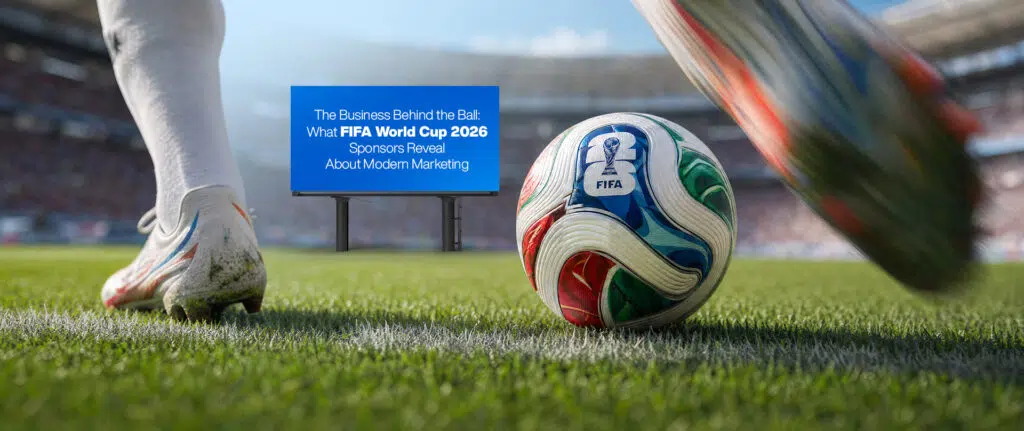
Every four years, the world stops to watch football. Billions of people across every timezone tune in, gather in living rooms, spill into fan parks, and argue passionately about offside calls they barely understand. And every four years, quietly behind the spectacle, some of the world’s most powerful corporations spend hundreds of millions of dollars to make sure their logo is in the frame.
The 2026 FIFA World Cup is bigger than anything we’ve seen before. Co-hosted across the United States, Canada, and Mexico, it features 48 national teams (up from 32), a gruelling 104 matches, and revenue projections that are expected to cross $11 billion. For anyone studying business, marketing, or strategy, it’s not just a tournament – it’s a live, real-world case study in brand building at global scale.
So let’s break it down. Not like a press kit, but like two people who actually find this stuff interesting.
Why Brands Spend Hundreds of Millions on a Football Tournament
Before we get into who’s sponsoring what, it’s worth asking the obvious question: why?
Think about what a World Cup actually offers a brand. You get a month-long event with guaranteed emotional investment from audiences across every continent. You get the kind of multi-generational, cross-cultural attention that no ad campaign can manufacture. And in 2026, with 48 teams instead of 32, you get entirely new fanbases that have never had a team at this stage before – fresh consumer demographics that brands are suddenly very interested in.
That’s the underlying logic behind every sponsorship deal you’re about to read.
You may like to read about business lessons from FIFA World Cup
The Sponsorship Ladder: Not All Logos Are Equal
FIFA doesn’t just sell “sponsorships.” It sells access – and it prices that access in tiers. Think of it like a building where the higher the floor, the more you pay, and the more you get.
Tier 1: FIFA Partners – The Long Game
These are the brands that don’t just show up for one World Cup. They sign multi-year commitments across all FIFA properties – the Women’s World Cup, youth tournaments, everything. In return, they get the broadest possible rights and the most prominent visibility. The estimated bill? Around $150–200 million per four-year cycle.
The 2026 FIFA Partners are: Adidas, Coca-Cola, Hyundai-Kia, Visa, Qatar Airways, Aramco, Lenovo, and ADI Predictstreet (the official prediction market partner, which tells you something about where fan engagement is heading).
Each of them has a clear strategic reason to be here. Adidas supplies match balls and staff kits, reinforcing its identity as a technical sportswear brand. Visa locks out every other payment network from official stadium transactions – a tactic that’s less about logo visibility and more about behavioral data and transaction volume. Hyundai-Kia uses the tournament to push its EV story through the operational logistics of the event itself.
These aren’t just marketing plays. They’re integrated business moves.
Tier 2: FIFA World Cup 2026 Sponsors – Targeting North America
This tier is tournament-specific. Brands here aren’t buying long-term FIFA equity – they’re buying into the 2026 edition specifically, with a clear eye on the North American consumer market that’s hosting the event.
The list includes Bank of America, Frito-Lay (Lay’s), McDonald’s, Verizon, Unilever, Hisense, AB InBev (think Budweiser, Modelo, Stella Artois), and Mengniu Dairy.
What’s interesting here is the category diversity. You have a major bank sitting next to a snack brand, a telecom giant next to a Chinese dairy company. That’s not coincidence – it reflects FIFA’s deliberate strategy of selling category exclusivity. Only one bank, one fast food chain, one telecom. If your competitor is shut out of the biggest sporting event on the planet, that’s as valuable as the logo placement itself.
Tier 3: The Operational Layer – Where Things Actually Get Done
This is the tier most business coverage skips, but it’s arguably the most interesting from a logistics and strategy standpoint.
Because this tournament spans three enormous countries across 16 host cities, FIFA expanded its third tier to cover everything that keeps the machine running. Brands here aren’t buying billboard space – they’re buying a role in the infrastructure of the tournament itself.
Travel and Hospitality: Airbnb is the official accommodation partner, with its listings integrated directly into the FIFA ticketing app. Marriott Bonvoy handles the corporate and luxury hotel layer. American Airlines manages the complex flight routes for teams, officials, and staff.
Technology and Data: Salesforce handles CRM and fan engagement platforms behind the scenes. Kraken brings crypto exchange visibility. Globant manages software integrations. ExpressVPN covers digital privacy (a tell-tale sign of how data security has become a mainstream corporate concern).
Logistics and Retail: DoorDash is the on-demand delivery partner around stadium zones. Fanatics runs the merchandise network – the stadium stores, the online shop, the whole retail pipeline. Rock-it Cargo handles the movement of broadcasting equipment and event infrastructure across international borders.
Lifestyle and Regional: Diageo (official spirits partner in the Americas), The Home Depot, and Inter Rapidísimo round out the regional and lifestyle layer.
What’s the takeaway here? Even at Tier 3, these partnerships require serious operational execution – not just a logo on a banner, but actual integration into how the tournament functions. That’s a different kind of brand relationship, and often a stickier one.
The Kit War: What National Teams Wear Is a Business Decision
Separate from FIFA’s corporate sponsorship structure, there’s an entirely different branding battle happening on the pitch itself.
When Argentina walked out to win the 2022 World Cup, Adidas had a very good night. When Brazil plays, Nike does. Kit sponsorships aren’t just about selling replica jerseys (though that market is enormous) – they’re about the long-term association between a brand and a team’s identity.
The 2026 tournament reflects a highly consolidated landscape:
- Nike outfits 14 teams, including Brazil, France, England, Portugal, the United States, Canada, South Korea, Australia, and Qatar. Their strategy is clear: secure the biggest market names and the fastest-growing ones.
- Adidas covers 13 teams – reigning champions Argentina, Germany, Spain, Belgium, Mexico, Colombia, and Scotland among them. Their portfolio leans on legacy and European dominance.
- Puma dresses 9 teams, with a strong showing in Africa (Morocco, Senegal, Ghana, Ivory Coast) and South America (Uruguay, Paraguay), plus European sides like Switzerland and Austria.
Together, the Big Three account for the overwhelming majority of teams. But the remaining slots are filled by a range of regional and specialist brands that deserve attention: Marathon (Ecuador and Curaçao), Kelme (Jordan and Bosnia & Herzegovina), Umbro (DR Congo), Kappa (Tunisia), Reebok (Panama), and others including Majid, 7Saber, Saeta, Tempo Sports, and Jako.
These smaller brands can’t compete on global advertising budgets, but a World Cup appearance gives them something money often can’t buy: authentic international exposure. A team going on a surprise run in the knockout stages can put a relatively unknown apparel brand in front of hundreds of millions of viewers overnight.
Get to know about FIFA World Cup 2022 sponsorship.
Who’s Broadcasting – and Why It Matters for Brand Strategy
One of the most significant shifts in sports media over the last decade has been the move from broadcast TV to digital streaming. The 2026 rights landscape reflects exactly that transition.
In India and South Asia, Zee Entertainment holds exclusive rights, with matches streaming on ZEE5. In the United States, FOX Sports covers English-language broadcasts while Telemundo and Peacock handle Spanish. The UK splits across BBC iPlayer and ITV’s ITVX. Canada streams via TSN and RDS.
For brands, this fragmentation of rights isn’t a headache – it’s an opportunity. Digital streaming platforms offer something traditional TV never could: precise targeting, real-time behavioral data, and interactive ad formats. When a brand sponsors a streaming broadcast, they’re not just buying reach; they’re buying insight into exactly who’s watching and when.
What Business Students Should Actually Take Away From This
Here’s the part where it gets directly relevant to you.
The FIFA World Cup isn’t just big sports business – it’s a working model of several concepts that show up across MBA curricula:
Market entry through association. Brands like Mengniu Dairy or Hisense aren’t household names in North America yet. Tier 2 sponsorship of the World Cup is, in effect, a market entry strategy. You borrow the cultural equity of an event to accelerate brand recognition in a new geography.
Exclusivity as competitive moat. Category exclusivity – the fact that if Visa is in, Mastercard is out – is a textbook example of using partnerships to create barriers for competitors. The value isn’t just what you gain; it’s what you prevent others from accessing.
Integrated vs. transactional partnerships. Compare a Tier 3 partner like Salesforce or DoorDash to, say, a stadium banner buy. One is a vendor relationship; the other is an operational integration. From a business development perspective, the latter is far harder to displace and creates compounding value over time.
The long tail of sponsorship. The hyper-local city sponsorships – Cox Enterprises in Atlanta, NRG Energy in Houston, Electronic Arts in San Francisco – show how mega-events create sponsorship opportunities at every scale. Not every brand needs to be Coca-Cola to find a meaningful role.
The $11 billion revenue projection for this tournament doesn’t come from ticket sales and broadcast rights alone. It comes from a meticulously tiered commercial architecture built around one simple insight: when the whole world is watching, attention is the scarcest and most valuable resource there is.
Frequently Asked Questions
- What’s the difference between a FIFA Partner and a World Cup Sponsor?
A FIFA Partner commits to a multi-year relationship across all FIFA competitions globally. A World Cup Sponsor buys in only for a specific tournament edition. Partners pay more and get significantly broader rights; Sponsors get targeted, high-value exposure for a defined window.
- Where can I legally watch the 2026 World Cup in India?
Zee Entertainment holds the exclusive rights for India and South Asia. Matches are available to stream live on the ZEE5 platform, with select games simulcast on free-to-air channels.
- How does studying sports sponsorships help with an MBA?
Mega-events like the World Cup compress an enormous range of real business decisions – contract negotiation, global logistics, cross-border marketing, consumer psychology, media strategy – into a single observable case. Watching how brands activate at different tiers teaches you more about marketing architecture than most textbooks do.
Interested in understanding the business strategy behind global industries like sports, media, and technology? Online Manipal offers UGC-entitled Online bachelor’s and PG degree programs from top-ranked universities – built for professionals who want to lead, not just participate.
Prepare for your next career milestone with us