
Listen to this blog

According to the World Economic Forum’s Future of Jobs Report 2025, 170 million new jobs are expected to be created globally by 2030, while 92 million roles may be displaced.
The statistics given above create a fear in everyone’s minds because we all know how fast AI is evolving. According to sources, artificial intelligence could now create what is called a ‘Ghost GDP’. This is a scenario where AI replaces white-collar jobs, boosting output and profit. On the other hand, it is creating new jobs that are beyond our imagination.
However, the reality is how AI is automating tasks reducing information-heavy and repetitive tasks.
For India, the stakes feel more personal. The IT and digital services sector here haven’t just powered exports and economic growth, it has been the ladder through which millions climbed into the middle class. So, the country now faces an urgent reckoning: how to move its vast workforce from execution-based roles into higher-value work in AI, cloud, cybersecurity, data engineering, and digital product innovation.
How Fast Is AI Taking Over Task-Based Work?
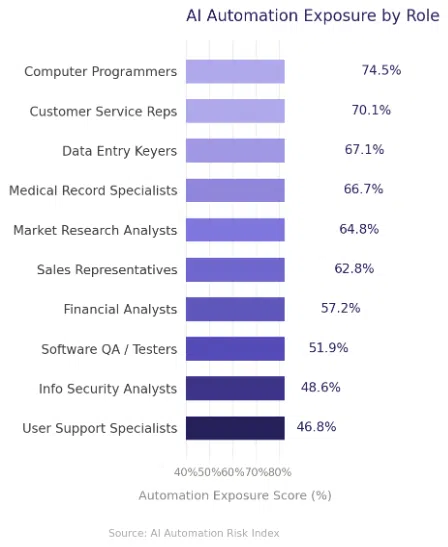
Artificial Intelligence is moving fastest in repetitive, information-heavy tasks, especially in digital-first roles. The latest usage data shows that the most exposed jobs and how much (in %) share of tasks LLMs can take up:
- Computer programmers – 74.5%
- Customer service representatives – 70.1%
- Data entry keyers – 67.1%
- Medical record specialists – 66.7%
- Market research analysts – 64.8%
- Sales representatives – 62.8%
- Financial and investment analysts – 57.2%
- Software QA analysts and testers – 51.9%
- Information security analysts – 48.6%
- Computer user support specialists – 46.8%
The shift isn’t really about jobs vanishing overnight; it’s more subtle than that. AI is quietly hollowing out the repetitive layers within jobs first: the support tickets, the documentation, the data crunching, the routine research. The work isn’t disappearing, but it’s getting faster, leaner, and increasingly AI-assisted.
Read More: 7 Job Roles That Will Survive the Rise of AI
The Fastest Growing Jobs in the AI Era
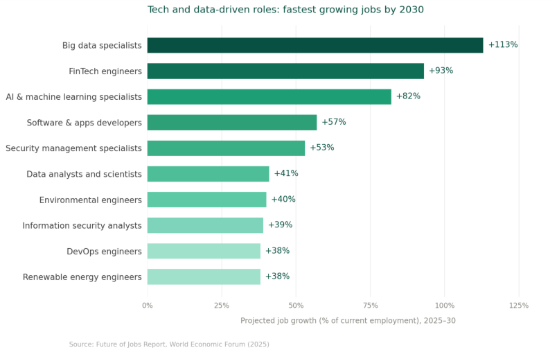
Now, here’s the other side of the story, and it’s one worth paying attention to. The same AI that’s hollowing out repetitive roles are actively creating demand for an entirely new category of work. According to the World Economic Forum’s Future of Jobs Report 2025, tech and data-driven roles are projected to see the fastest job growth globally between 2025 and 2030. This isn’t a distant forecast; it’s already happening. The question for workers isn’t just which jobs are disappearing, but which ones are worth running toward. Here are a few fastest growing job roles:
- Big data specialists — 113%
- FinTech engineers — 93%
- AI and machine learning specialists — 82%
- Software and applications developers — 57%
- Security management specialists — 53%
- Data analysts and scientists — 41%
- Environmental engineers — 40%
- Information security analysts — 39%
- DevOps engineers — 38%
- Renewable energy engineers — 38%
Can India Stay Resilient in the Age of AI?
This is one question that has likely been lingering in all our minds whenever we come across yet another article about AI taking over the world.
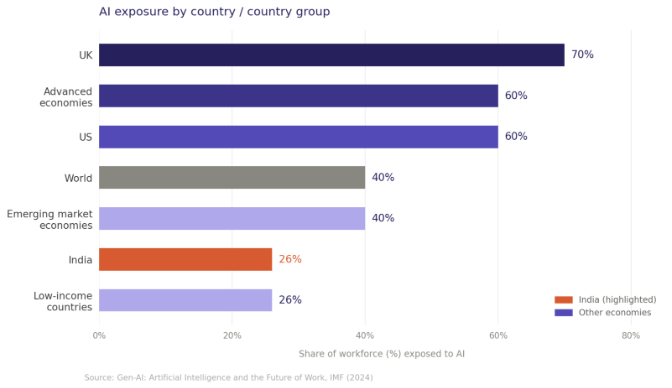
At first glance, India might seem relatively safe. Only about 26% of India’s workforce is exposed to AI disruption, far below the 60% in advanced economies like the US and UK, and even below the global average of 40%, according to an IMF study. That sounds reassuring, until you understand why the number is low.
India’s lower exposure to artificial intelligence does not necessarily mean it is safer. It mainly reflects the way jobs are spread across the country. A large part of the workforce is still employed in agriculture, crafts, and basic manual work, where AI has little immediate impact. The real concern lies in the IT and services sector, where India has made its biggest bets, because these industries face much higher AI exposure than the rest of the economy.
So, while the headline number looks modest, the reality for India’s urban, educated, white-collar workforce is far more uncomfortable. The UK sits at 70% exposure, the US at 60%, and the professional roles that India has built its middle-class growth story around closely mirror the job profiles most at risk in those economies.
So, India isn’t less exposed but it’s just that the exposed part just happens to be the part that matters most.
India’s IT Sector: Growth Story or Ticking Clock?
India’s exposure to AI is relatively low, but its IT sector tells a different story. The industry has long run on a simple promise, that is, high-quality services at competitive costs. But that very model is now being quietly challenged by AI.
The numbers from Niti Aayog says a direct point: India’s IT workforce, currently at 7.5–8 million, could fall to just 6 million by 2031 which is due to AI-led productivity gains, competition from AI-native firms, and macroeconomic uncertainty. Early signs are already visible on the ground: slower campus placements, reduced hiring, and a clear shift in what companies are looking for; Less execution, More AI awareness.
But the same Niti Aayog report holds out an equally compelling counter-scenario. If India moves fast enough by building global capability centers, skilling its workforce in AI, cloud, and advanced digital roles, then the IT workforce could instead grow to 10 million by 2031.
Everything depends on how fast these factors will evolve in the future.
An Interesting Find: How AI remains fastest growing skills across domains
Should You Fear the AI Bloom or Move Ahead of it?
The data is alarming, but fear is the wrong response. Every disruption in history has rewarded those who moved toward the change, not away from it. The skills AI now demands can be learned, and learning resources are easier to access than ever.
For both students and working professionals, online learning has quietly become the most realistic way to keep up. You don’t have to put your life on hold, leave your job, or move cities to grow. Platforms like Online Manipal make it possible to learn around your schedule, earn degrees and certifications that are valuable, and build the skills that employers are actively looking for right now.
The Manipal Academy of Higher Education (MAHE) has an Online MCA program with a concentration in AI and ML. Meanwhile, Manipal University Jaipur (MUJ) offers an Online MCA program that centers on AI and Data Science. The Online BCom program at MUJ also has electives like Accounting with AI and Digital Marketing with AI.
Read More: Can Online Education Stay Relevant in an AI-Driven Job Market?
Conclusion
AI isn’t a distant threat we can afford to think about later. It’s already here, quietly changing what jobs look like, what skills pay, and who gets the opportunities. Nobody is completely immune, but nobody is completely powerless either. The change should begin with us.
So, are you ready to evolve with AI and future-proof your career?
Reference
Prepare for your next career milestone with us