By Degrees
 24 months




You have probably run the numbers in your head more than once. Two years of studying alongside work, some savings or a loan going toward tuition, evenings that used to be free now spent on assignments. So, it’s natural to ask yourself: is an MBA actually worth it, or would that time and money grow faster somewhere else?
Here’s the encouraging part: once you actually look at the data instead of guessing, the answer tends to lean strongly in favor of the degree. Graduates consistently report faster promotions, meaningfully higher lifetime earnings, and skills that keep paying off well beyond the classroom. This blog breaks down what is ROI in MBA terms, what the numbers actually show about the long-term payoff, and what specifically determines whether an online MBA earns back its cost faster than you’d expect.
What Is ROI in an MBA?
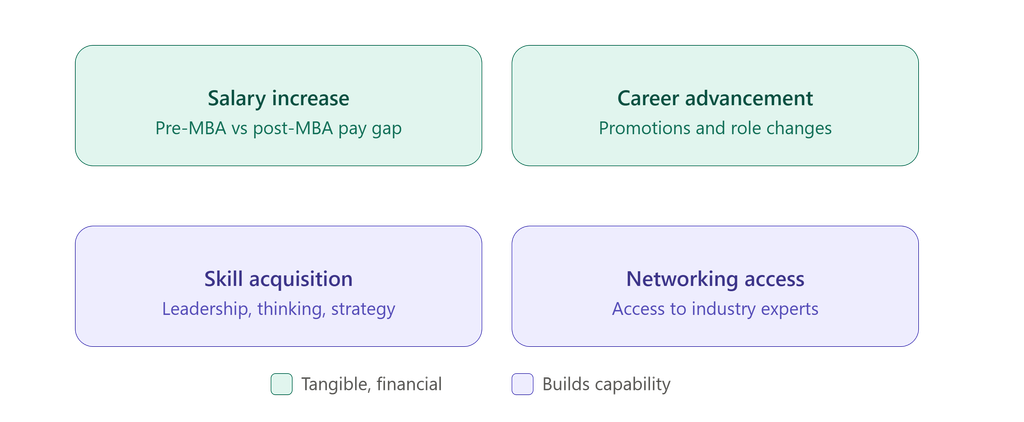
ROI, or Return on Investment, in the context of an MBA means weighing the career and financial gains the degree produces against what it costs to complete. The main factors typically considered are:
- Salary increase: the gap between pre-MBA and post-MBA compensation
- Career advancement: promotions, role changes, and access to leadership positions
- Skill acquisition: critical thinking, leadership, and strategic decision-making
- Networking access: relationships with peers, faculty, and industry professionals
Both tangible (financial) and intangible (personal growth, job satisfaction, confidence) benefits factor into a complete answer to what is ROI in MBA evaluations, not just the salary number alone.
An Interesting Read: How to Choose the Best Online MBA Electives for Your Successful Career
What Is the Lifetime ROI of an MBA?
Recent data gives a clearer, more current picture than older estimates. Bloomberg’s ongoing MBA ROI analysis, updated through 2026, found that the median annualized return on investment for US business schools has held at 12.3% over a 10-year horizon, a level that’s stayed consistent rather than eroding.
So, what is the lifetime ROI of an MBA in practical terms today? A meaningful, durable salary premium that compounds over a career, backed by employer demand that remains strong: 90% of surveyed employers said they planned to hire MBA candidates in 2025, outpacing every other degree type.
What Factors Determine If Online MBA Programs Provide a Strong Return on Investment?
Online MBA ROI depends on a slightly different set of variables than a full-time, on-campus program, since the cost structure and opportunity cost both look different.
- No lost income: Since most online MBA students keep working while studying, there’s no forgone salary to recover, which is the single biggest factor separating online payback periods from full-time ones.
- Program accreditation: A UGC-entitled, NAAC-accredited program carries the same recognition as an on-campus degree, which directly affects how the qualification is received by employers.
- Program reputation and employer relationships: Salary outcomes depend less on whether the coursework was online and more on the school’s accreditation and industry connections.
- Career stage at enrollment: Professionals already in mid-level roles tend to see faster salary gains post-MBA than those just starting out.
- Specialization relevance: An MBA specialization aligned with your existing industry tends to produce a faster and larger salary jump than a generic, unfocused choice.
Non-Financial Returns Worth Factoring In
Financial ROI isn’t the whole picture. Networking access, leadership skill-building, and increased confidence consistently show up as benefits graduates value alongside the paycheck, even though they’re harder to put a number on than a salary increase. The steady employer demand for MBA talent suggests these skills continue to translate into real workplace value, not just personal satisfaction.
Maximizing Your Online MBA ROI
A few things consistently improve outcomes:
- Choose a program aligned with your goals: curriculum, accreditation, and specialization matter more than brand recognition alone.
- Use internships and projects actively: practical exposure closes the gap between coursework and real managerial work.
- Network deliberately: online programs require more intentional effort here than a physical campus does.
- Keep learning after graduation: certifications and industry engagement extend the ROI curve well past the degree itself.
Online MBA ROI Through Online Manipal
If you’re evaluating online MBA ROI specifically within the Indian market, Online Manipal offers UGC-entitled online MBA programs through three universities: Manipal University Jaipur (MUJ), Manipal Academy of Higher Education (MAHE), and Sikkim Manipal University (SMU). All three are NAAC accredited (MAHE at A++, MUJ and SMU at A+), and admission is based on your graduation percentage rather than an entrance exam. Since you continue earning while studying, the online MBA ROI calculation skips the “lost income” cost that weighs down full-time programs, which is a large part of why online MBA ROI tends to look stronger on paper even when the salary premium itself is comparable.
Conclusion
So, what is ROI in MBA terms when you put it all together? It’s a real, measurable salary premium (median starting salaries around $125,000 and average three-year gains near 119% per current GMAC data), faster access to leadership roles, and a set of intangible gains, personal growth, confidence, and network, that compound well beyond graduation. The data on online MBA ROI specifically points to a shorter payback period than full-time programs, mainly because there’s no lost salary to recover. Whichever path you choose, the degree pays off fastest when it’s matched to a program and specialization that actually fits your career goals.
FAQs
1. What is ROI in MBA calculations, in simple terms?
It’s the career and financial gain from the degree (higher salary, faster promotions, new skills, networking) measured against its total cost in time and money.
2. What is the lifetime ROI of an MBA?
Recent GMAC data puts median starting salaries at $125,000 with roughly a 119% average salary increase within three years of graduation, and Bloomberg’s 2026 analysis shows a median annualized 10-year ROI of 12.3% across US business schools.
3. Is online MBA ROI better than a full-time MBA’s?
Often yes, in payback-period terms, since online students keep earning while studying, though full-time programs may offer stronger in-person networking access.
4. What factors determine if online MBA programs provide a strong return on investment?
Program accreditation, no lost income during study, career stage at enrollment, and how closely the specialization matches your industry.
5. How long does it typically take to recover the cost of an online MBA?
The global average payback period across MBA programs is around 4.25 years, though online programs often land on the shorter end of that range since there’s no forgone salary to make up.
Reference
GMAC 2025 Corporate Recruiters Survey; Bloomberg MBA ROI analysis, 2026.
Source: Research.com, 2026 Online MBA ROI Guide; MBA Schools, 2026.
Become future-ready with our online MBA program


Information related to companies and external organizations is based on secondary research or the opinion of individual authors and must not be interpreted as the official information shared by the concerned organization.
Additionally, information like fee, eligibility, scholarships, finance options etc. on offerings and programs listed on Online Manipal may change as per the discretion of respective universities so please refer to the respective program page for latest information. Any information provided in blogs is not binding and cannot be taken as final.