Blogs

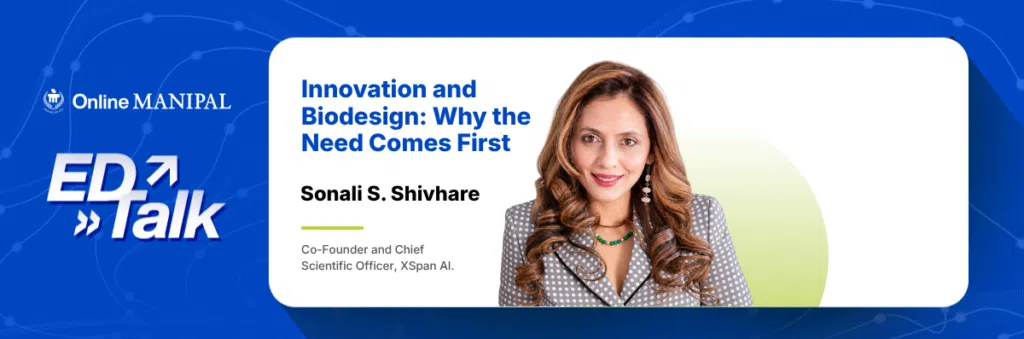
Innovation and Biodesign: Why the Need Comes First
Listen to this blog

Have you ever come across a brilliant technology that failed to take off? It happens more often than you’d think, especially in business and healthcare. Many products fail because they don’t address a genuine market need. Founders often spend years building impressive gadgets without first checking whether people need them.
I learnt this lesson through my training in Stanford Biodesign. Healthcare innovation doesn’t begin with a sleek product or an advanced medical device. It begins with a clearly defined need. That need forms the foundation of every successful invention.
If you want to solve real healthcare problems, fall in love with the problem, not the solution.
Sonali S Shivhare
Lessons from a Famous Tech Failure
When the Segway launched in 2001, technology leaders hailed it as revolutionary. Its inventor, Dean Kamen, had developed a self-balancing mechanism that showcased remarkable engineering. The excitement was enormous, and some of the biggest names in technology made ambitious predictions about its future.
- Steve Jobs compared its potential impact to that of the personal computer.
- John Doerr predicted that it would reach $1 billion in sales before the internet.
- Jeff Bezos imagined cities being built around the device.
But the market had other plans. The company expected to sell 40,000 units every month. Instead, it sold barely 30,000 over six years. That’s just 1.5% of its original target. The Segway was heavy, cost around $5,000, and required special training to ride. It was an engineering achievement, no doubt. But it failed to address a sufficiently strong, validated need.
There’s an interesting distinction here. Before the Segway, Kamen had developed the iBOT, a self-balancing wheelchair capable of climbing stairs. That invention addressed a genuine mobility challenge faced by people with physical disabilities. The Segway, however, rested on an assumption that everyday commuters wanted a heavy personal transporter. The team never validated that assumption adequately. This brings us to an important lesson: answers are easy to find, but good questions are much harder to identify.
AI can generate dozens of product designs in seconds. Yet identifying the right unmet need to solve still requires human judgement.
The Three Phases of Stanford Biodesign
Healthcare innovation involves risks that go well beyond those associated with conventional consumer technology. Human lives are at stake. Innovators must also consider regulatory requirements, clinical safety, liability, and complex insurance reimbursement models.
The Stanford Biodesign approach provides a structured framework to navigate these challenges. It follows an iterative process with three phases and six stages:
1. Identify Phase
This phase focuses on clinical observation through Needs Finding and Needs Screening. The objective is to understand problems firsthand without allowing existing technologies or preconceived solutions to influence observations.
2. Invent Phase
Once the team identifies a meaningful need, it moves to Concept Generation and Concept Screening. This is where ideas take shape. Teams create simple paper prototypes using everyday materials such as jars, rags, and plastic tubes to make their concepts tangible and test their assumptions.
3. Implement Phase
The final phase covers Strategy Development and Business Planning. Teams work towards bringing the proposed technology into clinical practice while addressing its commercial, regulatory, and operational requirements. The results speak for themselves. Since Stanford Biodesign began in 2001, technologies developed through its programs have impacted more than 18 million patient lives.
Consider the example of iRhythm Zio, founded in 2006. Traditional EKG monitoring for heart arrhythmia required cumbersome wires and multiple adhesive chest stickers. The team recognised the need for a more comfortable solution that could support long-term monitoring. Their innovation replaced the conventional setup with a single stick-on patch that continuously recorded data for 14 days while patients stayed at home. The solution simplified the monitoring experience without compromising its purpose.
Another team tackled arterial calcification by drawing inspiration from kidney stone treatments. This led to the development of Shockwave Medical, which Johnson & Johnson later acquired after its technology had reached more than a million lives.
Both examples demonstrate the same principle. Successful innovation begins with understanding the clinical problem, not deciding which technology to build.
Read more: What is Healthcare Management? A Complete Guide (2026)
How to Draft and Stress-Test a Need Statement
Innovation rarely comes from a sudden stroke of individual genius. It takes collaboration, observation, and a process that teams can repeat. Thomas Edison understood this well. He assembled a large team that included a machinist, mathematician, chemist, electrical engineer, and metallurgist. Each brought a different perspective to the problem. Healthcare innovation works in much the same way. It requires people with different skills and experiences to work towards a shared objective.
One of the first steps is to develop a precise need statement. This helps teams define the problem without committing to a particular technology or solution too early. For instance, writing “a wearable sensor to alert nurses” immediately pushes the team towards a specific product. It limits the scope of exploration before the team has fully understood the clinical gap. Instead, use a simple framework:
A way to address [SPECIFIC PROBLEM] in [SPECIFIC POPULATION] in order to achieve [DESIRED OUTCOME].
Once you’ve drafted the statement, put it through four essential filters.
1. Severity
How serious is the problem? Does it cause a minor inconvenience, lead to complications, or result in fatal outcomes? Understanding its severity helps establish the urgency of addressing it.
2. Population
How many people experience this problem? Assess the affected population in India and across the world to understand the potential scale of the need.
3. Feasibility
Can a focused team realistically develop, prototype, and validate a solution within two to three years? A good need statement should point towards a challenge that a team can meaningfully address.
4. Market Clarity
Is the clinical value of solving this problem clear? More importantly, would hospitals, insurance providers, or patients be willing to pay for a solution?
These filters help teams distinguish between interesting problems and genuine opportunities for innovation.
Practicing Biodesign in Real Ward Environments
Some of the most valuable insights come from simply observing how healthcare professionals work. During my clinical research, I spent hours standing quietly in operating rooms and busy hospital wards. I observed doctors, nurses, and patients, documenting their routines, challenges, and experiences in notebooks. I didn’t walk in looking for a product to build. I wanted to understand where things went wrong.
Consider a typical general ward in a busy hospital. One nurse may be responsible for 18 patients at the same time. The nurse checks their vital signs manually, records the readings on loose paper slips, and enters the information into the electronic medical record hours later. Now imagine a patient’s breathing rate increasing or oxygen saturation dropping gradually during a night shift. If the team misses these early warning signs, delayed documentation could postpone a potentially life-saving transfer to the ICU.
How do we approach this problem? The first step is to frame it correctly. Consider these three statements:
- Weak statement: A way to improve hospital care.
This doesn’t tell us much. The problem is too broad, and there’s no measurable outcome. - Flawed statement: A wearable monitor that alerts nurses when vital signs drop.
This sounds more specific, but it already assumes that a wearable monitor is the right answer. The team hasn’t explored other possibilities. - Strong statement: A way to detect early clinical deterioration in adult general ward patients during night shifts in order to reduce unplanned ICU transfers.
This statement identifies the problem, defines the affected population, and establishes a measurable outcome. It also leaves room for different solutions.
That’s the difference between solution-led thinking and needs-driven innovation. There’s another important aspect to this process: stakeholder conversations. Don’t limit your research to doctors or laboratory experts. Speak to nurses, physicians, financial administrators, and, most importantly, patients. Each group experiences the same healthcare challenge differently.
Researchers might focus on laboratory measurements and clinical outcomes. Patients, on the other hand, might be more concerned about managing pain, returning to work, or reducing the time they spend in hospital. These perspectives matter. They help ensure that the eventual innovation addresses a need that people genuinely experience.
Know more: Top Healthcare Management Skills You Need to Succeed in 2027
Mastering Needs-Driven Innovation for Healthcare Impact
Whether you’re a clinician, engineer, product manager, or healthcare administrator, the ability to identify the right problem can make a significant difference to your work.
Healthcare innovation isn’t about building the most sophisticated technology. It’s about understanding where existing systems fall short and finding meaningful ways to address those gaps. A disciplined approach to needs identification can help teams avoid unnecessary development costs and years of effort spent on solutions that don’t find a place in clinical practice.
As I often emphasise, sharpen your axe before you start cutting. A little more time spent understanding the problem can save considerable effort later. For professionals looking to build their management capabilities and contribute to meaningful change in the healthcare ecosystem, the Online MBA in Hospital & Healthcare Management offered by Manipal Academy of Higher Education provides an opportunity to develop a broader understanding of the sector. The program covers strategic, financial, and operational aspects of healthcare management, helping aspiring leaders understand complex healthcare challenges and work towards sustainable, patient-centred solutions.
Prepare for your next career milestone with us


Information related to companies and external organizations is based on secondary research or the opinion of individual authors and must not be interpreted as the official information shared by the concerned organization.
Additionally, information like fee, eligibility, scholarships, finance options etc. on offerings and programs listed on Online Manipal may change as per the discretion of respective universities so please refer to the respective program page for latest information. Any information provided in blogs is not binding and cannot be taken as final.