Listen to this blog

A decade ago, if you told a middle-class Indian parent that their kid’s phone-obsession would one day out-earn a government job, you would have definitely laughed it out of the living room. Today, that same kid might be running a six-person team, a merchandise line, and a brand deal calendar tighter than most CMOs. Somewhere between the ring light and the algorithm, “content creator” stopped being a hobby on a resume and became a legitimate career! Such is the power of the creator economy.
This is the story of the creator economy: what it actually is, why India has become one of its most explosive playgrounds, and why “digital influence” is quietly rewriting the rules of business, marketing, and even how young people imagine their futures.
So, What Really Is Creator Economy?
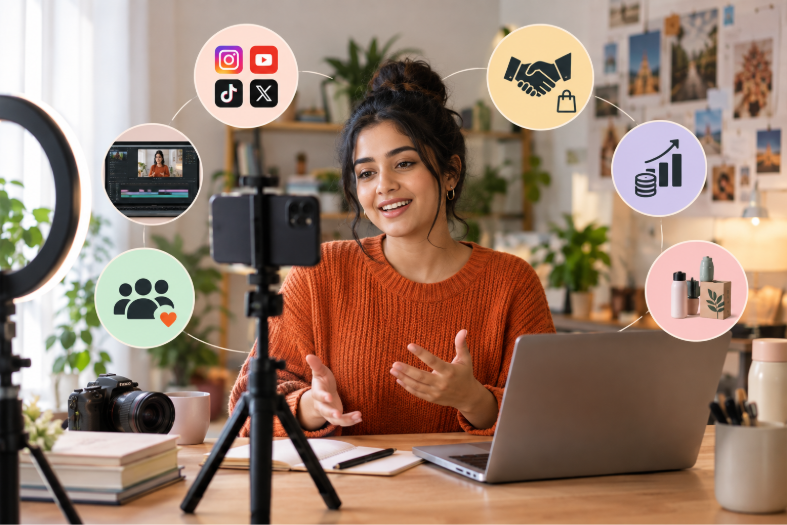
Let’s start with the basics, because the term gets thrown around loosely. What is creator economy? In simple terms, it’s the ecosystem of independent content creators (YouTube/Instagram/Facebook or any social media platform), and podcasters, who build audiences and then monetize that attention directly, without needing a traditional employer or media house standing in between. Instead of a studio producing a show, one person with a phone and an idea can build a business worth crores.
Did You Know?
The Indian creator economy market is estimated to be valued at USD 15.03 billion in 2026 and is expected to reach USD 61.87 billion by 2033, growing at a compound annual growth rate (CAGR) of 22.4% from 2026 to 2033.
Key Highlights: India’s Creator Economy Market
By 2026, social media platforms are expected to lead the market, holding an estimated 45.2% share. Among creator types, independent individual creators are set to come out on top, projected to make up 56.56% of the market that year. And when it comes to revenue, advertising looks set to be the biggest income stream, accounting for an estimated 31.4% share.
Pricing Breakdown: What Creators Earn in India
| Tier / Category | Benchmark Earnings (USD) | Approx. INR Equivalent |
| Nano creator (1K–10K followers) – short-form brand deal | ~$6 to $60 | ~₹579 to ₹5,790 |
| Micro creator (10K–100K followers) – brand deal | ~$30 to $970 | ~₹2,895 to ₹93,605 |
| Macro/celebrity creator (500K–1M+ followers) – short-form brand deal | ~$2,400+ (can go into several thousand) | ~₹2,31,600+ |
| Typical monthly earnings for most creators | ~$220 | ~₹18,000/month |
| Cost-per-view (CPV) for smaller creators | ~$0.002 to $0.07 per view | ~₹0.19 to ₹6.76 per view |
As you can see above, being a creator isn’t an easy job, it takes consistency and determination, but the reward at the end is high. This is also a field where there’s no real fear of losing your job, since consumer interest will never go down, though the competition keeps increasing. Hence, creators need to constantly work towards figuring out what interests people, which in itself is a tedious job.
In many ways, I wasn’t just creating content anymore. I was building and managing a growing digital media business.
— Aswin Menon M, creator and Online MBA graduate of MUJ
Read More on the Inspiring Journey of Aswin Menon: From Explaining News to Building a Business: Aswin Menon’s Journey with an Online MBA
What Is Digital Influence, and Why Does It Matter More Than Ever?
Here’s where things get philosophically interesting. What is digital influence, precisely? It’s not just follower count or viral reach, but, it’s the measurable ability of a person’s online presence to shift what people buy, believe, watch, or trust. A decade ago, “influence” belonged to celebrities and news anchors. Now it belongs to a 24-year-old finance creator in Indore or a home-cook grandmother with two million subscribers.
Digital influence has become so potent that brands are restructuring entire marketing budgets around it. Consider this: for every ₹1 spent on influencer marketing, the average return is close to ₹5.78, something which the traditional advertising rarely matches anymore. It’s no surprise that 93% of brands surveyed globally plan to increase their creator marketing spend in 2026. In India specifically, e-commerce (23%) and FMCG (19%) lead sectoral spending on influencers, with Instagram remaining the dominant platform of choice for over 93% of brands.
But digital influence isn’t just a marketing line item anymore; it’s reshaping product development itself. Creators today don’t merely promote skincare or supplements; many are launching their own D2C brands, using their audience as a live, 24/7 focus group. This “community-as-R&D” model means products get validated by real fans before they even hit shelves, cutting out the guesswork that traditional companies spend months (and crores) trying to eliminate.
Did you know?
Many of you might be familiar with the name – Parul Gulati! She, being an actress, didn’t stop at creating content and appearing on screen. She also built Nish Hair, a hair-extension brand inspired by her own experience with hair extensions. From actor to entrepreneur, her journey shows how creators can turn a personal problem, and an audience that understands it, into a consumer brand.
Read More: Digital sociology and online communities: How the internet is rewriting society
Beyond the Hype: The Real Shift Happening
What’s genuinely fascinating about the creator economy India narrative is how it’s colliding with mainstream business logic. Companies like Myntra, Amazon India, and even Dream11 have pivoted parts of their strategy to be creator-led, rolling out programs that plug influencers directly into commerce, not just advertising. Meanwhile, AI tools are being adopted by a striking 59–84% of creators (depending on the survey), speeding up everything from scripting to editing to audience analytics.
It’s not surprising, then, that courses are now being introduced to teach students content creation in depth. At Online Manipal, we believe in every talent a student brings to the table, which is why we offer new specializations under the MA JMC program such as AI-Driven Media and Content Creation, and Creator Economy & Digital Influence.
For More Details, Visit:
Online MA in Journalism & Mass Communication from MUJ
The Bottom Line
The creator economy is no longer a niche corner of the internet; it’s a genuine industrial sector, backed by government policy, contributing to GDP, and drawing boardroom attention. Digital influence, once dismissed as vanity metrics, is now one of the most trusted currencies in modern marketing!
The camera kids aren’t just influencing anymore. Increasingly, they’re the ones running the show.
References
https://www.coherentmarketinsights.com/industry-reports/india-creator-economy-market
Become future-ready with our online MA Journalism & Mass Communication program