Blogs
Blogs 
5 Practical Ways to Prevent Burnout in Online Learning

Listen to this blog

As a learner, you may relate to this situation. You wake up, and you feel tired and mentally exhausted even before the day starts. You may have already picked up your phone, replied to all the unread messages, and probably opened the recorded lecture you paused yesterday! By afternoon, your brain feels heavy and loaded with information. This is the brain burnout we will discuss in this blog.
Technically, your engagement ratio would be low, yet your brain is exhausted with the limited number of activities you performed. This is a clear sign of burnout and has become the reality of many learners today. When it comes to online learning, mental exhaustion not only comes from studying alone but also through jumping between tabs, managing notifications, and carrying the pressure of always staying connected. You are not just learning anymore. You are splitting your mental energy across a dozen invisible demands at once.
This kind of burnout builds slowly and is easy to dismiss precisely because it is invisible. But small, intentional shifts in how you study, rest, and protect your attention can genuinely change how your brain feels by the end of the day. And that is exactly what we are here to explore. Here are five practical ways learners can reduce online learning burnout and regain a healthier balance.
What is Burnout Among Students and Its Signs?
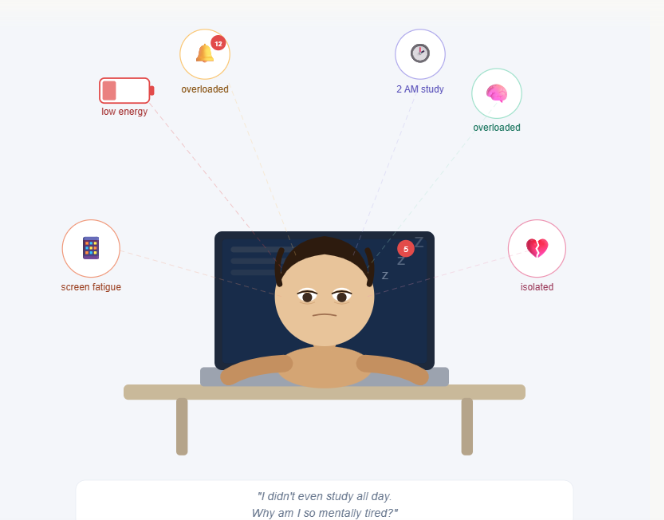
According to a 2025 study published by Springer, 73.2% of students reported moderate to high stress levels, while nearly one-third experienced frequent symptoms of burnout.
Burnout refers to a period when a person is physically, emotionally, and mentally exhausted due to ongoing stress. One of the most common signs of burnout is low motivation or desire to do anything, and also reduced productivity, engagement, and overall performance.
The term was coined in 1974 through a study conducted by psychologist Freudenberger and has since been studied thoroughly in fields of education, healthcare and service-based industries.
Signs of Online Learning Burnout
- Constant mental exhaustion even after resting
- Difficulty concentrating on simple tasks
- Feeling emotionally detached from studies
- Lack of motivation despite important deadlines
- Increased irritability or frustration
- Brain fog and reduced memory retention
- Feeling overwhelmed by small academic tasks
- Spending hours “studying” without real focus
- Trouble disconnecting from academic stress
- Emotional exhaustion from continuous screen exposure
Recognizing these signs early can help learners make healthier adjustments before burnout becomes severe.
5 Ways to Prevent Burnout in Online Learning
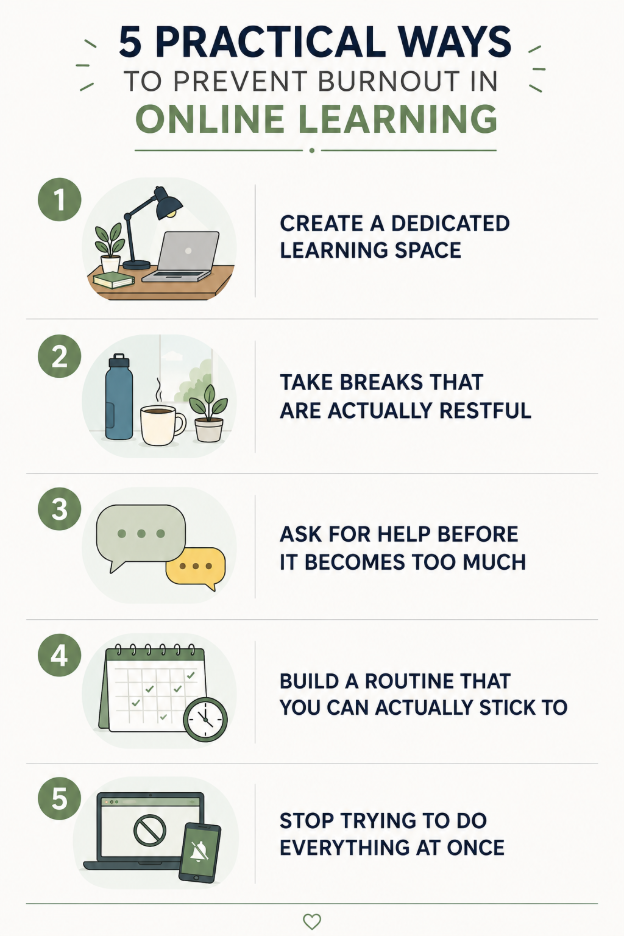
1. Create a dedicated learning space
The tricky part about studying online is that you are sitting in the same spot where you also eat, scroll, relax, and sometimes do nothing at all. Your brain picks up on this. It stops knowing when to switch on and when to switch off.
You do not need a separate room or a perfect desk setup. Even a small corner that you only use for studying can help. Let your family or roommates know when you are in study mode. It sounds simple, but it genuinely reduces the number of times you get pulled out of focus.
When your environment has some structure, your mind tends to follow.
2. Take breaks that are actually restful
Once a lecture ends, most of us reach for the phone. Another screen, another scroll. It feels like rest, but it rarely is.
Your eyes are still working. Your brain is still processing. The tiredness just keeps building without you realizing it.
A short walk, some music, sitting near a window, even just stepping away from your desk for ten minutes, these things actually help your brain recover. Rest is not laziness. It is how you show up better for the next session.
An Interesting Read: Why Rest is Essential for Academic Success in Online Education
3. Ask for help before it becomes too much
A lot of students quietly reach their limit before they say anything. They sit with confusion, or a pile-up of deadlines, or the feeling that everyone else has figured it out except them.
In online learning, nobody can really see when you are struggling. Your camera might be off. You might not type in the chat. And so, the pressure just stays with you.
Reaching out, whether to a faculty member, a classmate, or even the support team, takes the weight off. Burnout tends to grow quietly. Saying something, anything, is often the first step out of it.
4. Build a routine that you can stick to
Flexibility is one of the best things about online learning. It is also one of the hardest things to manage.
When there is no fixed time for anything, studying ends up happening at odd hours, in short bursts, with a constant low-level guilt that you should be doing more. That kind of day is exhausting even if you did not study much.
A simple routine helps. Not a perfect schedule, just a consistent one. Figure out when you actually focus well, morning, afternoon, or late evening, and try to build around that. The less you have to decide on the fly, the less mentally drained you feel.
5. Stop trying to do everything at once
Online learning comes with a lot of noise. Notifications, group chats, emails, open tabs, a lecture playing in one window while you check something else in another.
None of them feel like a big deal at the moment. But your brain is switching tracks constantly, and that switching has a cost.
Closing tabs you are not using, putting your phone face down, working on one thing until it is done; These are small habits that make a real difference. Sometimes you are not burned out from doing too much. You are burned out because your brain never got a clear run at anything.
Read More on This: Mental Well-being Tips for Students Managing Work and Online Education
How the Right Online Learning Environment Makes a Difference
May is the month of mental health awareness, and it is interesting how something that was barely spoken about not too long ago now has an entire month dedicated to it!
That shift says a lot about where we are headed as a society, and it matters especially for learners who are navigating education in a space that can feel quietly overwhelming.
For online learners, the platform you study on is not just technical. It shapes your daily experience more than most people realize. An online learning environment that is built around the student, not just the curriculum, can genuinely reduce the kind of pressure that leads to burnout.
Online Manipal, for instance, gives learners the flexibility to study at their own pace, with a mix of live and recorded classes so you are not always racing against a fixed schedule. The coursework is organized in a way that does not leave you piecing things together on your own, and there is academic support available when you need it.
For working professionals especially, this kind of structure is not a luxury. When your day is already full, knowing that your learning environment is set up to work with your life, not against it, makes a real difference.
Conclusion
Online learning should help learners grow, not leave them constantly mentally exhausted. By creating healthier study habits, taking proper breaks, and choosing supportive learning environments, students can reduce burnout and build a more balanced learning experience.
Because in the end, what is the point of learning if it comes at the cost of your wellbeing?
References
https://link.springer.com/article/10.1186/s40359-025-02602-6
Avoid online burnout with these helpful tips – Virtual Learning Leadership Alliance
Prepare for your next career milestone with us



Explore Similar Blogs
View All
 25 Sep 2026
 7 mins
 23 Sep 2026
6 mins
23 Sep 2026
6 mins
 20 Aug 2026
10 mins
20 Aug 2026
10 mins
 19 Aug 2026
10 mins
19 Aug 2026
10 mins